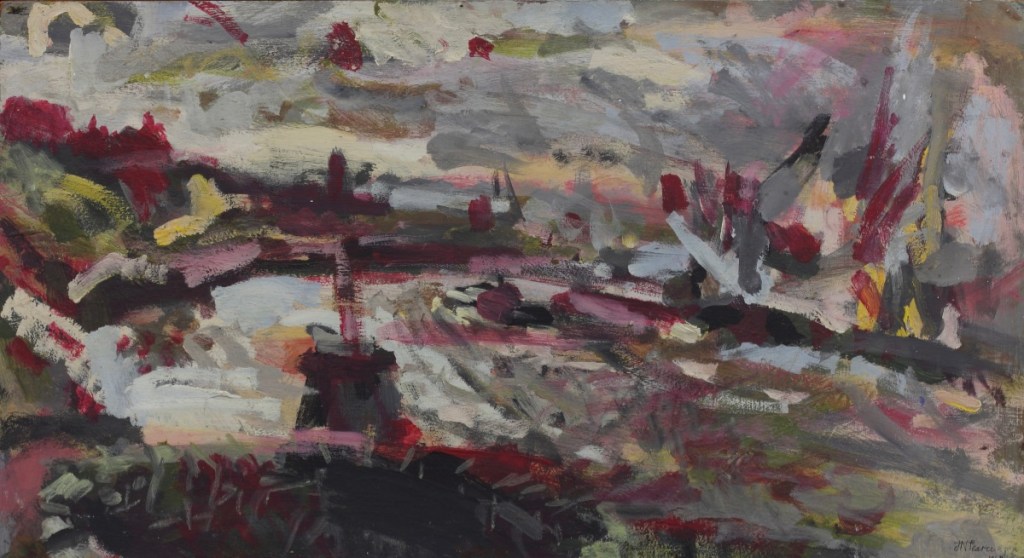
The pictures selected below are mostly now in private or public collections and not readily obtainable for exhibition. The present online selection therefore serves as an exhibition of sorts. There are numerous other works, such as the 1963 view of the Tyne above, that were important at the time of painting, though, like the above, might represent just a few moment’s pause on a walk. Those reproduced below were considerably more prolonged undertakings.
Carl Jung wrote: ‘Being essentially the instrument of his work [the artist] is subordinate to it, and we have no right to expect him to interpret it for us. He has done his utmost by giving it form, and must leave the interpretation to others and to the future.’
(C. G. Jung, ‘Modern Man in Search of a Soul’, tr. Cary F. Baynes 1961)”.
What is most interesting in a painting is often that which was the least foreseen or intentional. What I have written is not an attempt at self-interpretation, just a few contextual observations or recollections. It goes without saying that you are not obliged to read them – nor indeed to look at all the illustrations, of which there are a lot. Just dabble and follow your interest!!!
Or you might be interested to peruse: https://plantcurator.com/john-pearces-plant-soliloquies/
(There is also a space for YOUR comments – please don’t hesitate to share them – any such responses are valuable!)
1. NEAR CHIPPS COMMON, WHEELER END, BUCKS. Oil on hardboard, 1962
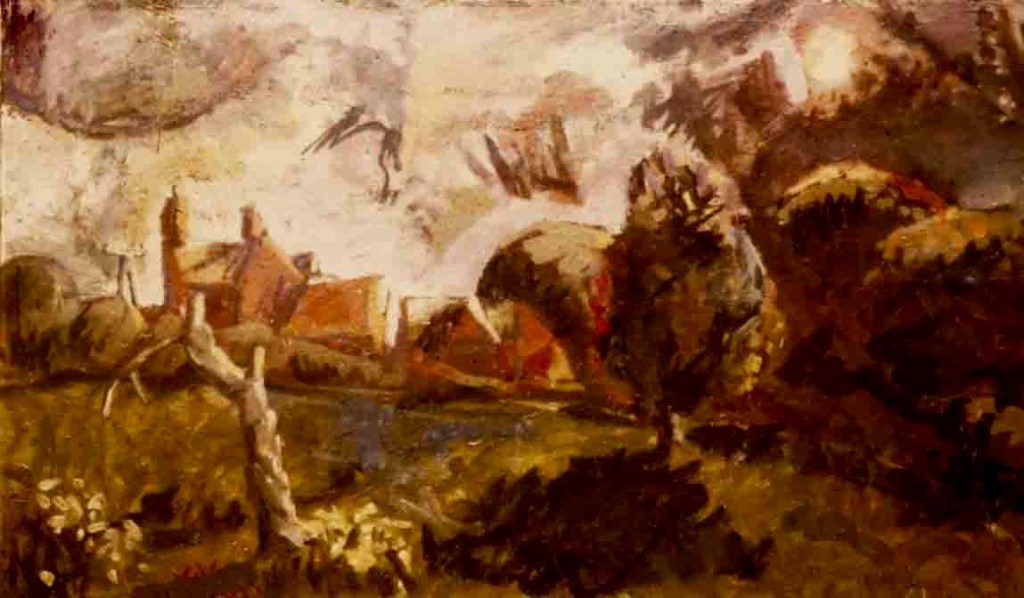
This rather apocalyptic-looking painting was done from a pencil sketch made on a walk in Buckinghamshire. Having obtained the Intermediate Diploma at Hornsey College of Art, and anticipating entering the painting school to study for the National Diploma in Design next term, I worked at home on this picture during the summer holiday, and took the picture into College at the beginning of term. It was promptly exhibited on the corridor wall where it remained for the remainder of my time at the college, reportedly favourably remarked on by the whole staff, including the notoriously critical Arnold Hauser, our Art History lecturer. Oh, and Kieth Grant had a go at me for the dead tree in the foreground.
2. THE EXPULSION FROM THE GARDEN OF EDEN – Oil on canvas 4’x6′ 1961 – 2
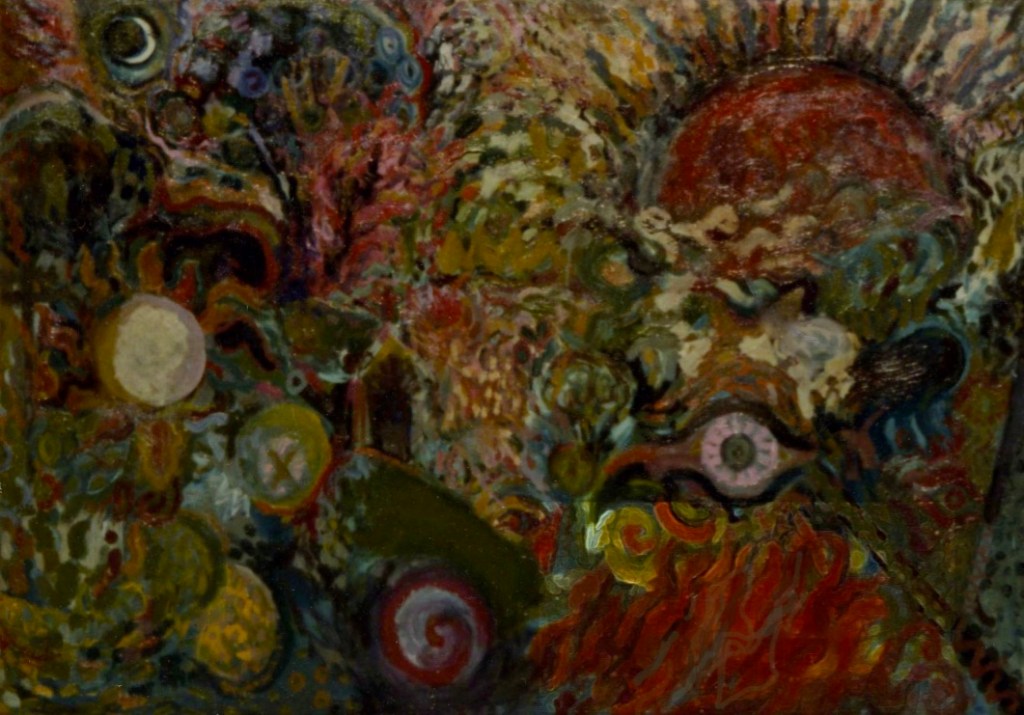
This picture, which was accepted for the 1962 Young Contemporaries show at the RBA galleries in Suffolk Street, London, is in a symbolist manner reflecting my more introspective interests at the time – cultural heavyweights such as Richard Wagner, William Blake and Carl Jung. The idea of duality, as conveyed by complimentary colour opposites (like red and green) is also a factor. The dawn of human consciousness is conveyed by the open eye and the rising sun; the telegraph pole, barely visible near the left hand edge, could imply transmission of esoteric knowledge – or maybe just a nod to Eric Ravilious.
Reportedly, at the Y.C. Forum the sculptor Anthony Caro singled out this painting for favourable comment – possibly because it stood aloof from the ‘Pop Art’ manner prevailing among paintings by Royal College of Art students at the time.
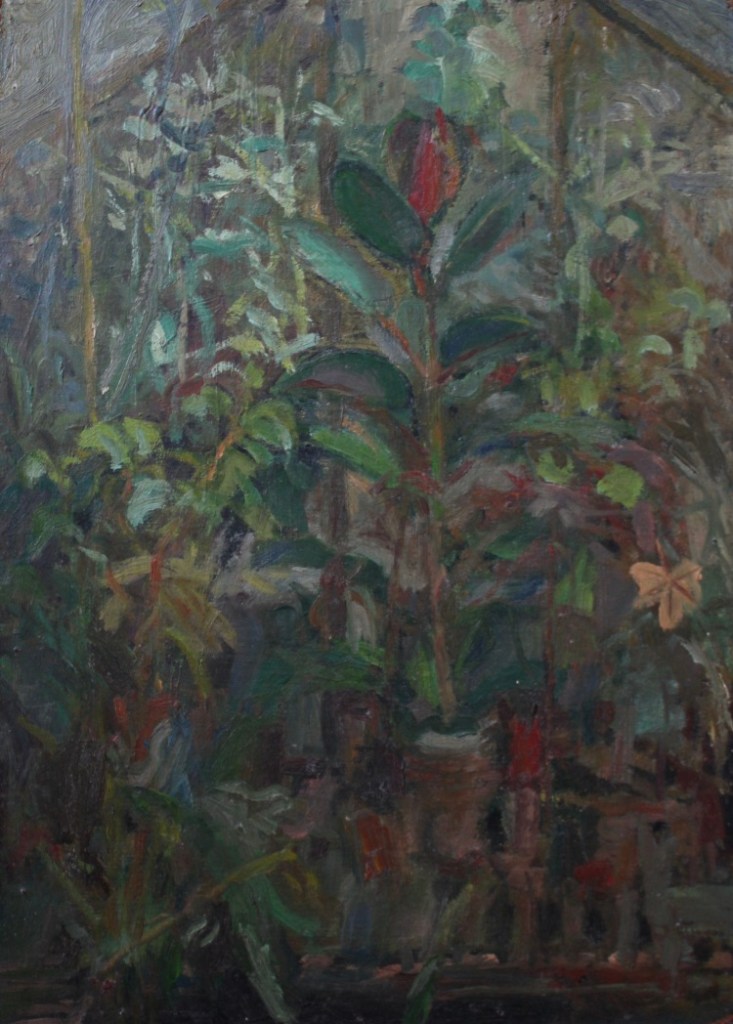
3. The Greenhouse, Hornsey College of Art, Oil on canvas 42″ x 34″ 1962
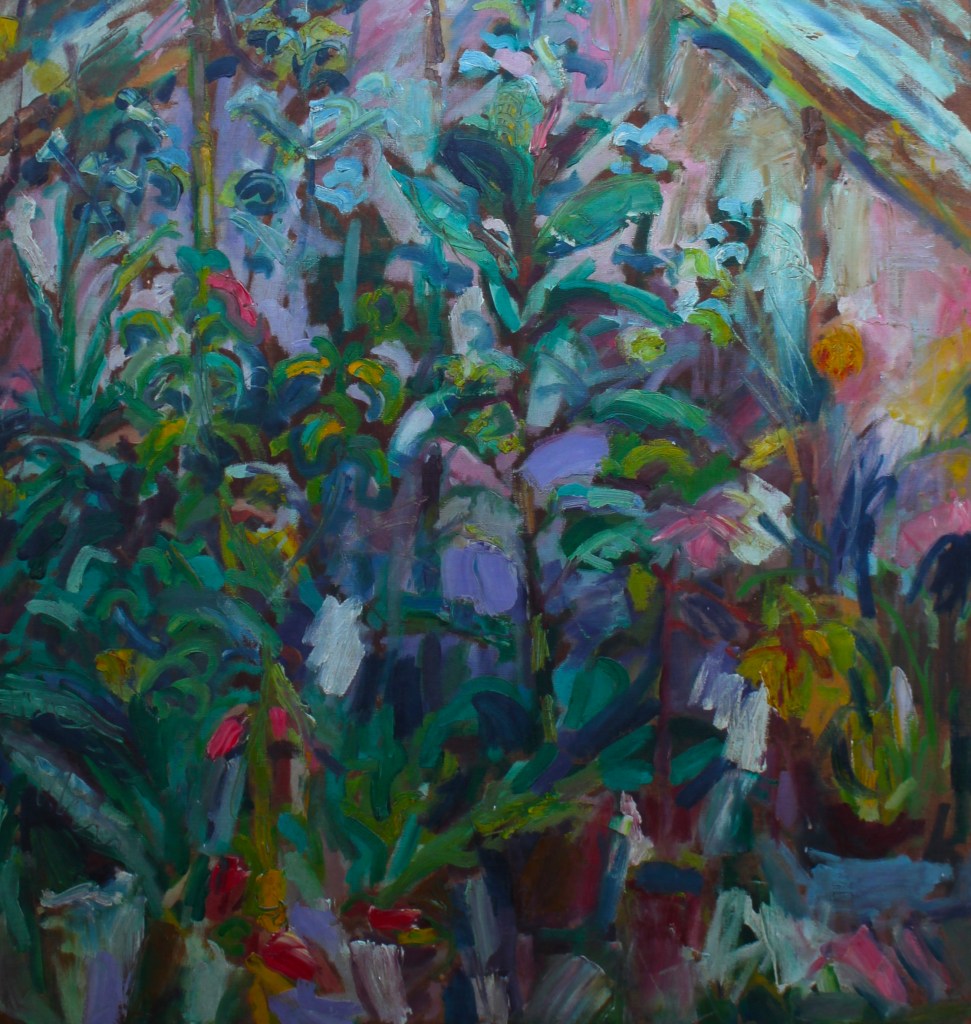
I enjoyed the freedom of painting in the Art College greenhouse – away from the discipline of the life room! At the same time I wanted to work more from direct observation. Towards the end of the summer holiday I’d had a cycling accident and a fortnight in hospital, which perhaps influenced this change of attitude. Back at College my first greenhouse painting was modestly observational. >
4. A BACK GARDEN IN CROUCH END oil on canvas 40″x60″ 1962
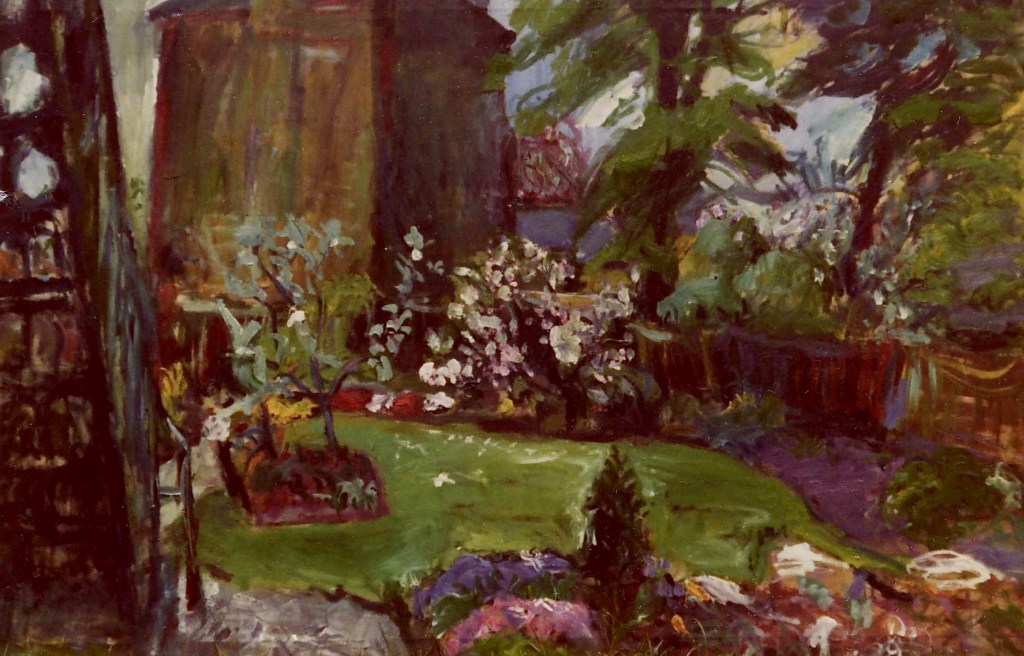
All of the above paintings were done while I was a student at Hornsey College of Art. When I painted this view of our back garden in Crouch End- in just one session – I saw it as an uncomplicated, direct response to the scene. One of our tutors, John Wormell, later observed that the composition worked principally in terms of colour. As mentioned elsewhere on this site, the work was awarded the ‘Sketch Club Prize’ at Hornsey Art College – the visiting judge being none other than L. S. Lowry.
.
5. CHIPPS COTTAGE, Oil on hardboard, 1970.
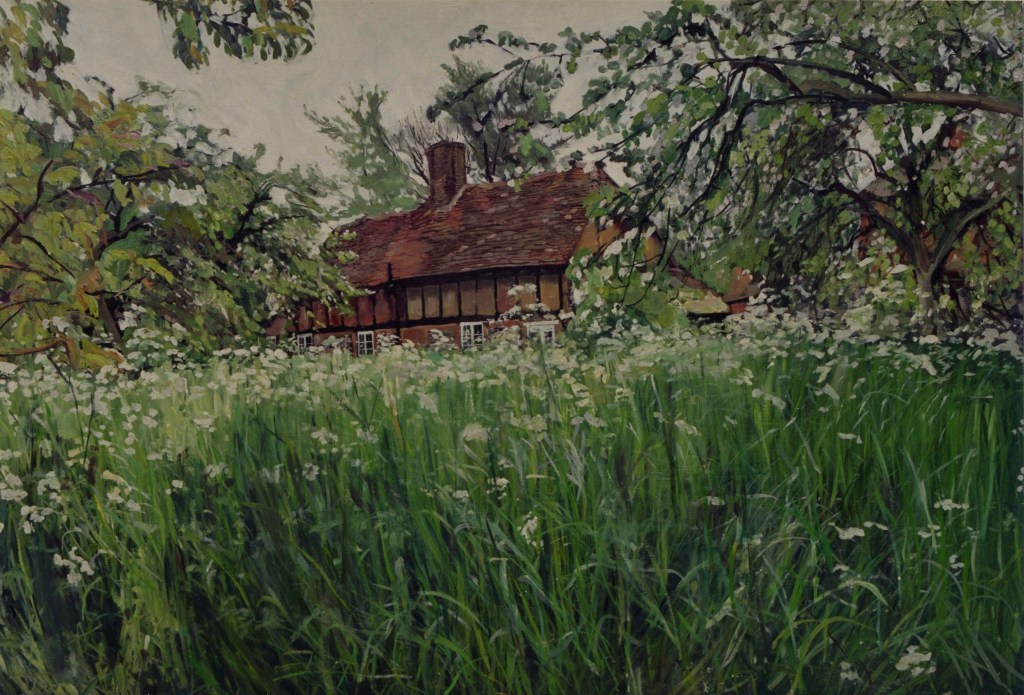
As in life, colour is an energetic force in a painting, even when the intention may be merely descriptive. Our exciting first glimpse, as we got off the bus at Wheeler End Common, was the chimney of Chipps Cottage and the smudge of pink-brown roof among the trees. Our holidays there were important to my family from as long ago as I can remember. When the cottage was sold in about 1980 it was the end of an era, but its effect on me – and my painting – remains…..
6. THE ORCHARD, CHIPPS oil on board 40″x50″, 1974.
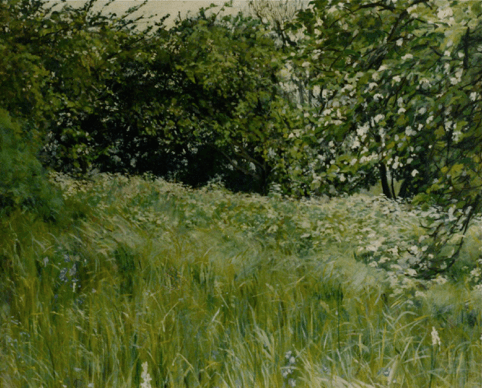
Beyond the darkness of the enclosing hedge, the land slopes away, and one can see through it the blue, humid glint of a valley of chalk downland – it is typical of Chiltern countryside that the valleys are enclosed spaces of chalk grassland, while the hilltops are crowned with extensive beech woods, scattered villages and common land.
The meadow-like orchard would be scythed at midsummer, but in May, when I painted this scene, the grass was lush, the apple was in blossom, there were a few lingering bluebells among the grass, and a creamy-white topping of cow parsley. Most important was the grass; the rhythm of its interplay with light, and the beautifully curved plane of each blade offering its surface to the sun and moist air.
At the time I had little sense of it being a success, yet I find that in my subsequent work, despite changes in vision and technique, I still refer to this painting in the back of my mind.
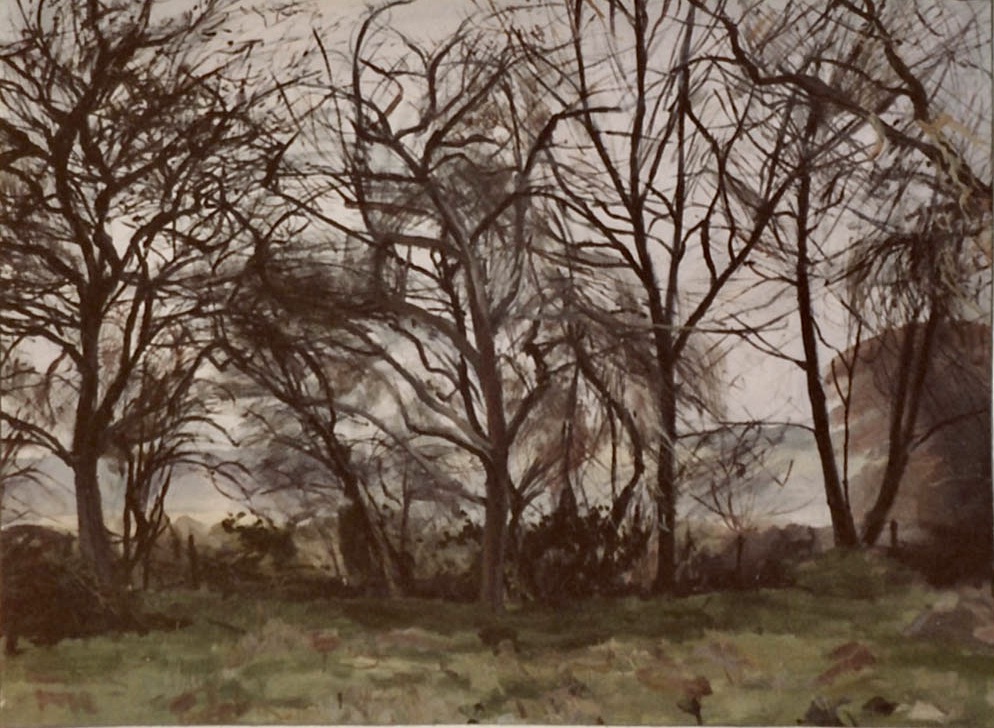
7) Chipps Orchard in winter – acrylic on hardboard
Below… The orchard in Autumn
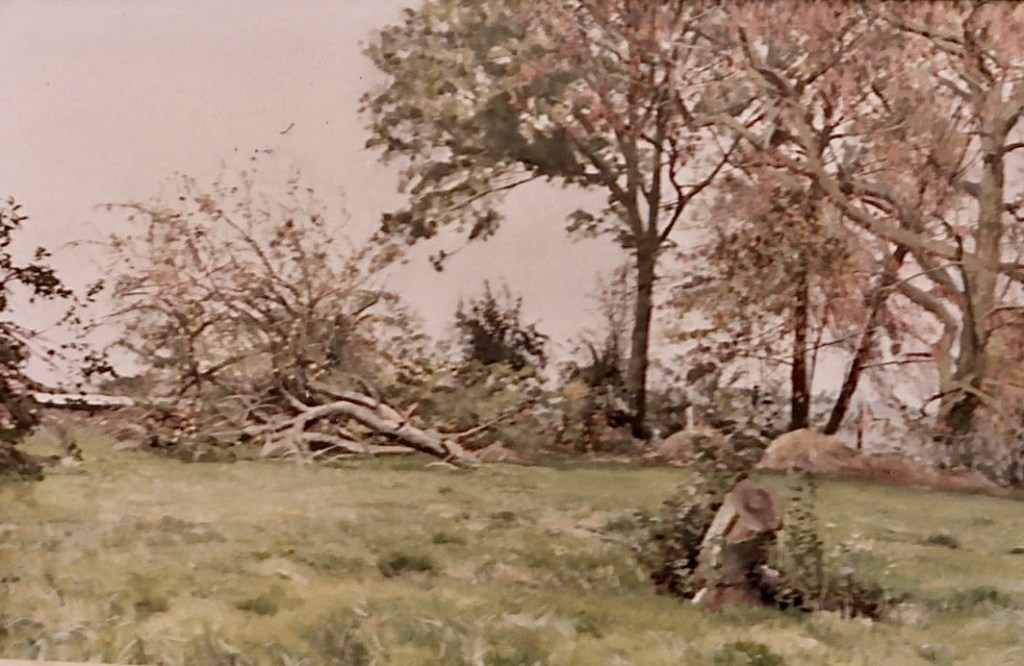
8. CHIPPS ORCHARD Oil on board, 24″ x 32″ 197?
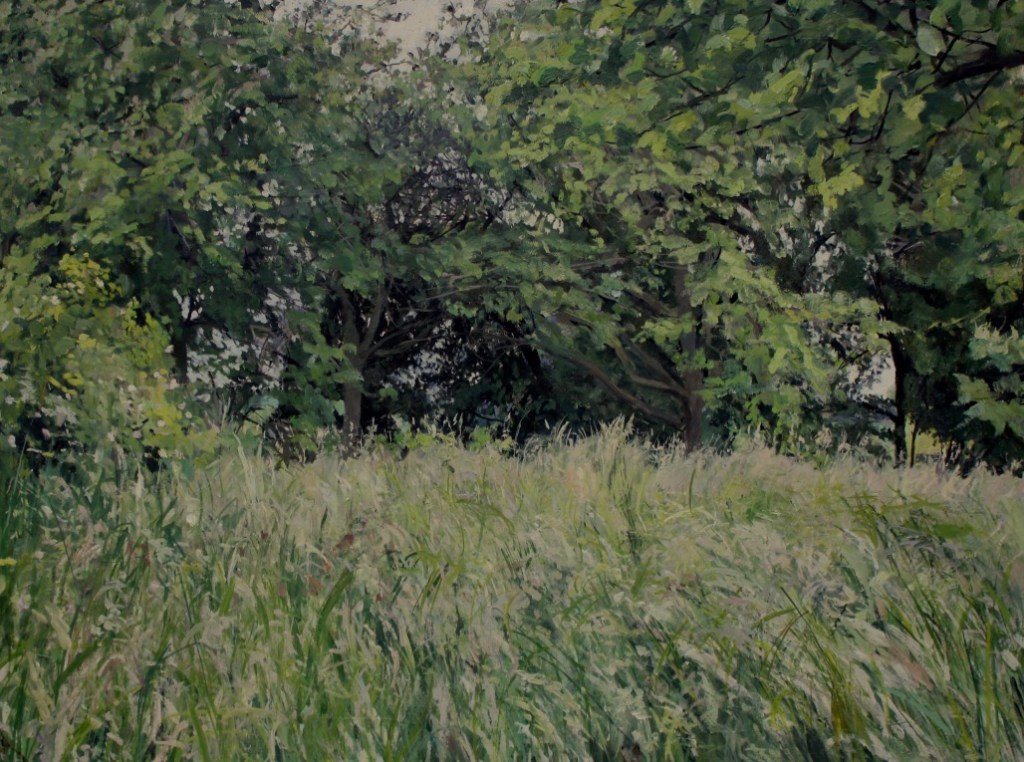
Although the grass is once again claiming my attention, this seems almost a picture of nothing; just a place and a space. This painting in particular may have been important to me, but the whole experience of staying at Chipps and going walks in the Chiltern countryside, gave impetus to my outdoor drawing and painting.
9. A NEGLECTED GARDEN, STOKENCHURCH. oil on hardboard 20″x30″ 198?
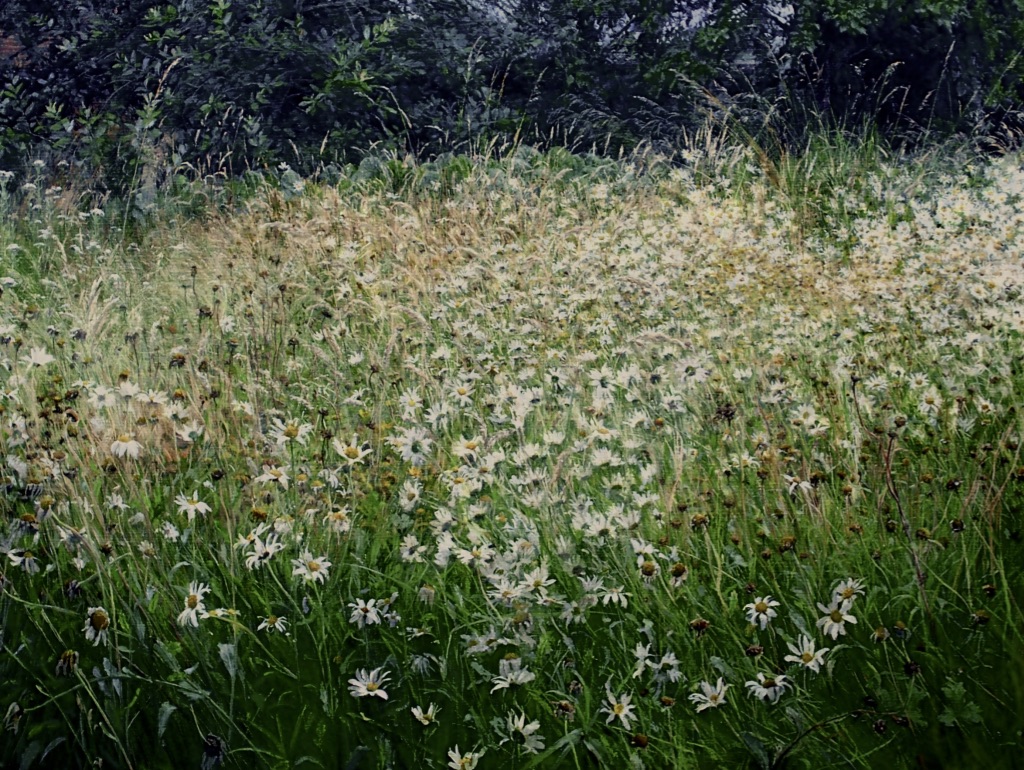
Painted in the forgotten garden of a former inn at Stokenchurch, Buckinghamshire, maybe pursuing the theme of long grass – though obviously the Ox Eye Daisies predominate.
10. BEECH WOODS, Buckinghamshire 197Os acrylic on hardboard, 48″x36″
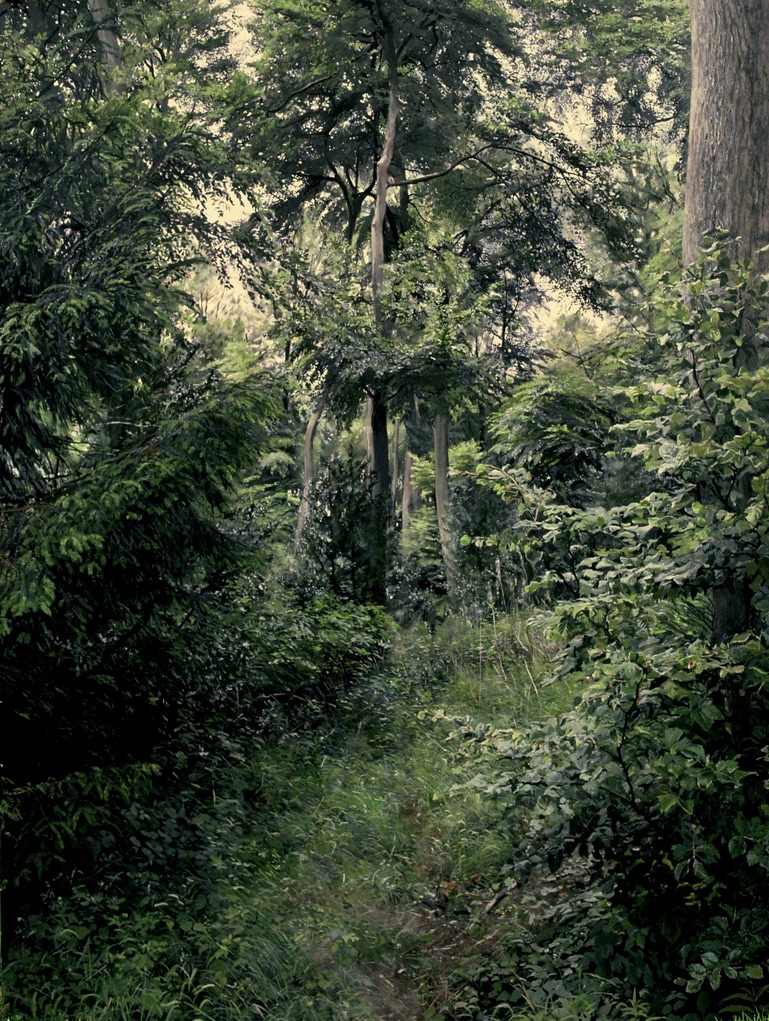
Painted in a beech wood near West Wycombe, while staying at the former inn mentioned above. I was very conscious of the work becoming quite detailed. Its supposed ‘realism’ caused a bit of a stir when it was first exhibited – at the opening of a friend’s newly-built wine store. But, for me, it isn’t a total success; After much tinkering with it, I’m still not sure if the close-up tree trunk on the right hand edge quite works…
11. BLACKBERRIES IN AUGUST, MUSWELL HILL Acrylic on panel 36″X48″ 1980.
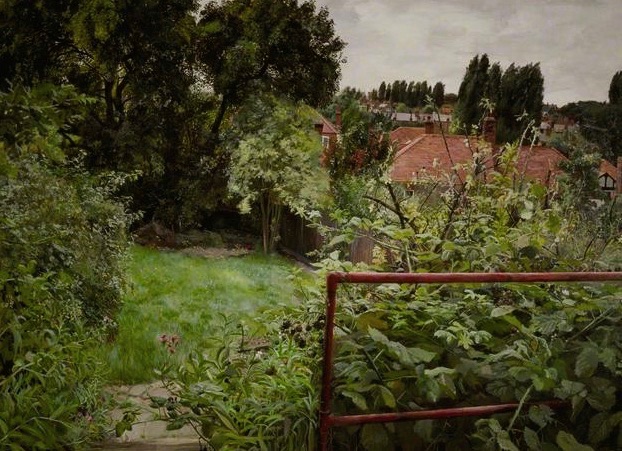
I had permission to paint this garden in August 1980, while its owners, John and Thelma Holford, were on holiday in France – I was looking for a subject with long grass. They had told me they seldom mowed their lawn – though it’s the brambles that seem most out of control!
Working seven or eight hours a day, I completed the picture in four weeks – at that time the longest I’d ever spent on a single painting! The foreground brambles grew rapidly and I paid increasing attention to them.
The painting was awarded a prize in the Greater London Council ‘Spirit of London’ Exhibition at the Royal Festival hall in 1980 – the visiting judge being Frank Auerbach. I is nowt now in the permanent collection at London’s Guildhall Art Gallery. It was also exhibited in 1982 in Hornsey College of Art’s exhibition ‘A Century of Art Education, 1882 -1982’, held at Hornsey Library.
I have received more feedback from people looking at this painting than from any other of my works. I imagine them sitting in the Guildhall Gallery looking at the picture and writing to me on their smartphones at the same time. Here is an extract from one such letter ; I won’t embarrass the writer by naming him or her:
“When I looked closely at everything that you have done, I realised that I could do it as well, but I will need a lot of time and focus on what I want to do…and now I have someone that has inspired me… “you”…thank you so much! Now you are my guiding star. Thanks a lot….for everything. I hug and kiss you, John Pearce!”
12. A GARDEN NEAR HAMPSTEAD HEATH
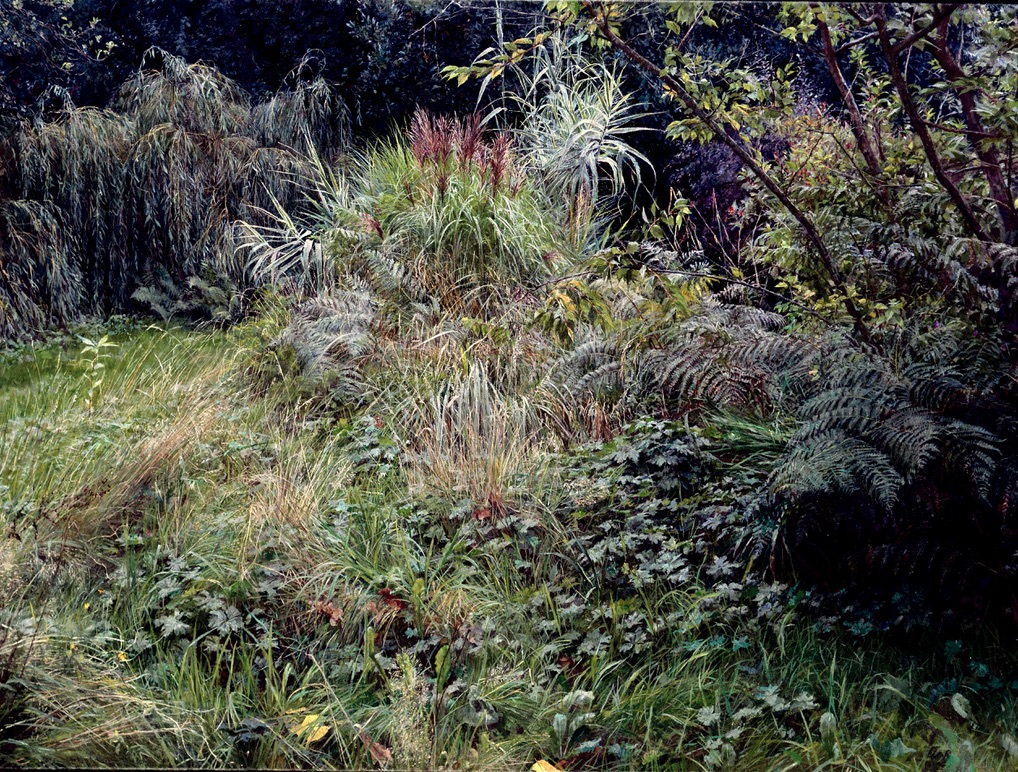
I’m very much indebted to the late Nicky Gavron for allowing me to paint in her garden, and for the interest she showed in the picture’s development.
13. CLEMENT’S GARDEN oil on canvas 48″x36″ 1986.
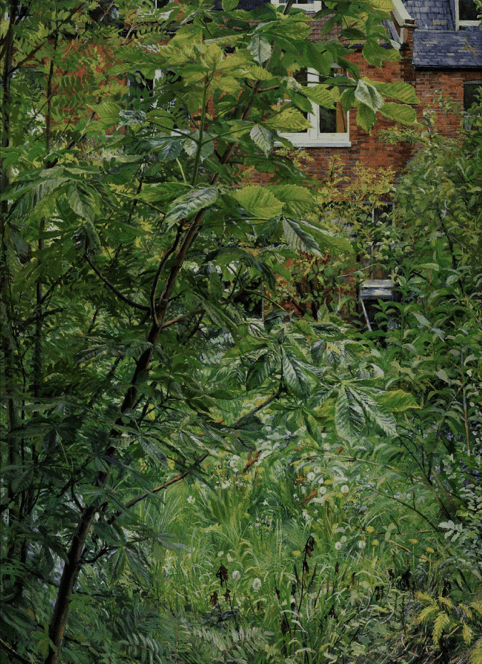
Initially attracted by the long grass and the dandelions, I began this painting in my old friend Clement Griffith’s garden in Whitehall Park, Highgate in April 1986. The Chernobyl disaster was in the news and I wondered whether the heavy spring rain falling on the garden was affected by the nuclear cloud. But as time passed, there was nothing abnormal; the dandelion flowers gradually became clocks and the horse-chestnut leaves came to dominate the composition, adding a certain complexity.
I particularly noted the warm glow of colour from the undersides of the leaves, compared to the cold light glancing from their upper surfaces – not light simply defining passive material but light in the complex biochemical process of photosynthesis – the leaves are ‘eating the sun’.*
The picture was exhibited – and sold – in the Royal Academy in 1987. In 2004 it was included in Tate Britain’s feature exhibition ‘Art of the Garden’. I’m told that the complete run of postcards of this painting was sold out in the Tate’s shop.
Nevertheless, Nicholas Cranfield, art critic of The Church Times, completely failed to engage with my painting,simply comparing it unfavourably with a comparatively minor work by Lucian Freud hanging nearby in the same Tate show. Cranfield wrote that my painting lacked any of the ‘real depth’ he claimed to find in Freud’s picture.
I myself very much admire Freud’s paintings, but readers of The Church Times might find Cranfield’s remarks essentially lazy and superficial in dismissing the work of a comparatively unknown painter beside that of an established master.
14. Clement’s Garden in Winter; Acrylic on board, approx 8″x6″.
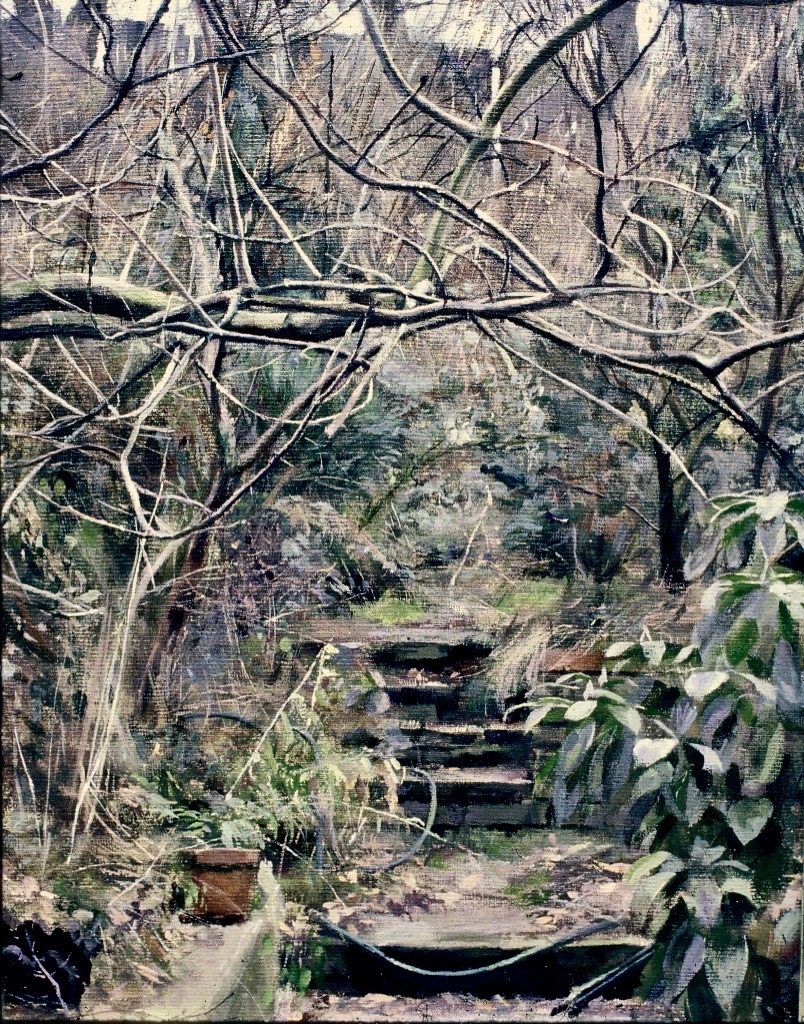
I don’t remember what prompted me to paint this small picture – a view of Clem’s garden, possibly in the New Year. The garden slopes steeply up and has a series of levels, the topmost affording a view over the rooftops. The view is the reverse of the previous picture (No 13 above) having been painted from the garden door, looking up towards the fence at the top.
15. GARDEN IN NORTH LONDON oil on canvas 3’x4′ circa 1992
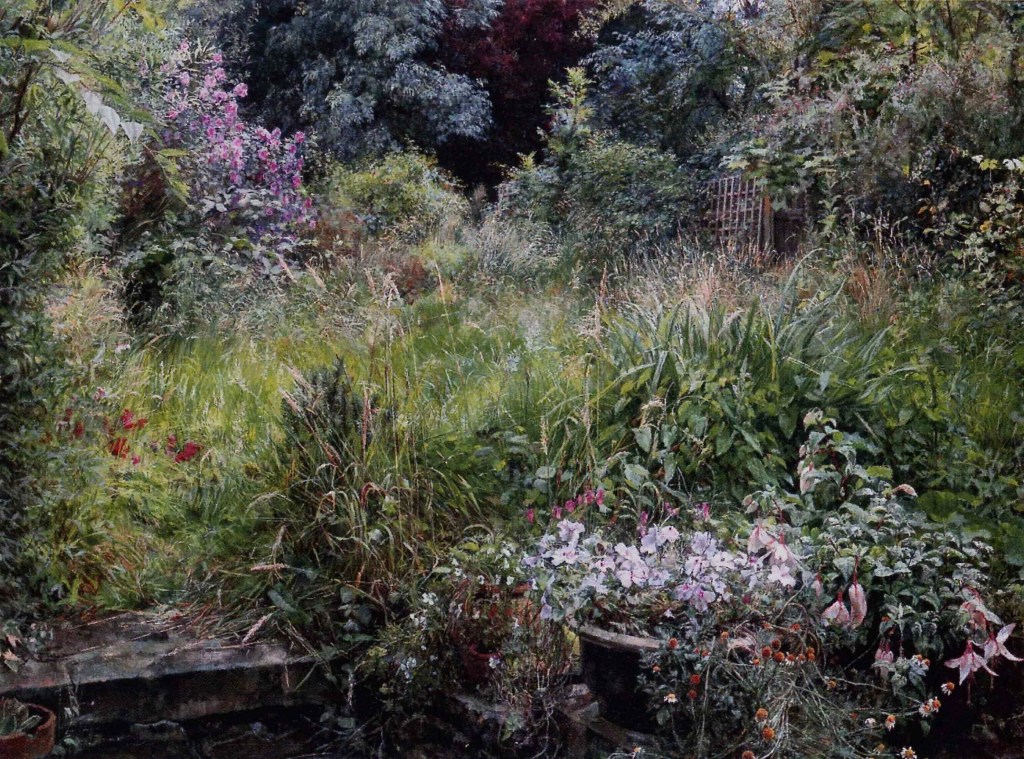
This was the first of many works I was to paint in the garden of my friend and colleague, Jackie Baker – a nature lover who maintains her garden in a semi-wild state. Backing on to Alexandra Park in North London, it is visited by foxes and hedgehogs, and home to nightingales and woodpeckers, as well as familiar wild plants.
16. HERBE FOLLE oil on canvas 4′ x 5’4″ 2000
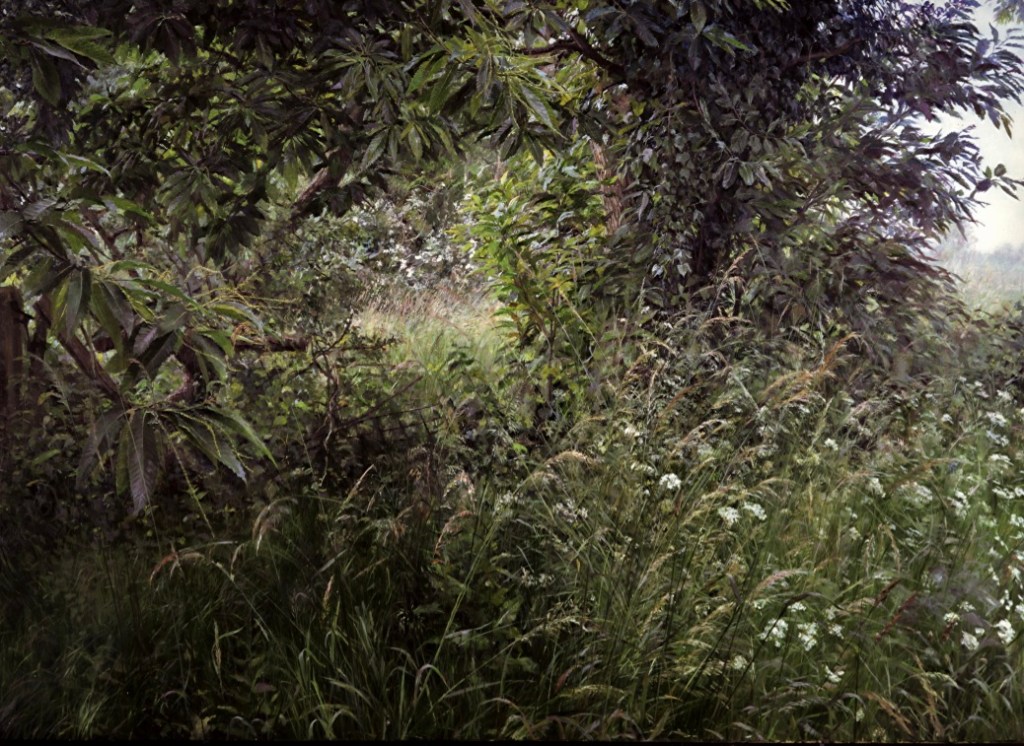
This was painted on the edges of the estate of Les Bouillons near Orval in Normandy, with themes of Marcel Proust in mind, hence the mid-distance glimpse of Hawthorn in flower.
The painting was exhibited at the Francis Kyle Gallery exhibition ‘The Art of Memory’ and subsequently at the National Theatre, London, to coincide with the staging of a screenplay by Harold Pinter based on Proust’s ‘A La Recherche du Temps Perdu’.
Being aware of what Francis Kyle had in mind, while working in Northern France I had read Proust’s ‘A La Recherche’ novel in its entirety . No doubt there are genuine connections between this part of Normandy and Proust’s ‘In Search of Lost Time’ but the painting is essentially a record of what the Les Bouillons artist & curator André referred to as ‘an immersion in nature’. The title was suggested by the Les Bouillons residents.
17. BRAMBLES IN A NORTH LONDON GARDEN oil on canvas 40″x30″, 2001.
I consider that drawing or painting from observation is never outdated and that it is the ‘perennial philosophy’ of visual art.
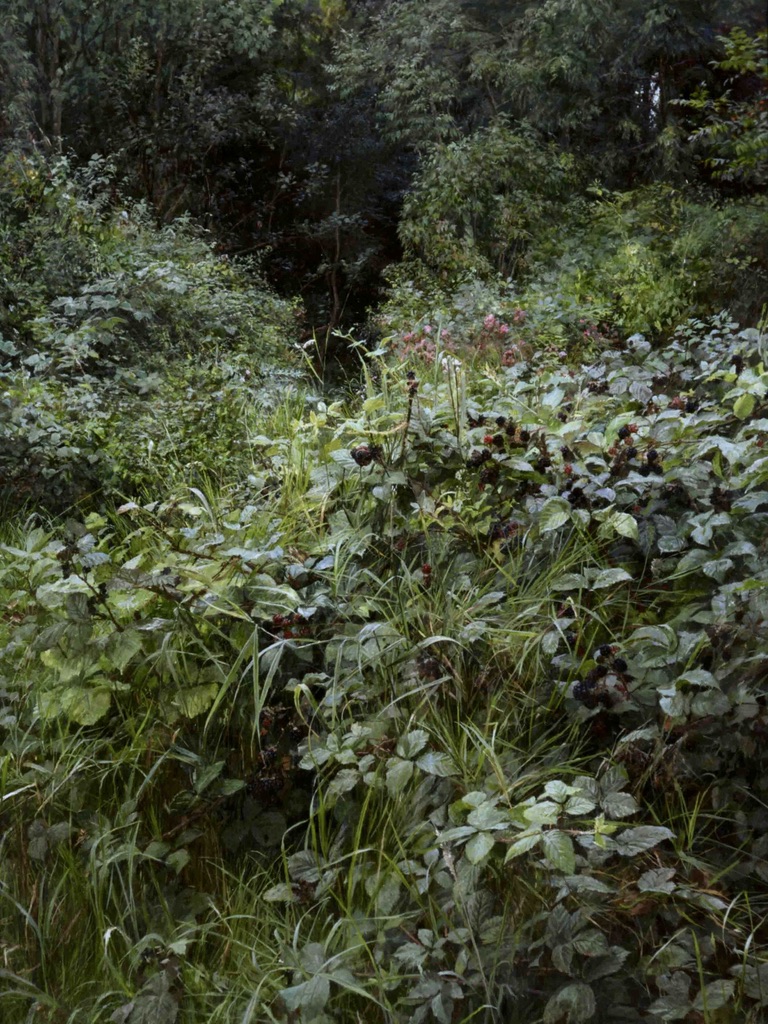
Drawing or painting from direct observation is a serious, questioning process; one puts aside preconceptions and works in terms of the here and now. In painting this picture – again in Jackie Baker’s garden – it struck me – like an unexpected coincidence – that while I am using light in a visual medium to explore the plants, they themselves are using the same energy – the cold light of day as much as the warm sunlight – in photosynthesis, upon which the ecology, economy, culture and consciousness of the whole planet depends – including my ability to be here painting them!
A picture can sometimes be felt as returning the beholder’s gaze, perhaps answering his/her question with another question. At any rate, a sense of reciprocal involvement with blackberries, biochemistry and daylight, was, for me, a unifying theme in this painting.
‘Brambles’ was initially exhibited in the first of my one-man shows at the Francis Kyle Gallery in 2002, and in 2007 at The Geffrye Museum, London (now renamed ‘The Museum of the Home’) in the exhibition ‘Home and Garden: Paintings and Drawings of English, middle-class, urban domestic spaces 1914 to 2006’. The curator Christine Lalumia wrote about my painting: “This is suburbia gone wild, a hidden world behind the neat facades of the houses. Indeed, there is something ambiguous about this picture…..the garden is so overgrown that the boundaries have disappeared, making it seem infinite. On the other hand, the garden is literally an enclosed refuge. The contradiction creates a tension: are we trapped in the undergrowth or unbounded and free in this wild garden?”
18. THE TREE HOUSE, oil on canvas 3’x4′
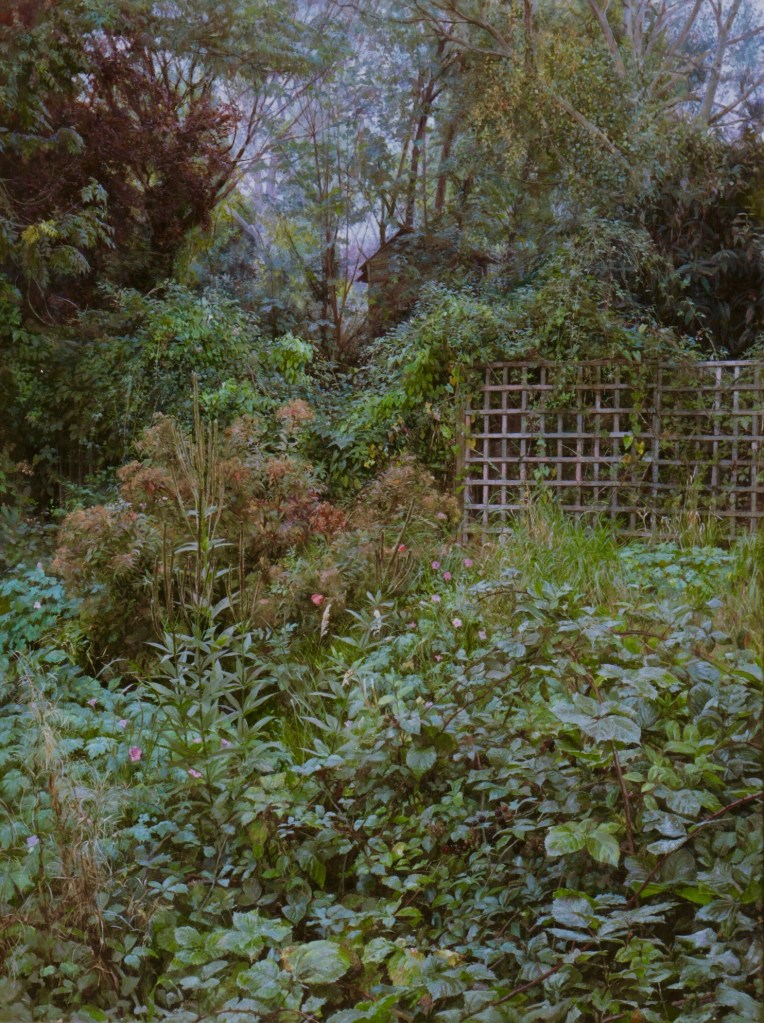
This painting was subject to a common misfortune of outdoor painting – a gust of wind blew it off the easel and on to a sharp corner of stonework which tore the canvas. Luckily, my friend Michael Dickens found me a picture restorer able to make an invisible repair.
It’s not unknown for my painterly concentration to be interrupted by a gust of wind sending the canvas cartwheeling across the landscape. I sometimes suspect there are hidden forces opposed to any honest or meaningful endeavour. If so, such setbacks must be seen as encouraging!
19. AN OVERGROWN ROCKERY also entitled ‘Saint Saviour Church, Muswell Hill, London’, oil on canvas 4’x3′ painted from a ‘well neglected’ north London garden.
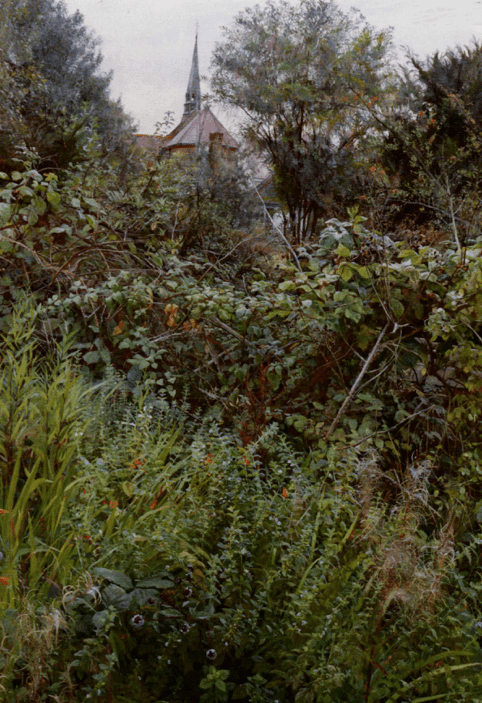
Saint Saviour Church, looming in the background of this painting, was due for demolition – I was told it was gradually sliding down the muddy hillside! Built between 1903 and 1909, more or less contemporary with the surrounding houses, it was pulled down in 1994, some years after this painting was completed.
To the left of this scene the garden slopes up to a row of trees, beyond which is the deer park of Alexandra Palace in North London. The water mint, flowering in the immediate foreground of my picture, shows the damp conditions that also affect this garden.
The garden is an ever changing subject for paintings, which Jackie Baker has kindly made available to me over many years. Somewhat large to be kept fully cultivated, Jackie’s interest in natural history also inclines her to keep at least some of the garden in what I’ve called a ‘well neglected’ state.
My painting values the quiet anarchy of a ‘hands off’ approach, yet strictly speaking there isn’t such thing as a ‘wild garden’. The human world is ever-present in the background, one way or another predisposing nature’s free expression. As a painter, I accept the ‘rockery’ as it is: overgrown with mint, rosebay and bramble.
I understand that this painting, under the title ‘Saint Saviour church, Muswell Hill, London’ is currently on display at the Nature in Art museum, Gloucester: Nature in Art, Wallsworth Hall, Sandhurst Lane, Twigworth, Gloucester, GL2 9PA. Direct tel: 01452 733942 Tel: 01452 731422 http://www.nature-in-art.org.uk.
20. MIDSUMMER oil on canvas 32″x24″ 2005.
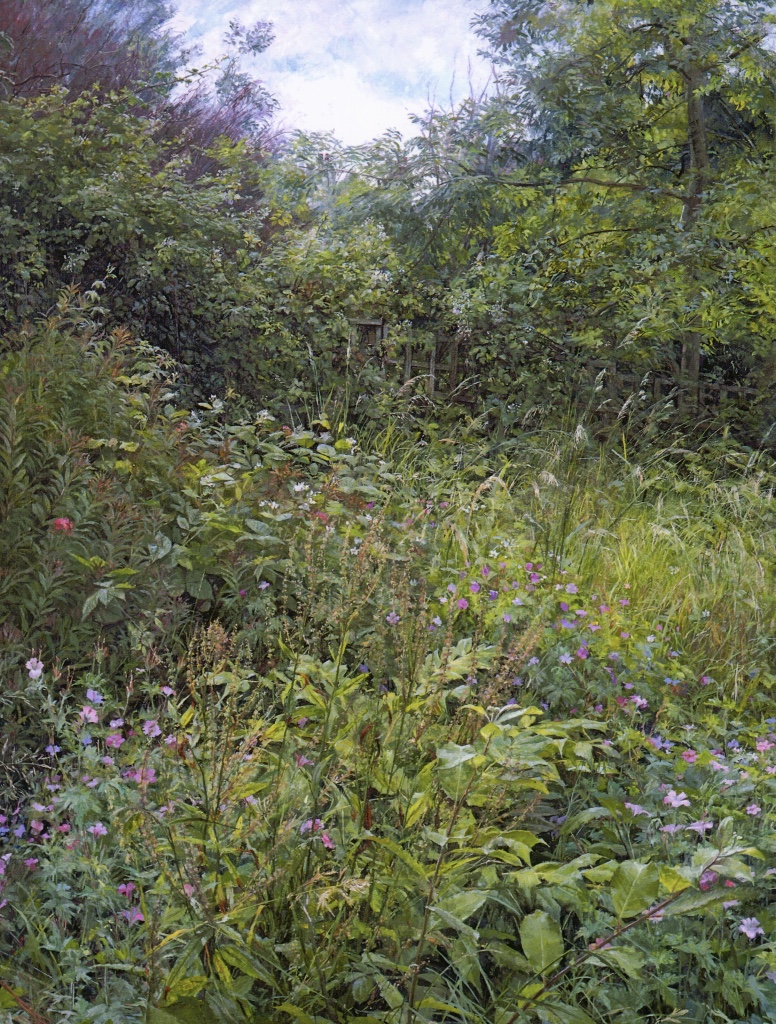
This is yet another study of Jackie Baker’s garden in North London, showing a profusion of wild plants and cultivated varieties. (St. Saviour church no longer looms on the skyline!) The painting was begun in May and finished at the height of summer.
21. A WALLED GARDEN oil on canvas 30″x40″, 1999 – depicting the former vegetable garden of a small farmhouse in La Trancardière, Normandy.
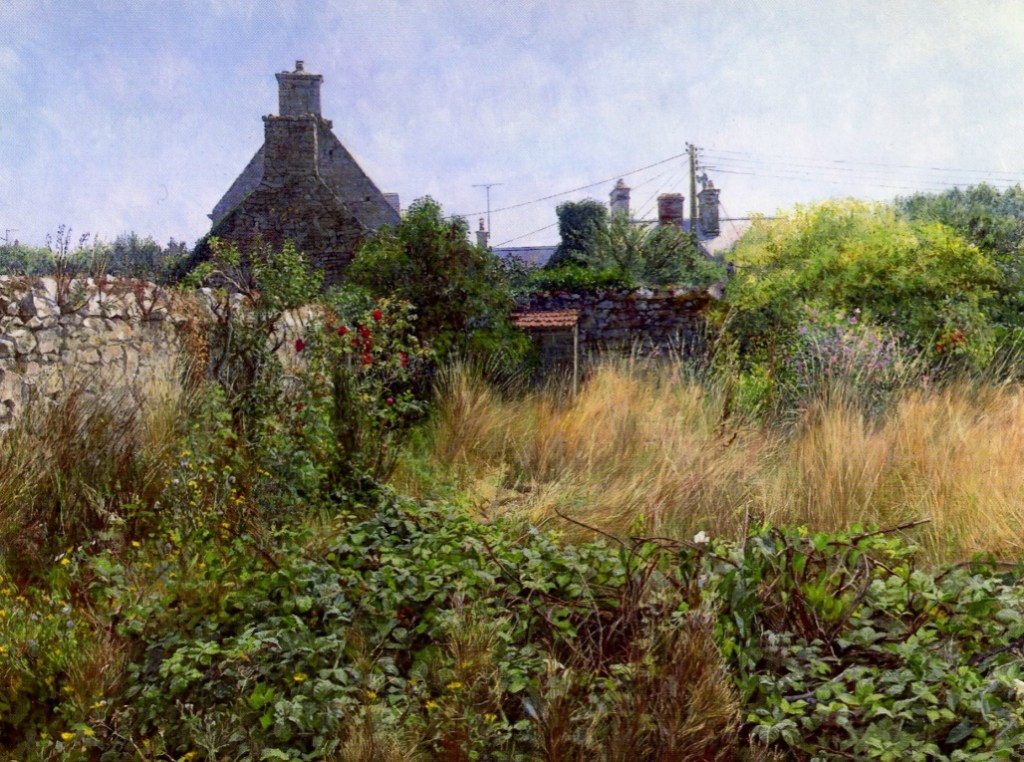
This was painted over many weeks, getting to work in the early morning, but stopping as soon as the sun started to shine on the gable end.
Though every detail must have been the product of fairly intense scrutiny and decision, I have almost no memory of doing any particular part of the picture, and can hardly believe I did it. This is not meant to sound clever, simply a fact – in some ways a painting paints itself.
Below: an early stage of the work –
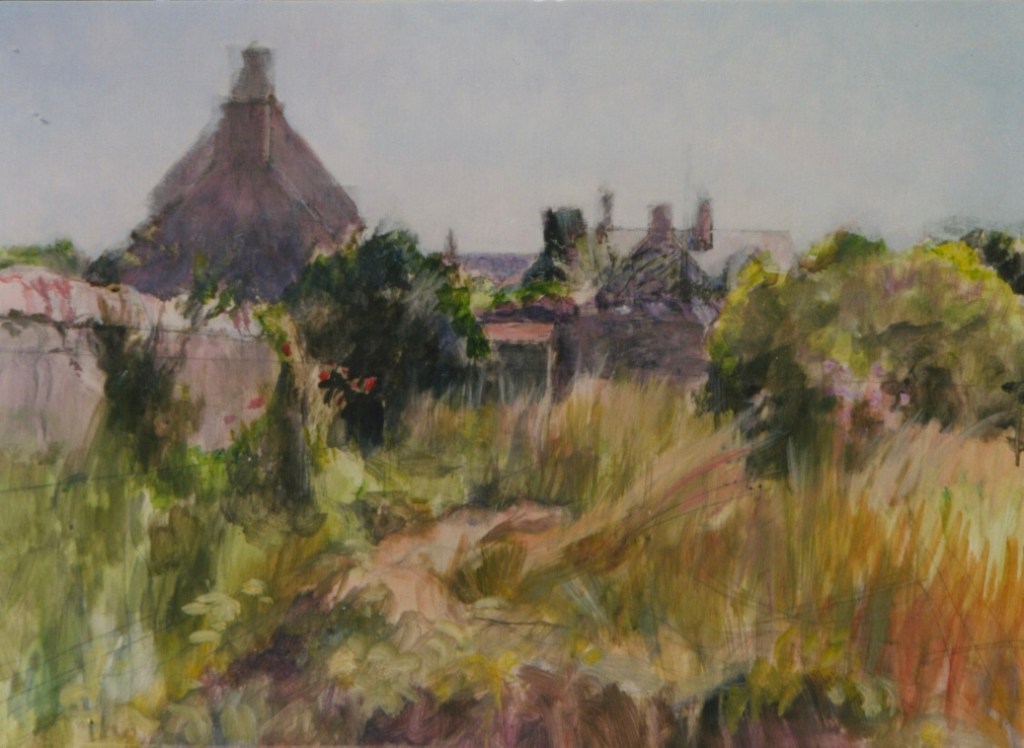
22. Eleanor in the Garden, La Trancardière
An intimate scene, except for the glimpse of the wide open space through the garden door.

23. WILD PLANTS, NORMANDY oil on canvas 4’x 5’4″ 2007.
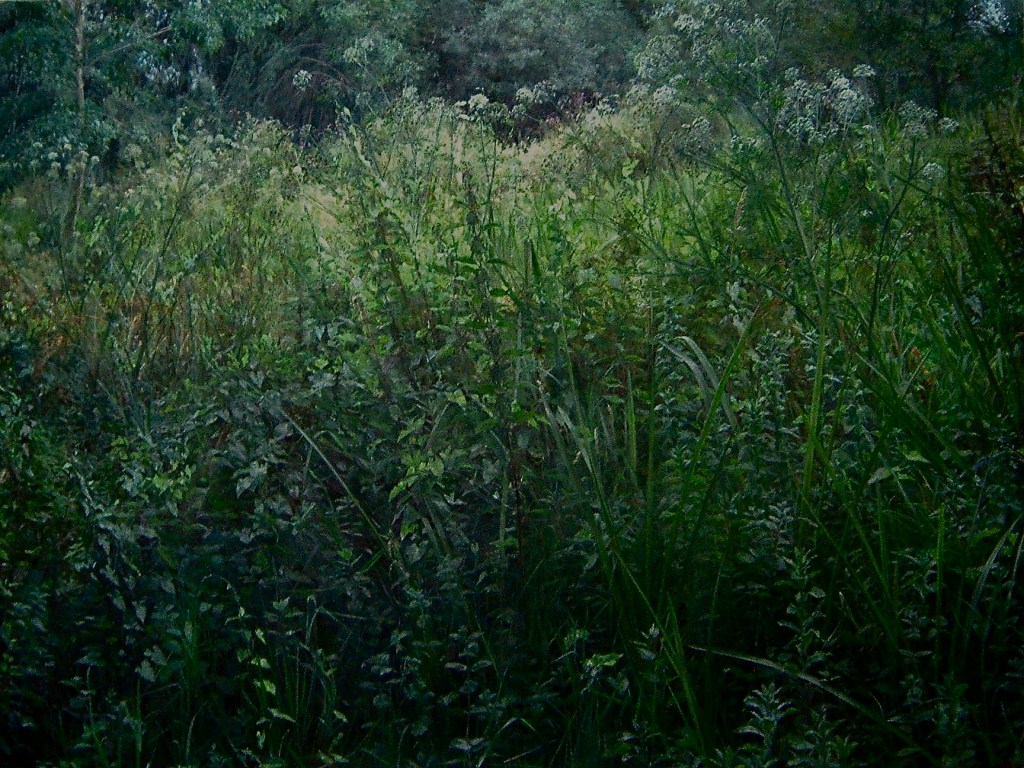
A study of plants in the Normandy bocage growing in a hidden world of profusion. I regard this as one of my best paintings, though it was sold before I was able to get a very good photo of it.
My representation of nature could be termed ‘realist’, but I admire Jackson Pollock’s masterpieces, and the sort of composition I favour is definitely post-cubist. That gives scope to a more subtle interplay of the physical surface of the painting with spatial illusion. I am painting on my feet, composing the scene from slightly changing angles. As Harold Rosenberg wrote of abstract expressionism, what goes on the canvas is ‘not a picture but an event’ (ARTnews Dec 1952 quoted by Martin Gayford 2018)
I worked on the edge of woodland looking across a more open wetland area in which most of the plants are growing to higher than eye-level. Water-mint is identifiable in the immediate foreground, along with nettles. Also Hemlock Water Dropwort – one of Europe’s most poisonous indigenous plants (but only if you eat it!). This is a community of wild plants, quietly getting on with the task of carbon sequestration and renewing the atmospheric oxygen – from which we all benefit.
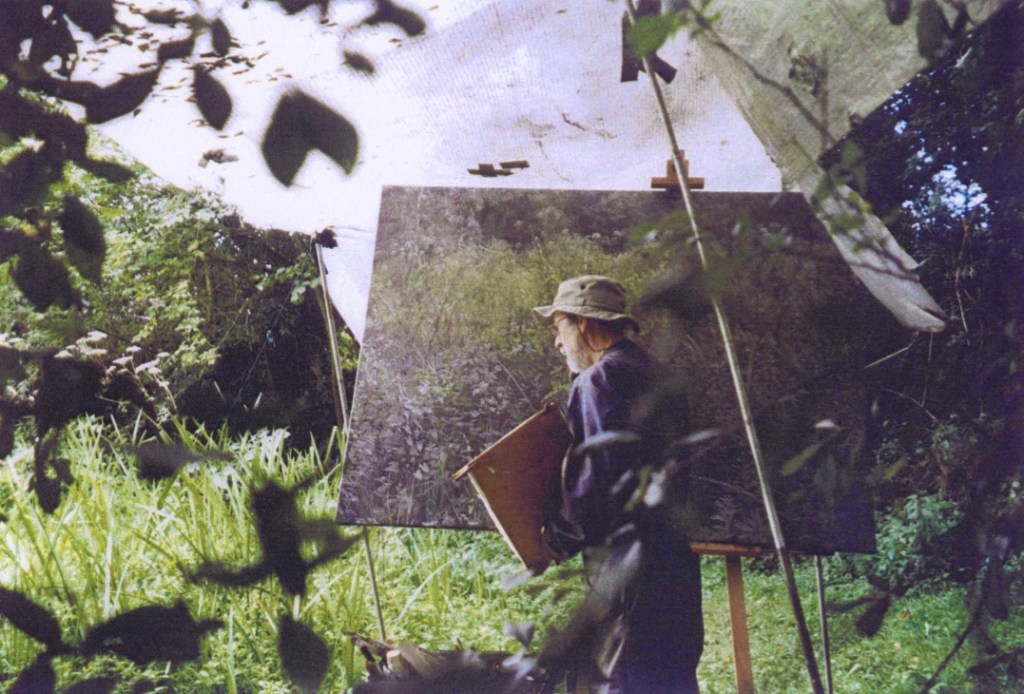
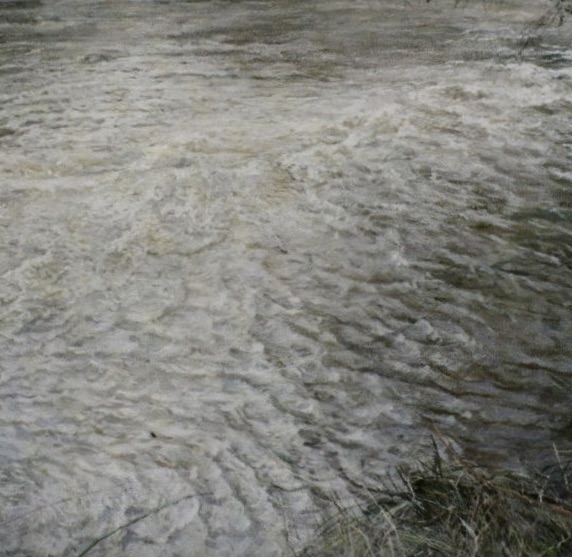
24. LA SIENNE oil on canvas 4’x5’4″ 2001. A wild upper reach of a river in Lower Normandy.
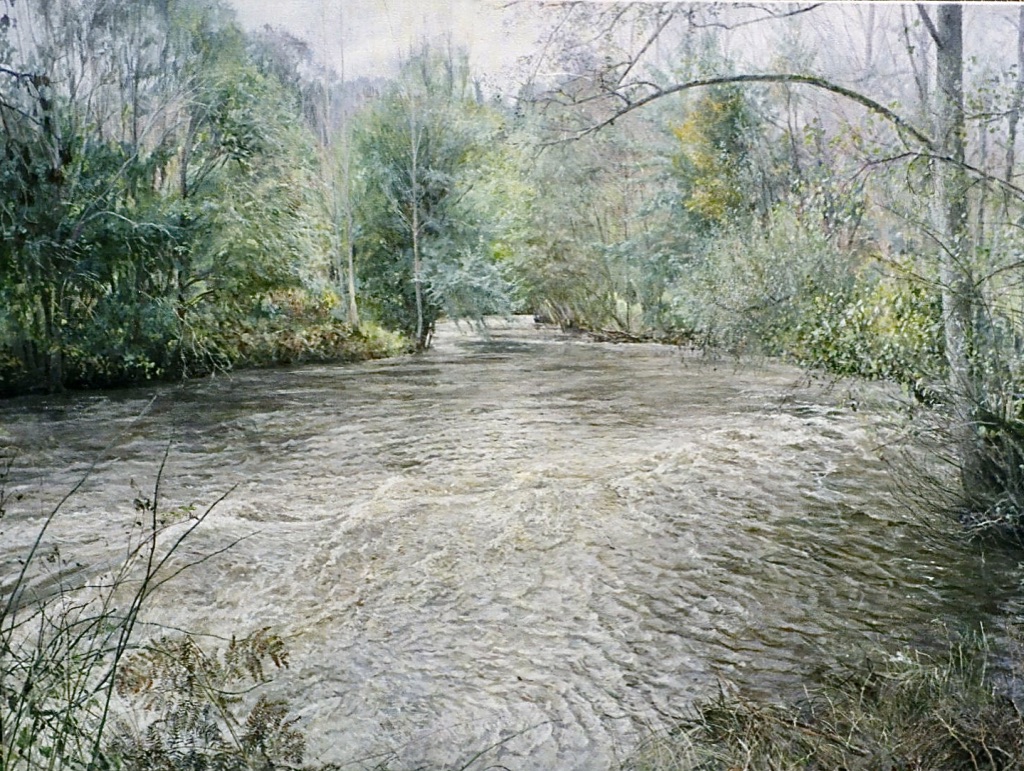
I remember the moment when, emerging from the surrounding trees I came upon this scene: the sudden expanse of light seeming like a moment of self-realisation! I had to paint it! Hidden behind copses, the river widens to a pool below a rocky cataract, and seems to exist in its own world. At first rather daunted by the moving water, I made some preliminary studies, including this 15″x20″ canvas:
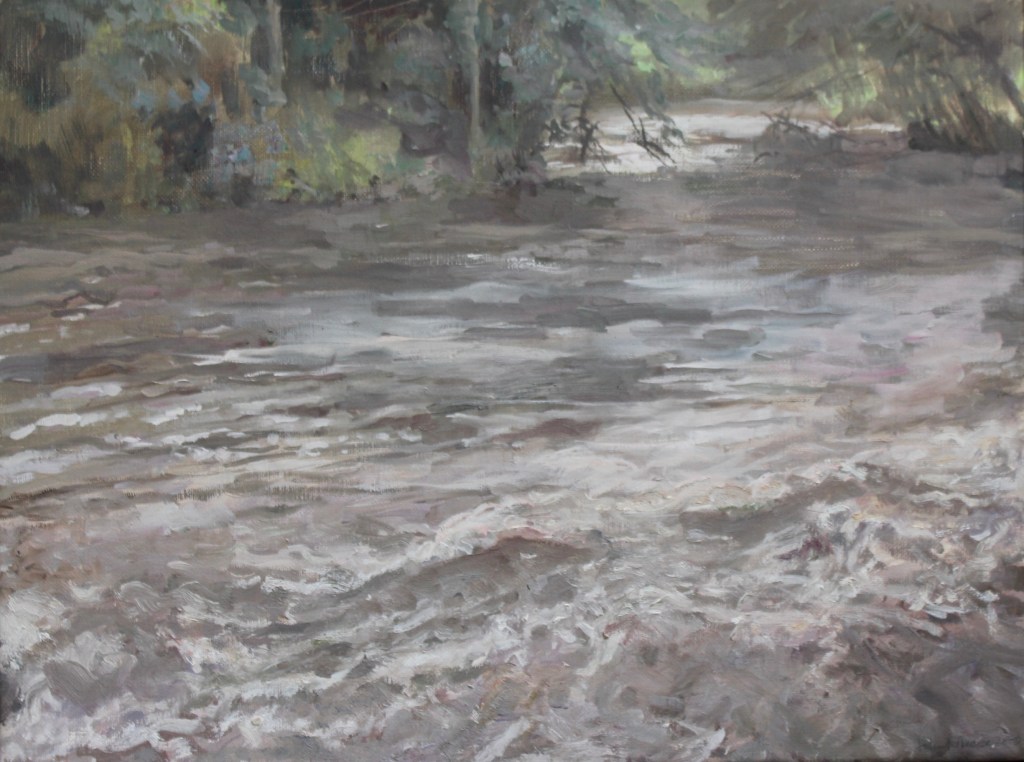
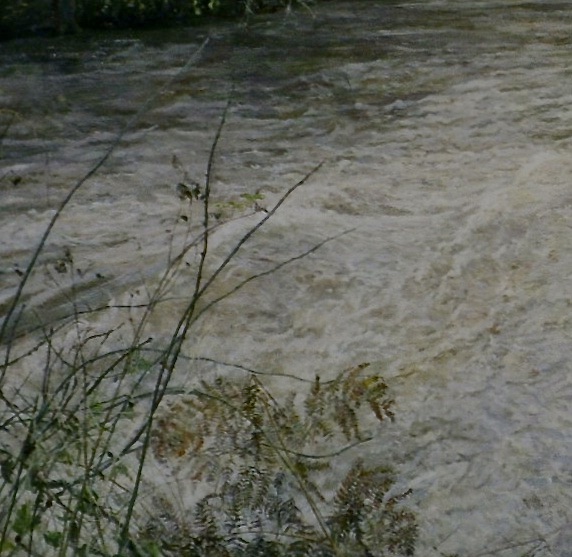
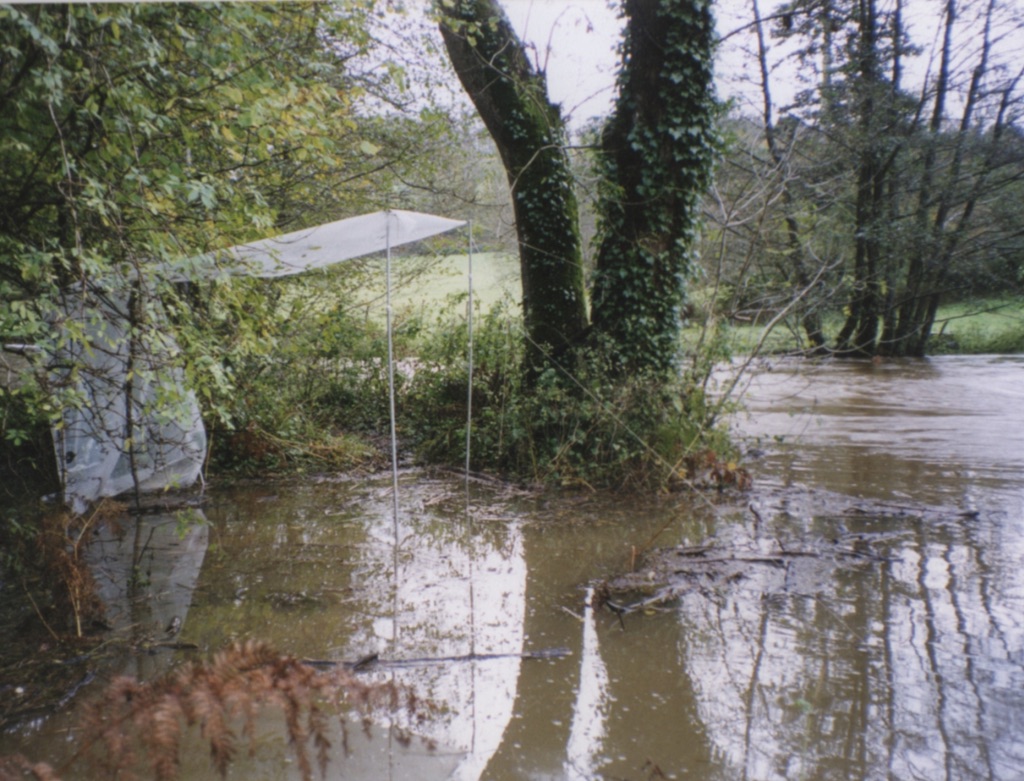
It was November, and after heavy rain, the river valley became a lake. To some extent this would have been deliberate – as with other French rivers, the current was regulated at sluice gates. I often approached the site wearing waders and using a ladder to bridge hidden dykes.
The painting took many weeks and frolicking otters got quite used to my presence.
25. MEADOW NEAR ORVAL, NORMANDY – oil on canvas 4’x6′
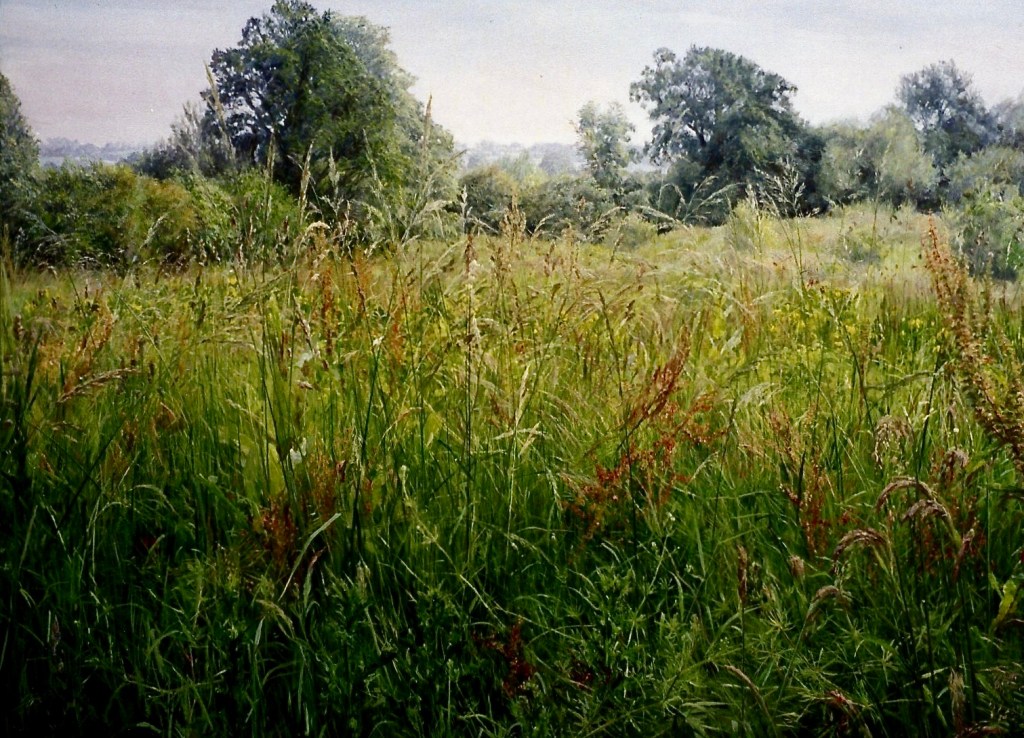
Another ‘painting of nothing’ I suppose. Although the beautiful interplay of distance and immediate proximity is important, the subject is as much paint and the painting itself as what it purports to depict. (The essayist William Hazlitt dismissed Turner’s experiments with atmospheric effects as “pictures of nothing, and very like”. But, as Michael Prodger, the Guardian critic comments “They may indeed be paintings of the immaterial, but they are also evidence of Turner’s search for the numinous.”)
26. LES BOUILLONS – two works, one painted in the morning, the other in the evening, 1995… over the same period of time in early summer, 1995, each on a 4’x 3′ canvas
Les Bouillons Evening
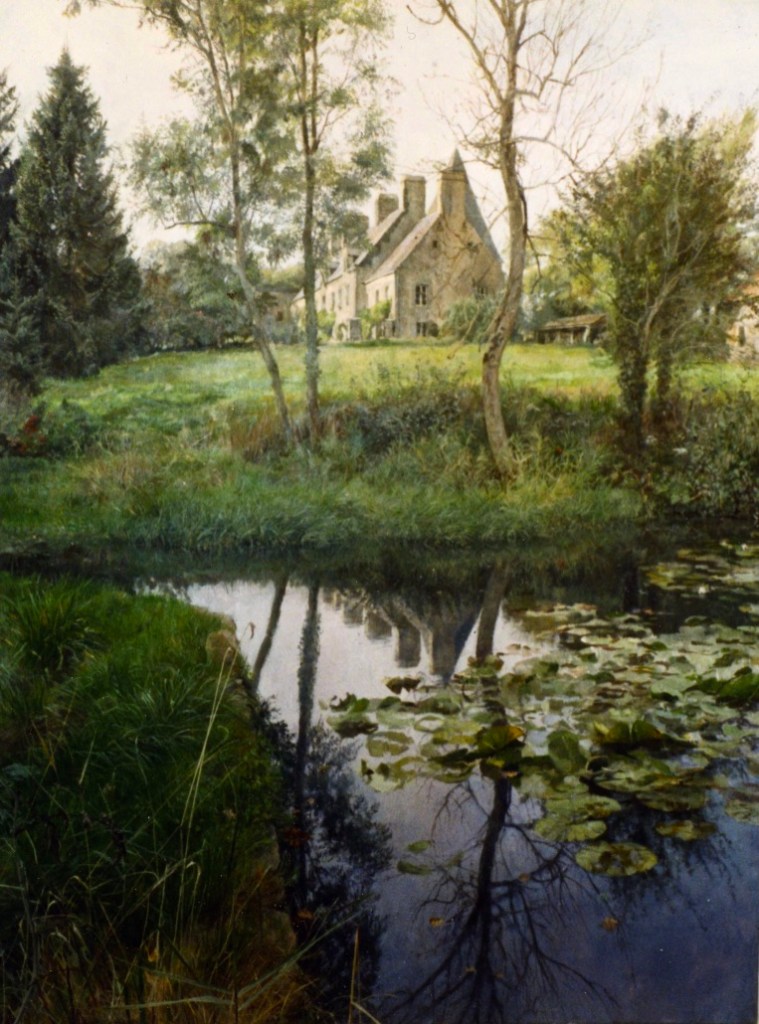
I worked on the two paintings over the same period of time. To me the above evening picture, in particular, evokes the beauty of the place and happy memories.
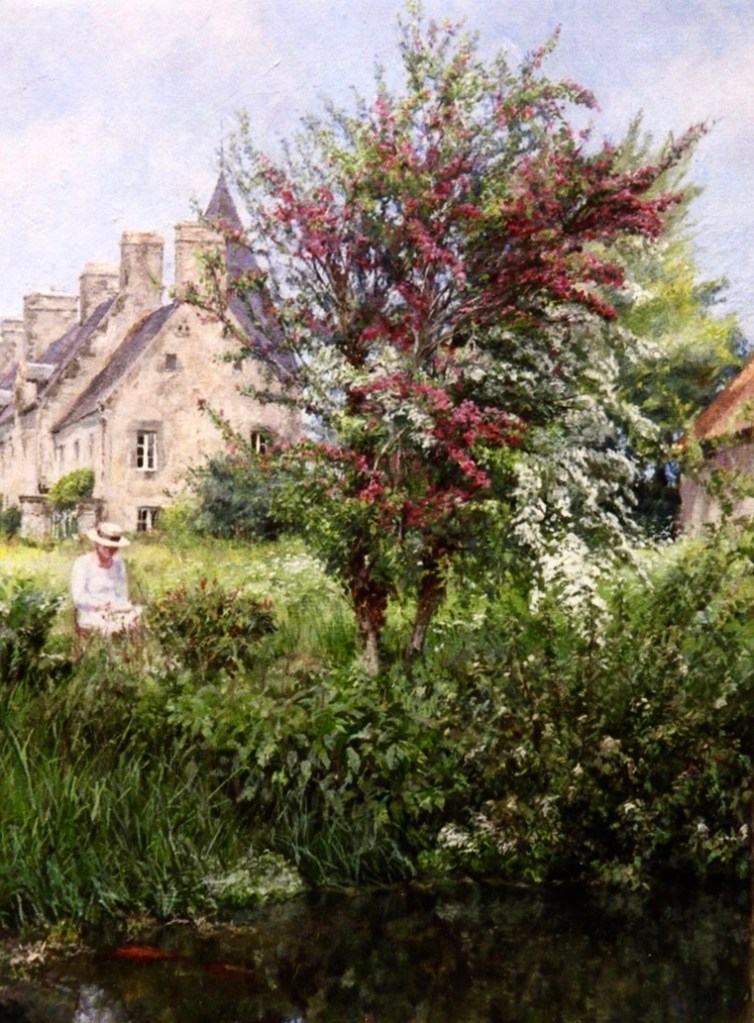
An exhibition of Achille Tanqueray’s work was held aux Bouillons in September 2023 ->
One of my neighbours in Regnéville, Monsieur Sylvain Letenneur, took me to ‘Les Bouillons’, a beautiful estate near Orval in Lower Normandy, and introduced me to his Great Aunt Mimi and others of his relatives – the Saussayes and the Gemins. Being artistically inclined themselves, they were very happy for me to paint on their estate.
From Julie Saussaye I learned that ‘l’ancêtre’ – Achille Tanqueray, a 19th C. artist and collector – had accumulated works by Jean-Léon Gérôme at a time when that once celebrated academic painter and École des Beaux-Arts professor was unfashionable. When interest in Gérôme later revived, Tanqueray sold his collection to The Louvre and was thereby able to acquire Les Bouillons – at the time a productive farm – where he established his own studio.
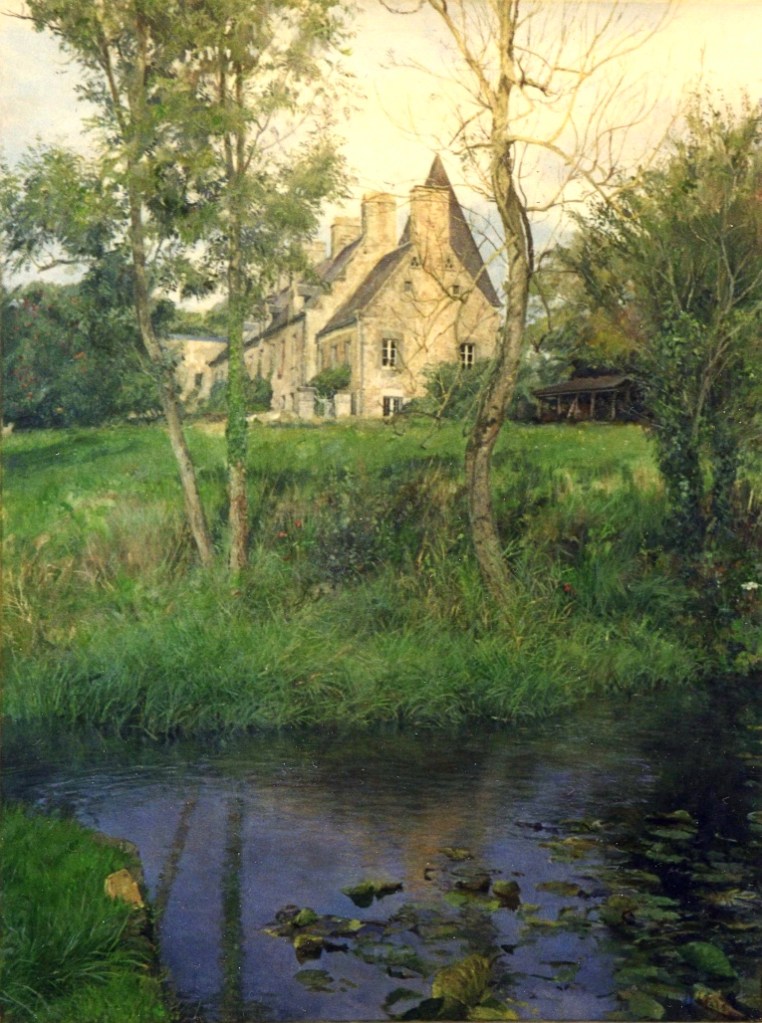
Les Bouillons, Morning.
27. THE FISHPOOL, LA FOUBERDIÈRE, GRATOT, NORMANDY oil on canvas 4′ x 5′ 4″ 2005
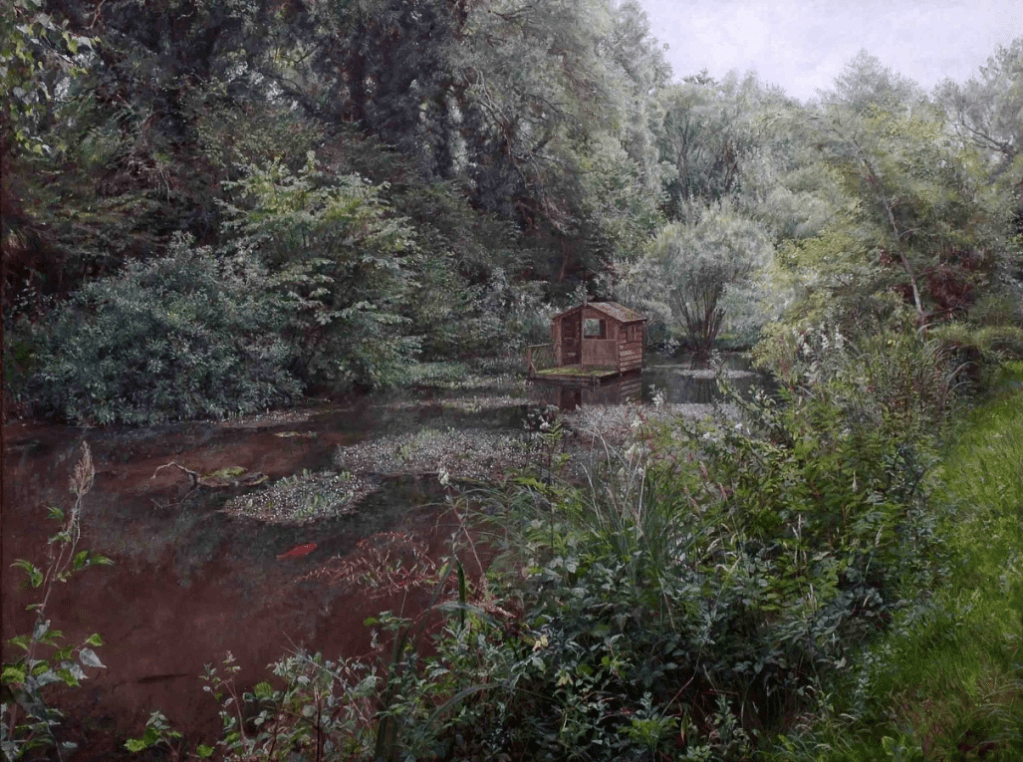
It is unusual for me to include a quickly moving creature such as a fish; to do so is to freeze a single moment, whilst the painting as a whole distils a far longer span of time. The golden carp, and a less conspicuous native species in the shallows, frequented this area of the pool in the last weeks of work on the painting, seeming to demand inclusion!
28. COW PARSLEY, ORVAL oil on canvas 40″x30″ 2005
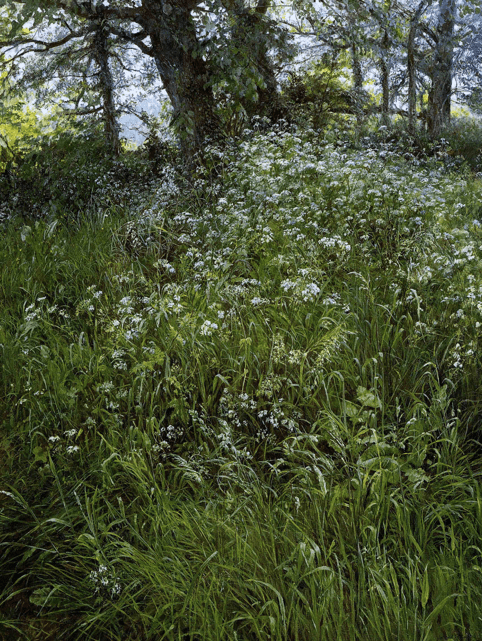
Being aware of his literary background, I always included notes such as these with each picture I submitted to Francis Kyle: “According to the environmentalist Richard Mabey (Flora Britannica 1996) ‘Cow Parsley is arguably the most important spring landscape flower'”. In May time it is as ubiquitous as Hawthorn. Geoffrey Grigson (The Englishman’s Flora 1958) refers to Cow Parsley as a ‘plant of lace and moonlight’ and notes traditional associations with the devil and witchcraft.
This is another Les Bouillons painting. ‘Persil de vache’ in French…? In English, the name ‘Queen Anne’s Lace’, despite its genteel appeal, has never quite caught on. ‘Cow Parsley’ may well mean an inferior form of Parsley, yet association with cattle is appropriate to a flower of May, when the sun enters the zodiac sign of Taurus, the bull, whose upturned horns may be those of the new moon in this most fertile month.
Growing on the verges of country lanes, Cow Parsley is usually mowed before I have time to paint it. On this occasion I prevailed on the Les Bouillons folk to hold off till I finished the picture.
In the catalogue note of my 2005 exhibition, Francis Kyle referred to this painting as ‘vertiginous’, and writes perceptively of the ‘springy, textural density’ achieved by the brushwork, distinguishing the technique from more traditional approaches to realism in the way ‘the action of painting becomes identical with the subject’. As with my 1970s paintings of ‘Chipps Orchard’, the grass is important to the composition.
29. THE PATH HALF-LOST oil on canvas, 24″x18″, 2010
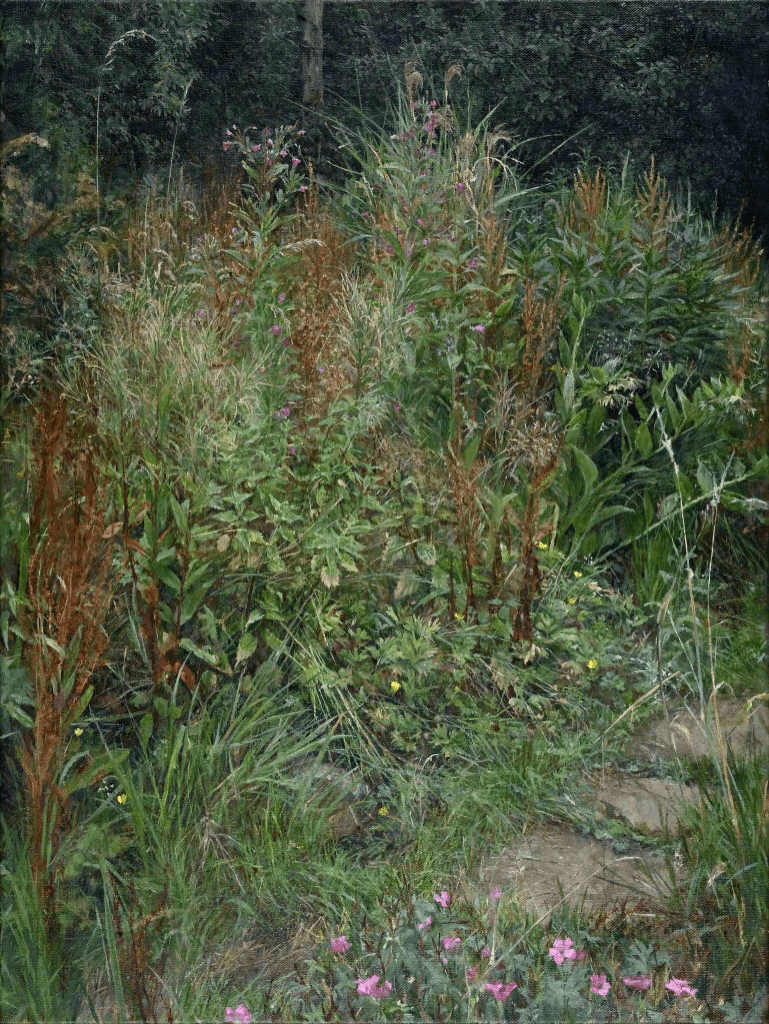
This painting was exhibited in ‘This Twittering World’, an exhibition at the Francis Kyle Gallery in 2011 with a theme of T. S. Eliot’s Four Quartets. The Literary context here is optional, though not misleading.
I wrote the following description for Francis: “‘The Path Half Lost’, shows an oblique view of a garden path surrounded by overgrown flowerbeds, with wild and cultivated plants: Hellebore, Buttercup, Nettle, Dock, Rosebay and Wild Geranium. The viewpoint from beside the path could suggest a point outside of time.
I had in mind the phrase from Eliot’s poem: ‘Into our first world’
It seemed to me that in Burnt Norton The garden represented the poem itself. Within it Eliot contemplated personal memory, but also ‘other echoes’, from a cultural universe inhabited by both reader and poet. Like Dante, he has lost his path in a dark wood, and, like Orpheus, he negotiates a shadowy world of hints and suggestions by means of his art.
Eliot and his American friend Emily Hale had lost their way, on a woodland walk in Gloucestershire in 1934, when they strayed into the garden of Burnt Norton Manor. The poem conveys a heightened awareness under the eyes of unseen observers: leaves full of children, unheard music in the shrubbery, and trepidation appropriate to holy ground. Out of the formality and aridity of a drained concrete pool ‘the lotos rose’, and the poet glimpses a mirage of the absolute. The vision fades, and a bird urges them to leave, because ‘humankind cannot bear very much reality’.
Eliot completed the Four Quartets during his time as a fire warden in the Second World War. Like his, my own work has autobiographical and historical echoes. I was born in North London near the end of the Second World War, and the vivid glow of childhood recollections is set against that sombre background: playing at the edges of my father’s allotment, or later, on the bomb sites which nature had regenerated with reassuring abundance.
There may be few parallels in poetry to T. S. Eliot’s tone of meditative soliloquy in Four Quartets, but I have found that painting can follow a comparable path in a quest for ‘the point of intersection of time and the timeless’.
30) ST. JOHN’S CHURCH, LITTLE GIDDING.
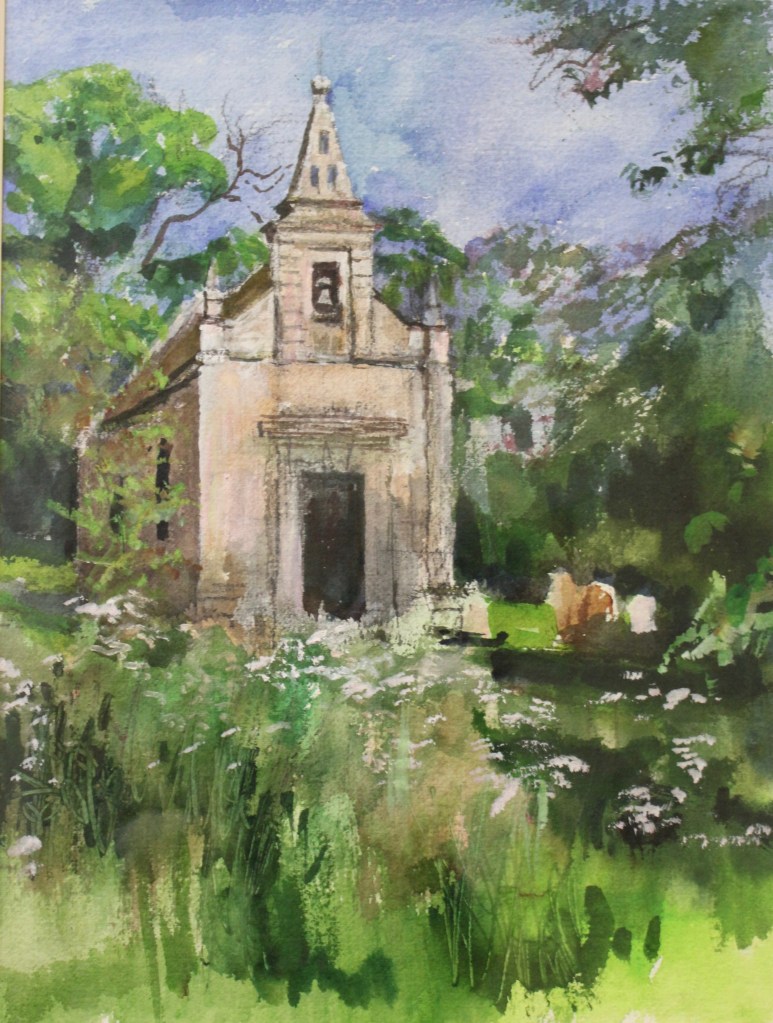
My watercolour – a sketch from observation – is another work with a T.S.Eliot connection, Little Gidding being the subject of the fourth and final poem of his Four Quartets. While such a painting hardly evokes the depth and scope of Eliot’s poem, the place itself was and is a tangible focus for its spirituality: “you are here to kneel, where prayer has been valid.”
31) IBSTONE CHURCH, Buckinghamshire – acrylic on board
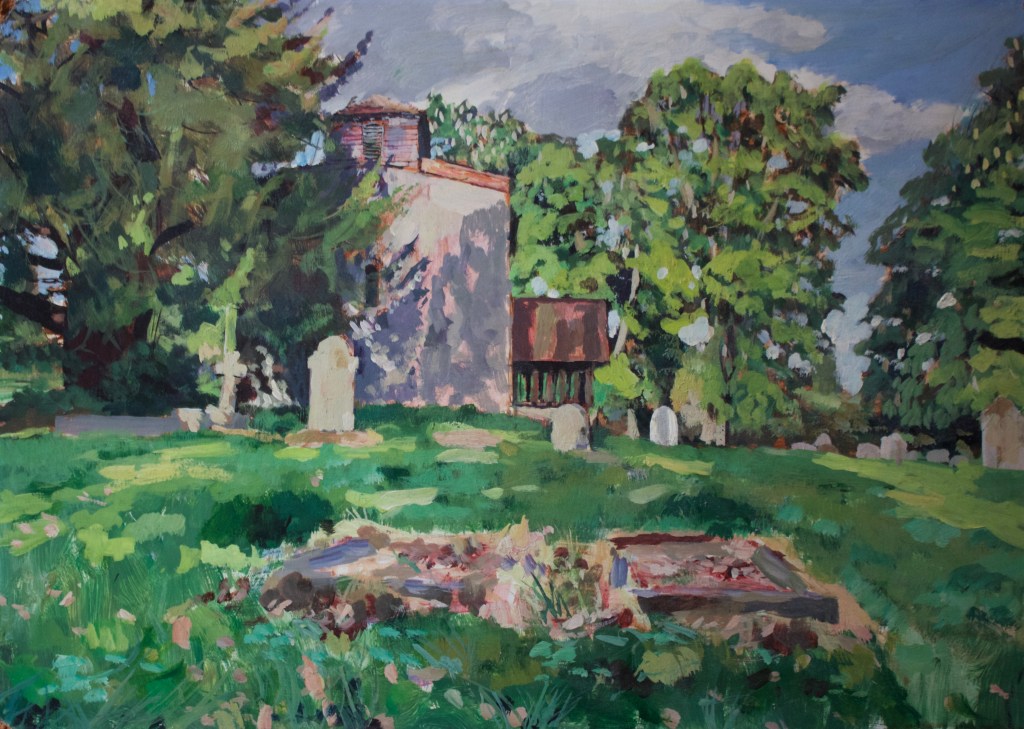
St. Nicholas Church at Ibstone, High in the Chiltern Hills. I painted in the churchyard while my sister Elaine practiced her singing inside the building.
32. A GARDEN IN HAMPSTEAD GARDEN SUBURB, Oil on canvas.
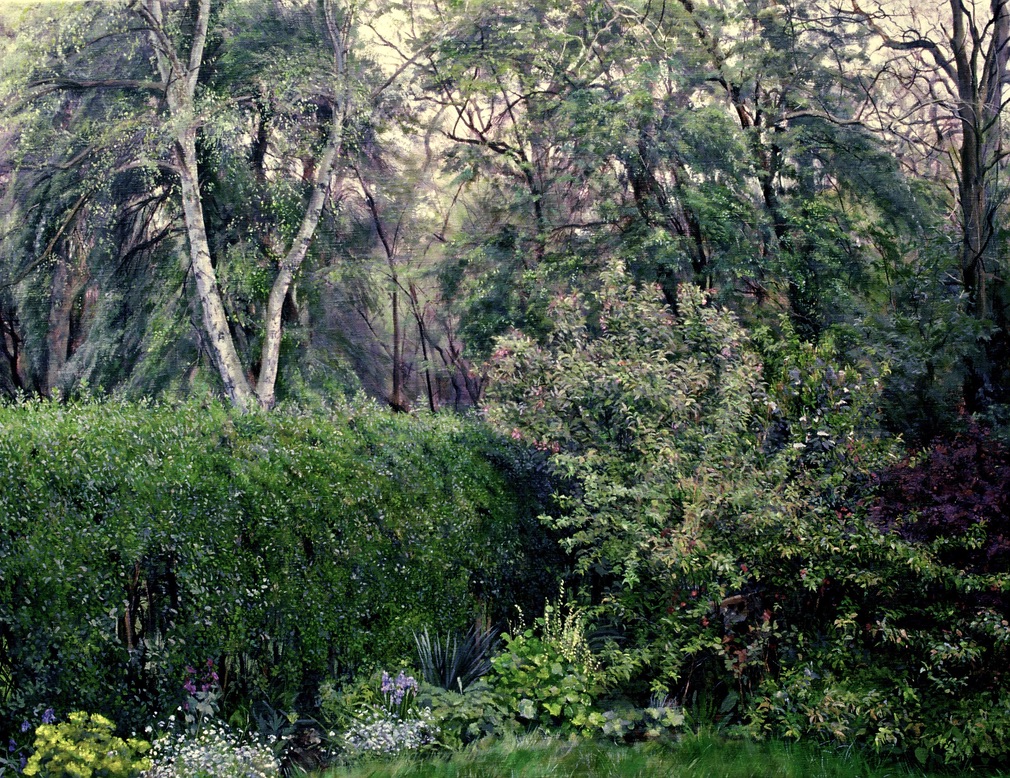
33. IN A NORTH LONDON GARDEN Oil on canvas 4’x3′ 2010
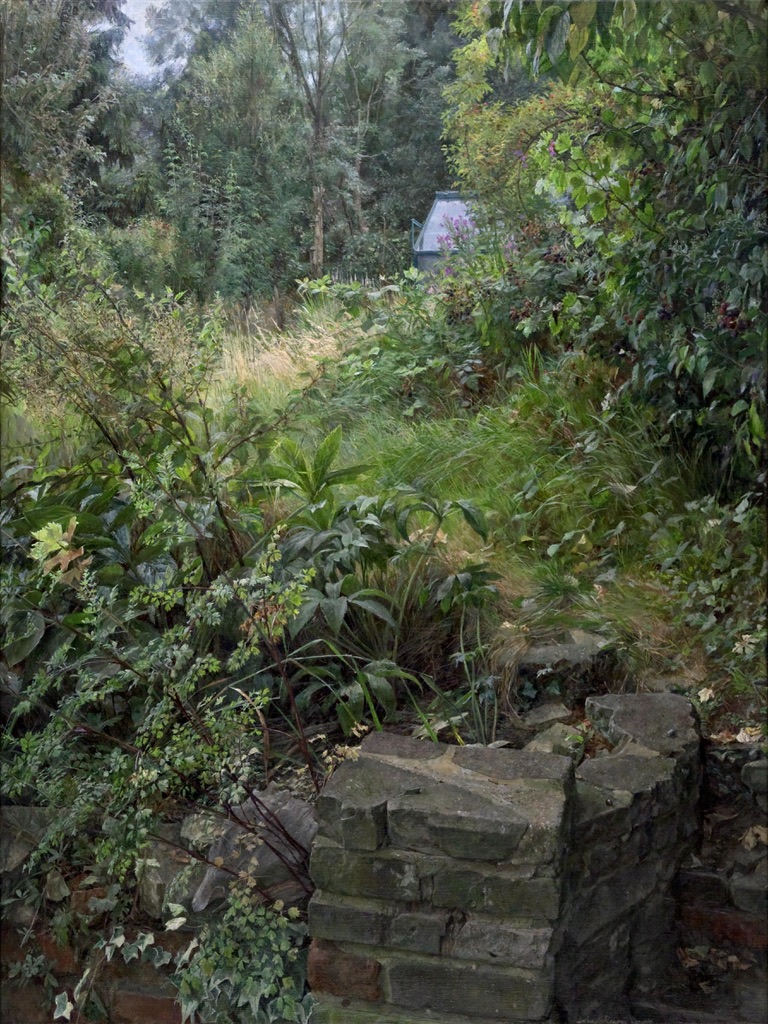
Yet another painting done at Jackie Baker’s garden. All I can remember about this is finding the perspective of the foreground brickwork unexpectedly subtle – in particular the geometry of the horizontal square surface.
As I bob around mixing colour or lean forward to apply a brushstroke the visual relationships change, but, needless to say, I have not attempted a cubistic painting. Nevertheless, while the foreground drawing implies an unchanging point of view, in exploring the depths of the garden the eye-line changes constantly.
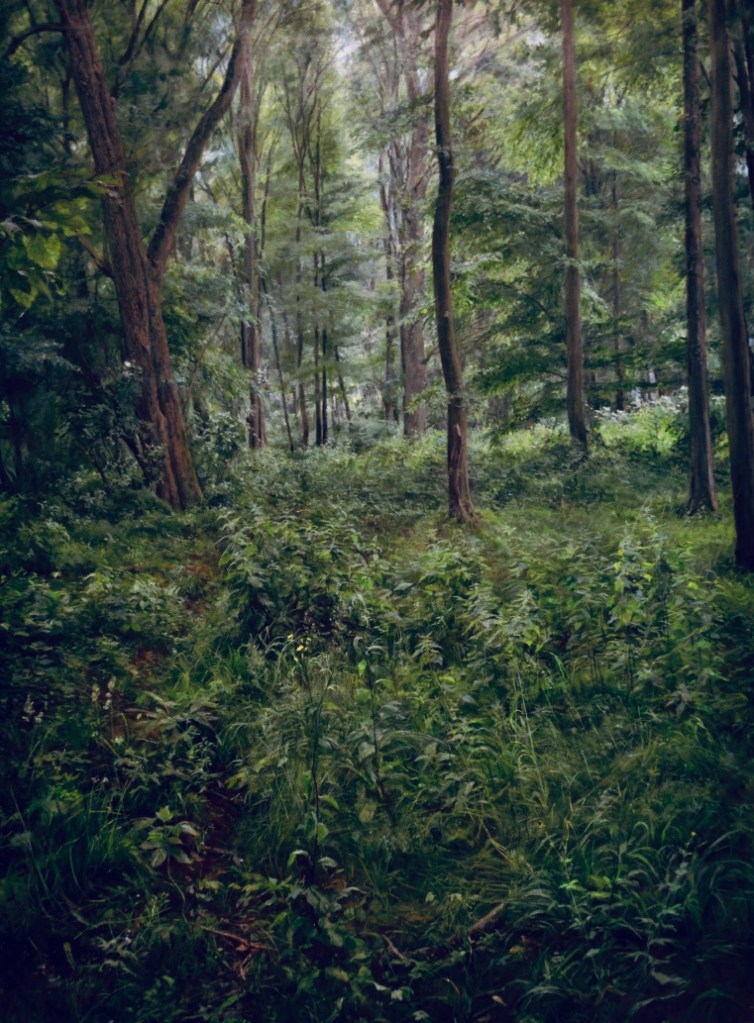
34) Mametz Wood – another wood interior, painted in Normandy for a Francis Kyle gallery exhibition ‘Everyone Sang’.
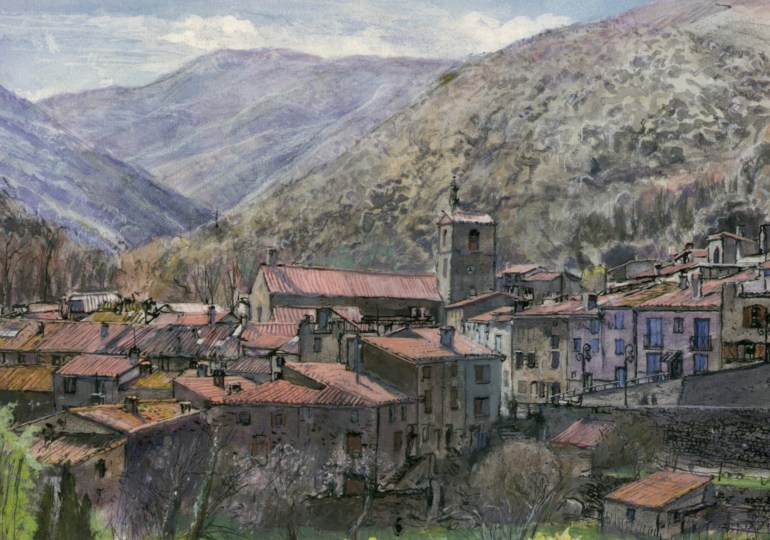
35) Rigarda – a village in the French Pyrenees
36). Joch – A hilltop Village in the French Pyrenees. Oil on canvas 4’x 5’4″
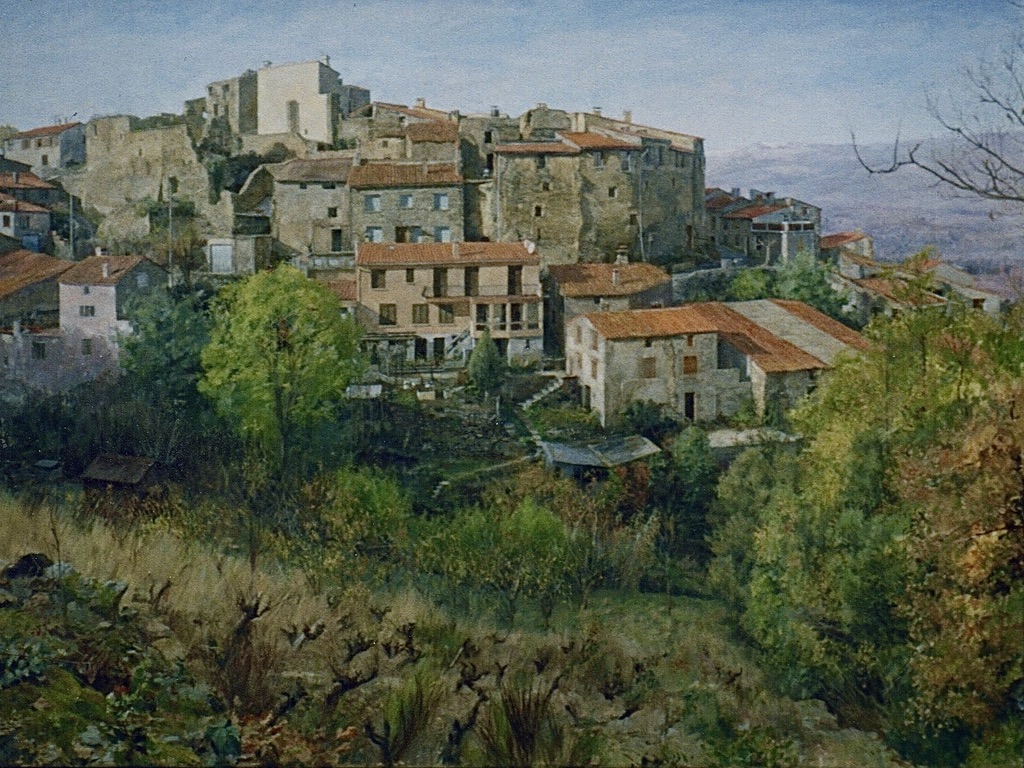
On a walk from Rigarda, where I was staying at the time, and following a mountain stream, I discovered the hilltop village of Joch.
I was struck by the almost shocking contrast of newer building, serene ancient stonework and blue distance. I found a painting position on the opposite slope.
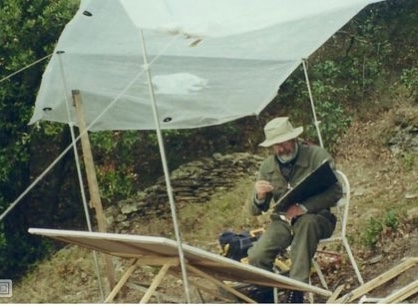
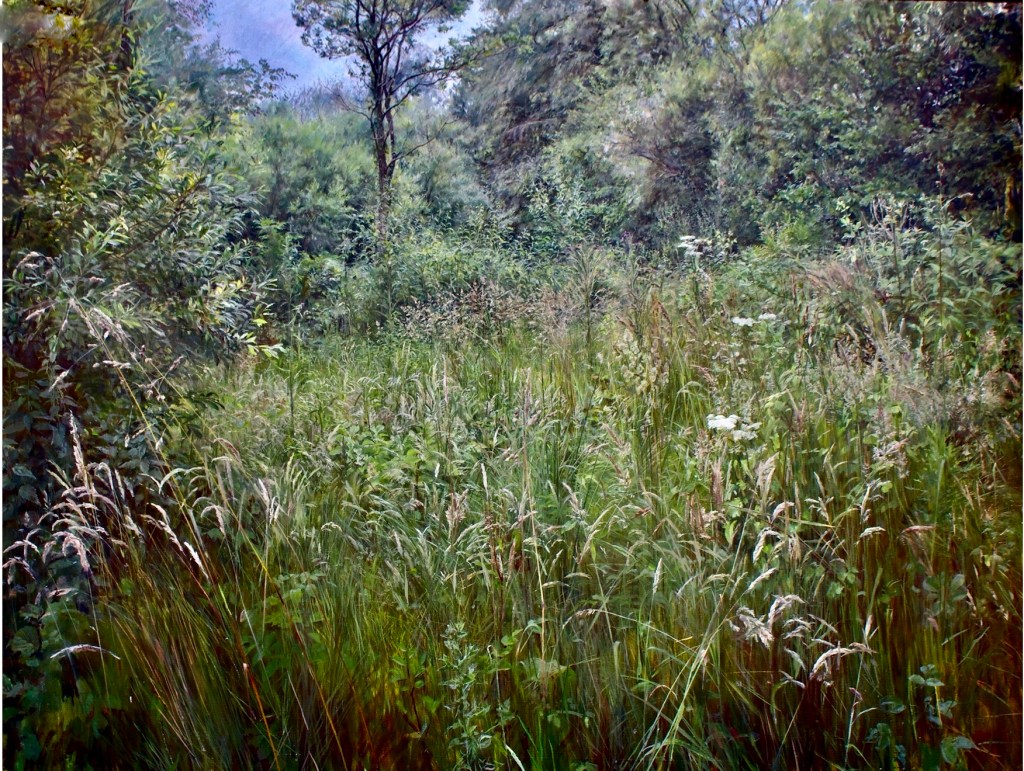
37). L’ORIGINE – Oil on canvas 4′ x 5′ 4″, painted in a wild, secluded Normandy estate, ‘La Fouberdière’, from May 1st to August 1st 2014, and exhibited in the Conciergerie of the Château de Regnéville Sur Mer, Normandy from 15th – 20th August the same year. The title, L’origine’, could equally be ‘L’énigme’, since understanding the world is always an unfinished task.
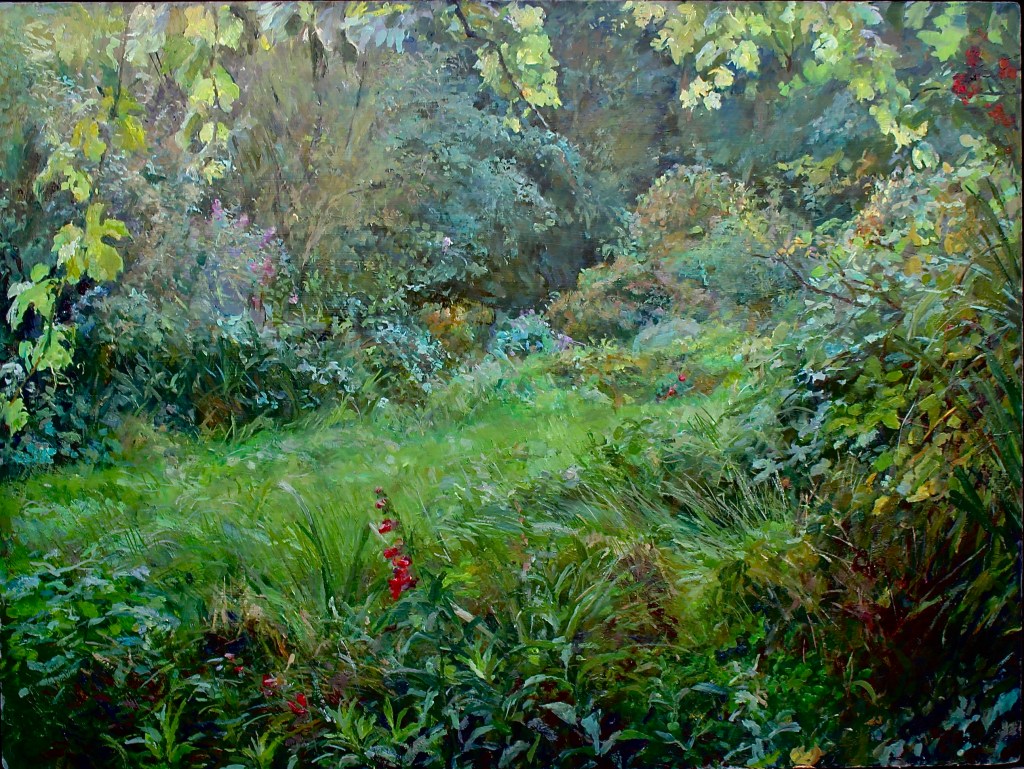
38) Below: A Garden near The Alexandra Park, in North London .
PORTRAITS.
I’m not sure that ‘a portrait’ is quite the same thing as ‘a painting’. The term is more specific, and, alongside any other aesthetic impact on the viewer, ‘recognition’ is more important than in other painting. The fact that it is called ‘a portrait’ emphasises a separate category and a different approach to the subject matter, from that of a landscape, still-life or ‘abstract’. True, a ‘portrait’ frequently is a painting, but the word can also mean a drawing, photograph, or piece of writing.
‘The sitter’, for all his or her apparent passivity, can contribute almost as much to the power of the resulting image as does the artist. The main aim is a recognisable ‘likeness’, and success in securing that has an importance that can outweigh other artistic qualities. Does the accurate depiction of the subject matter of a landscape or a still-life have comparable significance? And does a painting of a beautiful subject or sitter mean the painting is necessarily beautiful?
I suppose I’m suggesting that successfully securing a likeness – which not everyone can do, though I would modestly suggest that I usually do so – does not in itself qualify the result as a successful or a great painting. The subject of any painting is important, and the effect of a portrait could primarily emanate from the sitter; a skilled artist has simply conveyed it and a competent photographer might do the same. Yet Rembrandt’s portraits, which survive their sitters as ‘great art’, have more to them than mere recognisable likeness. In any case we have never met his sitters, so are unable to evaluate the portraits in such terms.
Portraiture demands the equal commitment of artist and sitter. Each of the items selected below is a record of such an encounter – a sort of wordless conversation to which artist and sitter have both contributed. Hopefully, the resulting image will have something of the power or individuality of the subject. One such example may be the drawing of the Cabalist Tony Potter (The sixth image below – though whether a person has met him or not will obviously affect one’s response). Others have made the portrait part of a larger composition in which the background has some relevance to the personality of the sitter.
1)The Artist’s Mother – Dorothy Pearce
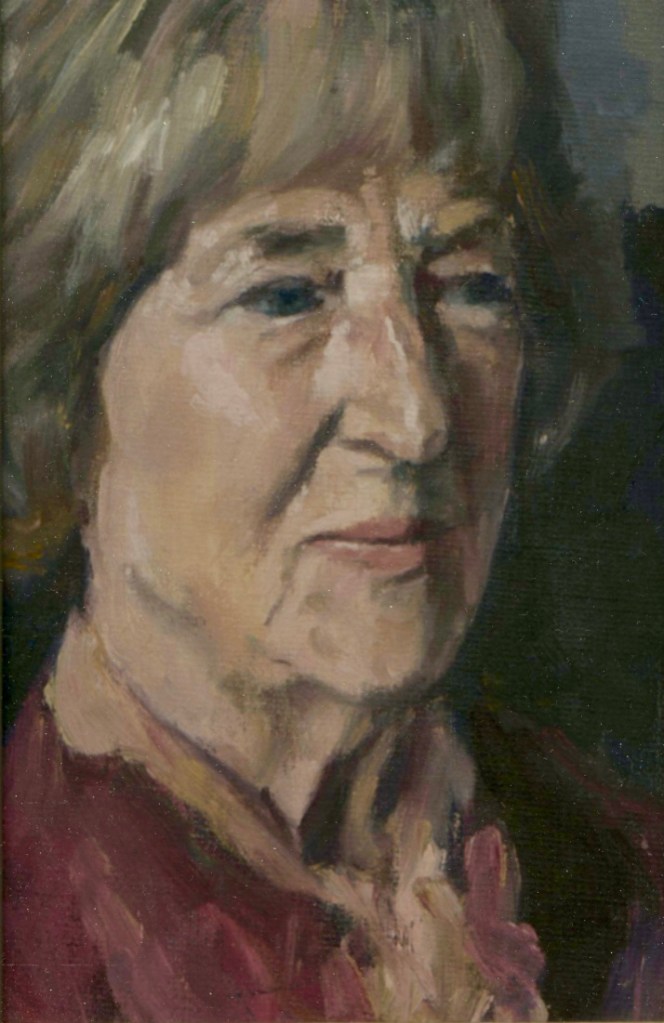
2)The Artist’s Father – Nelson Pearce.
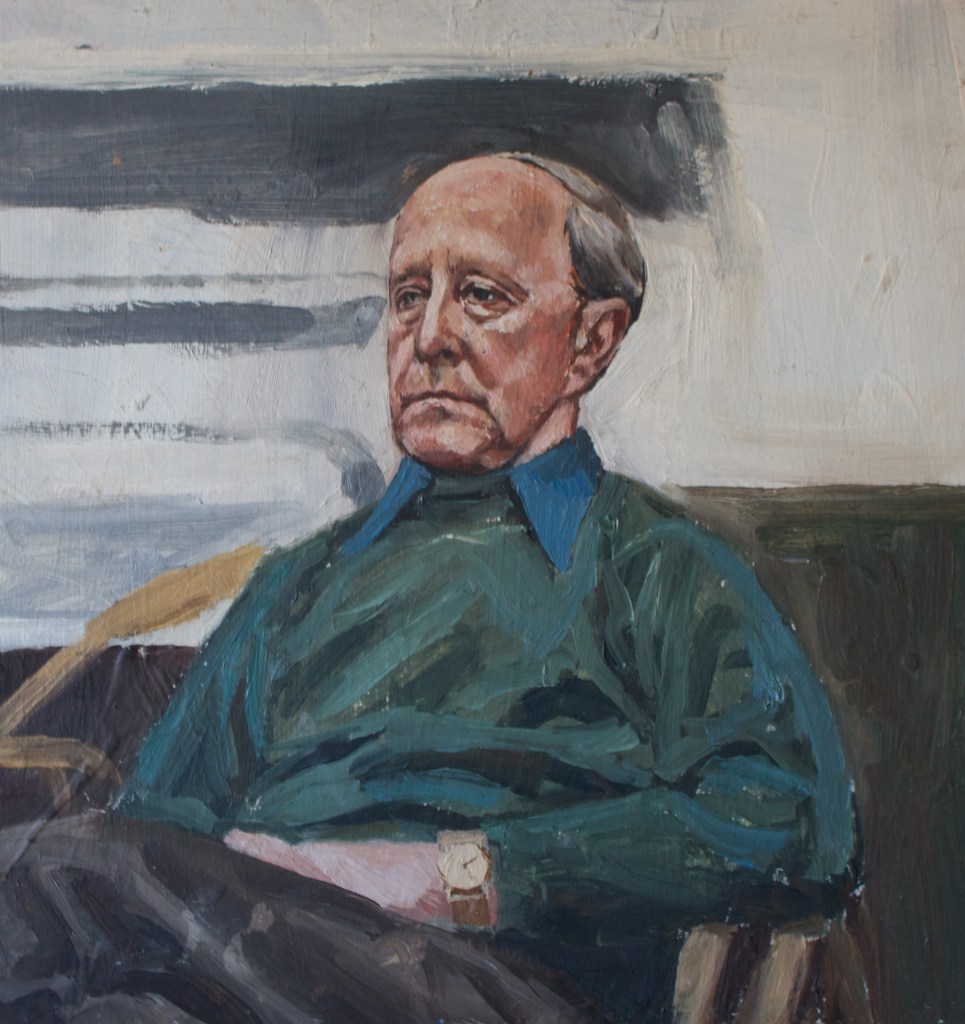
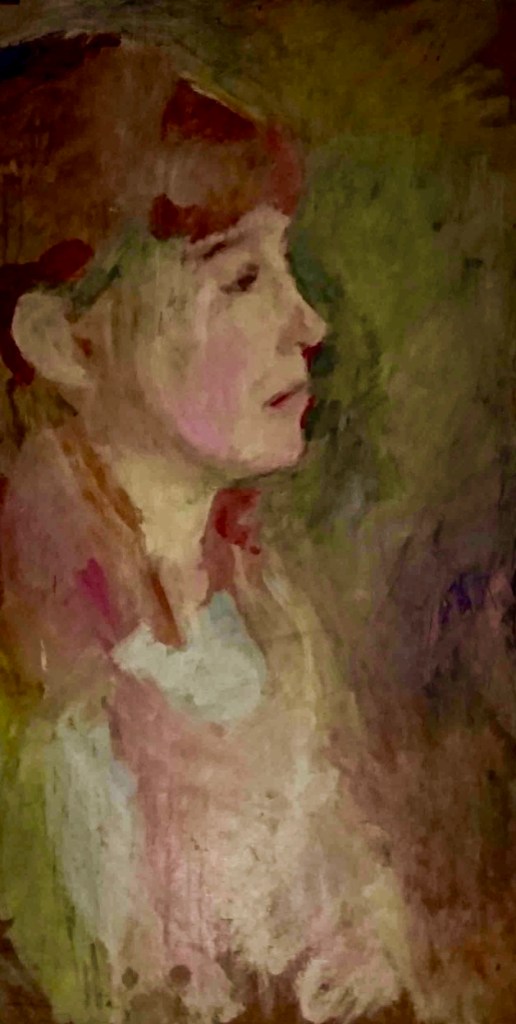
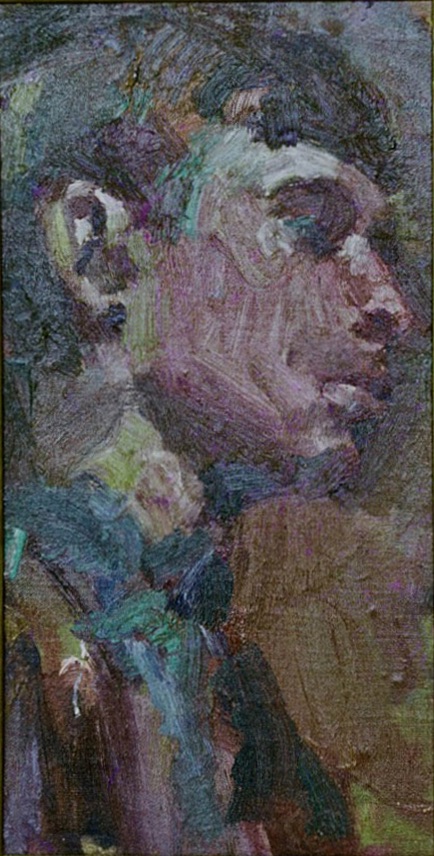
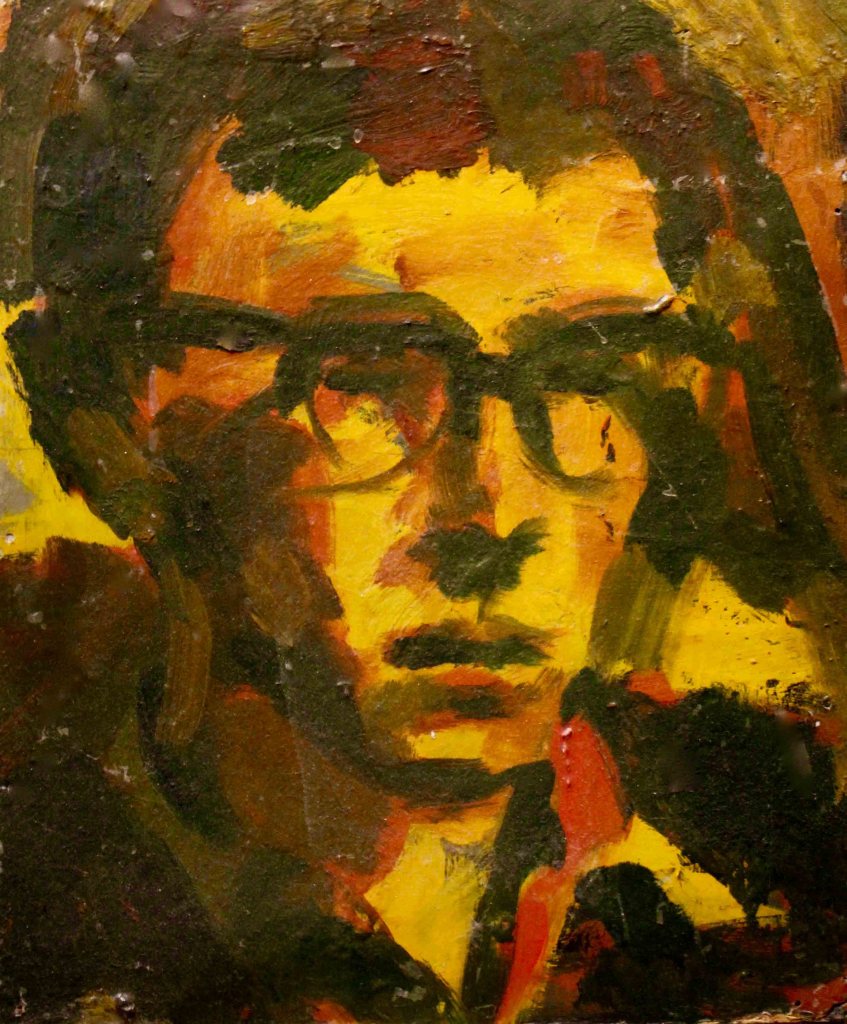
3) Above – The artist’s brother and sister: Roger – a scientist, and Elaine – a professional singer.
Below – my brother Roger (painted some years ago.)
4) Below – Two more of Elaine.
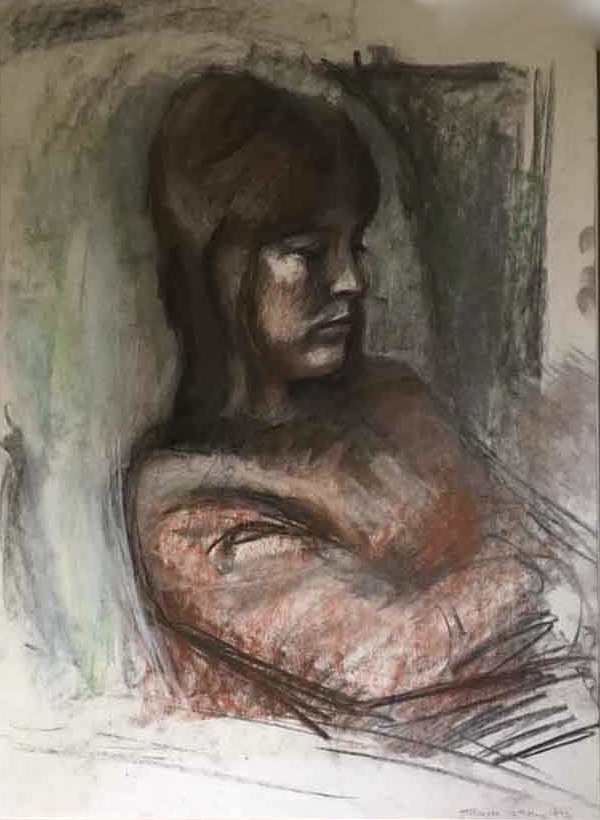
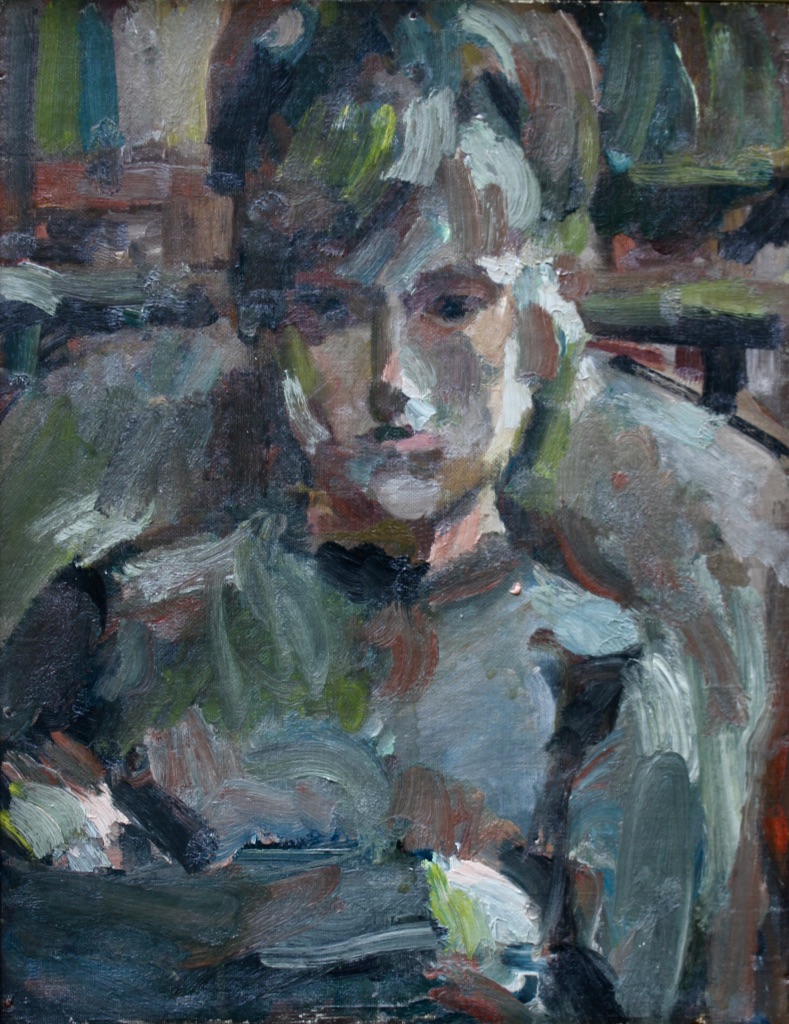
5) Below – eight renderings of my daughter Eleanor – at different ages.
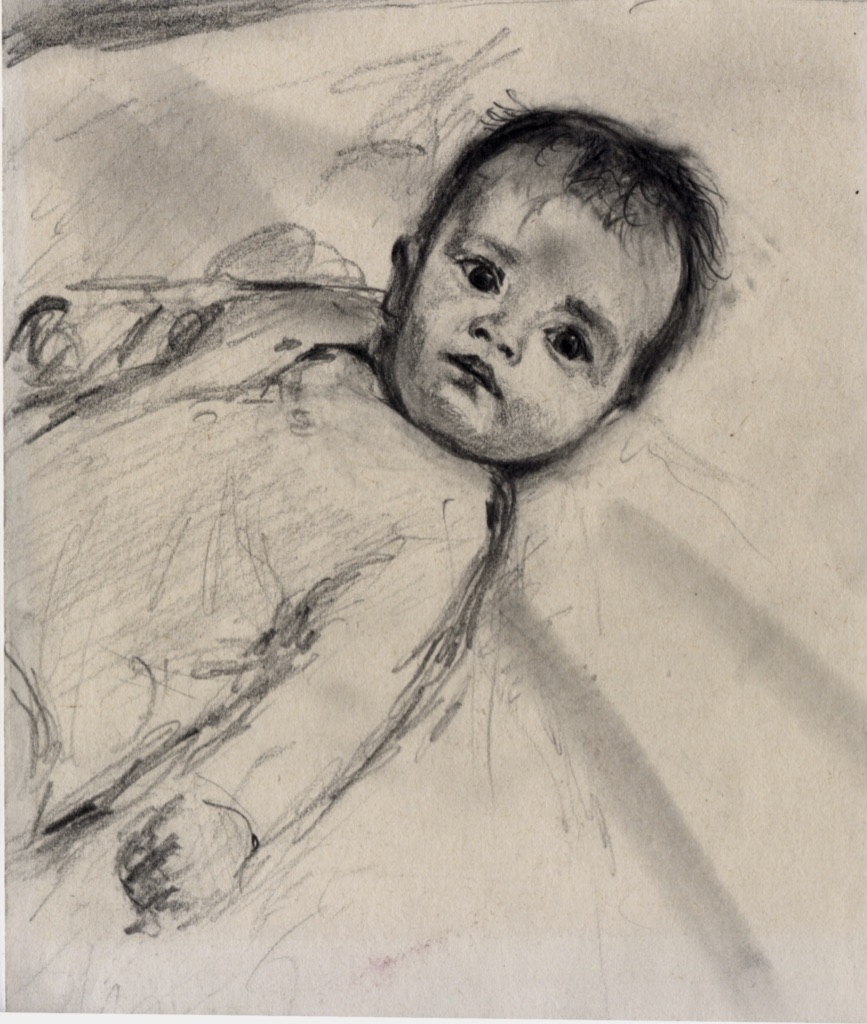
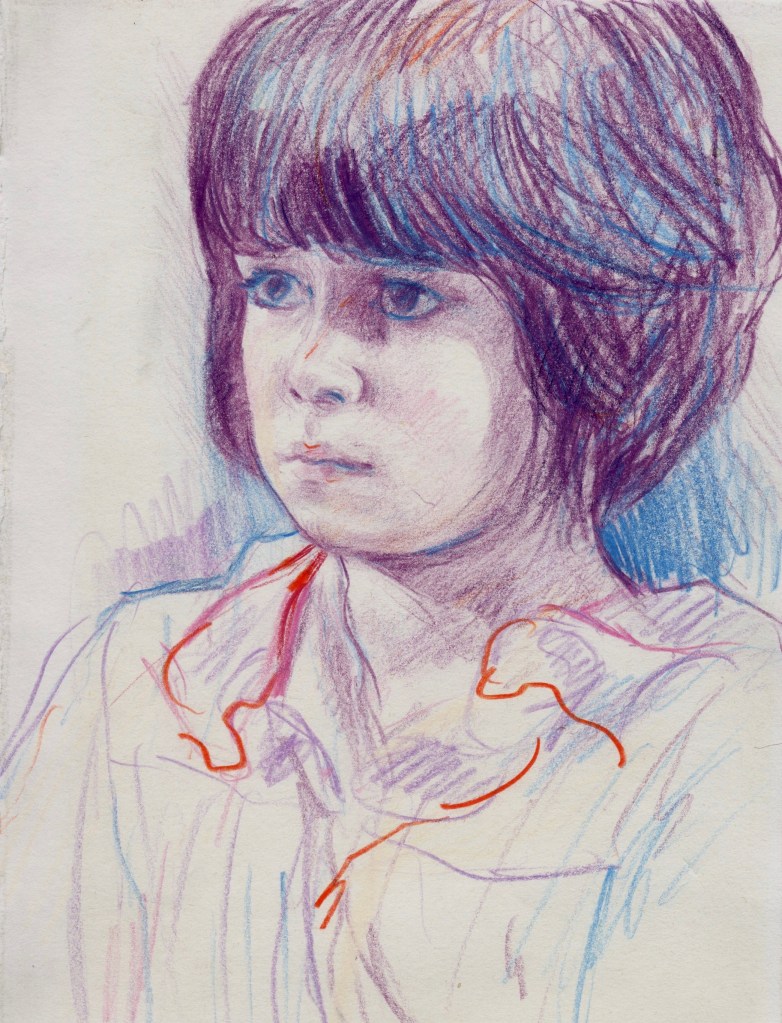
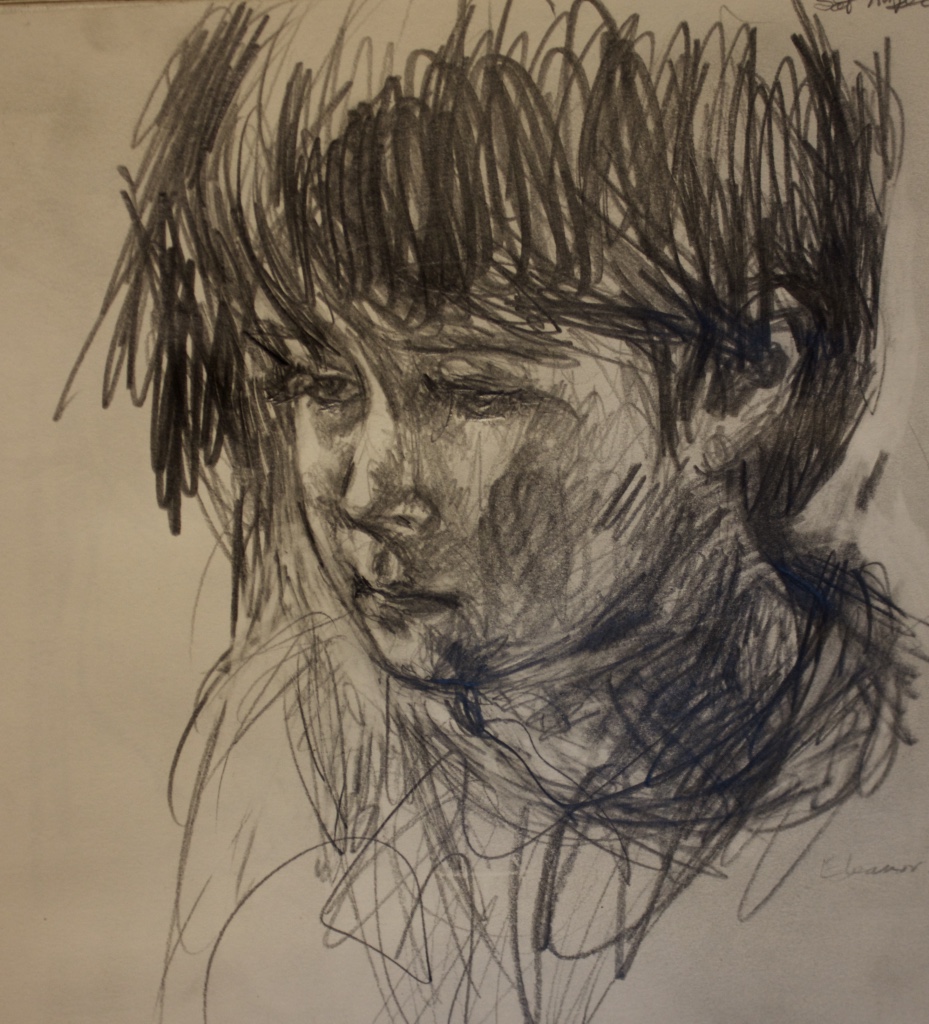
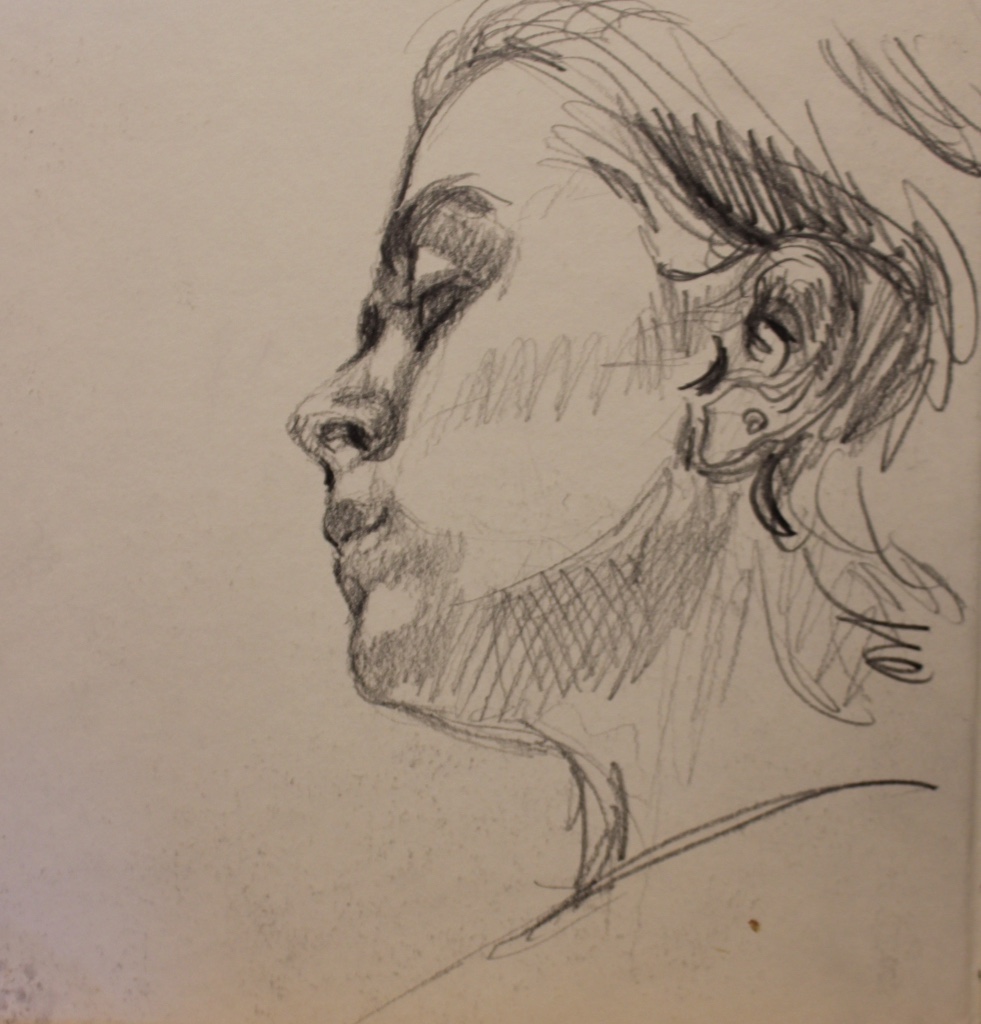
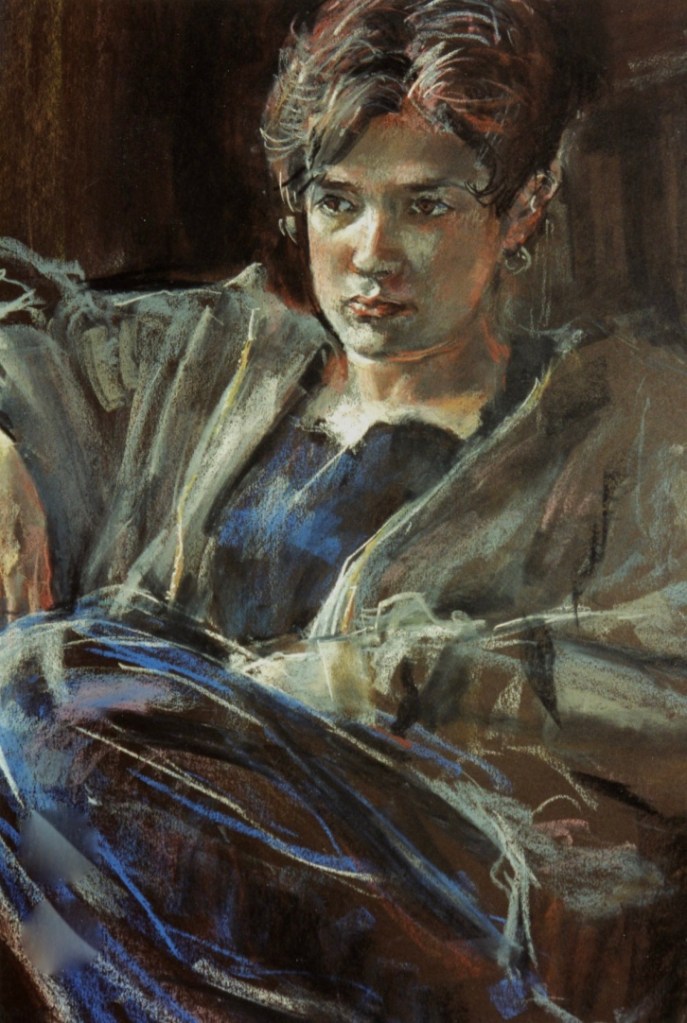
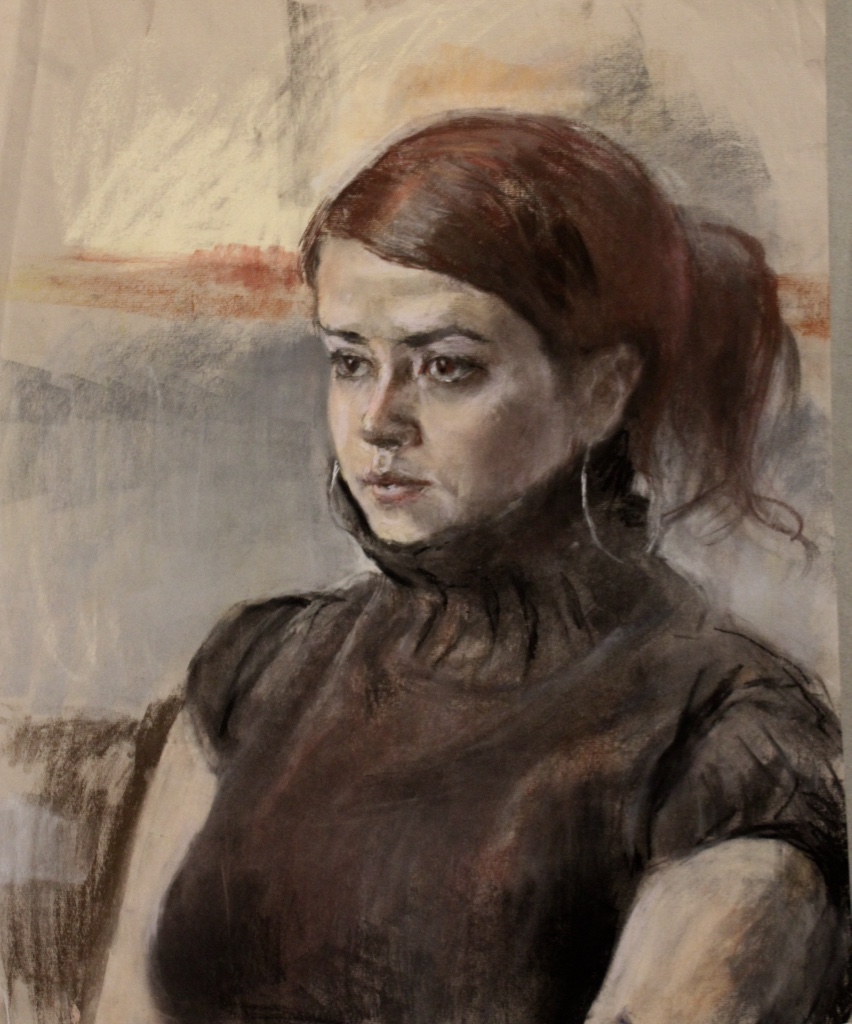
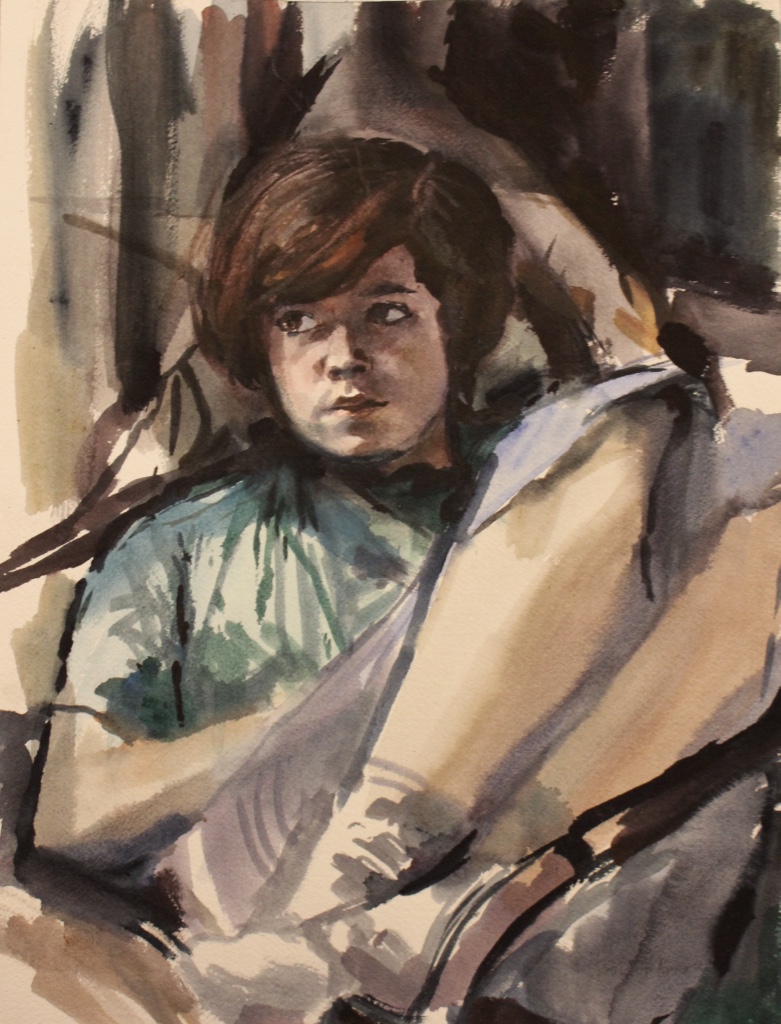
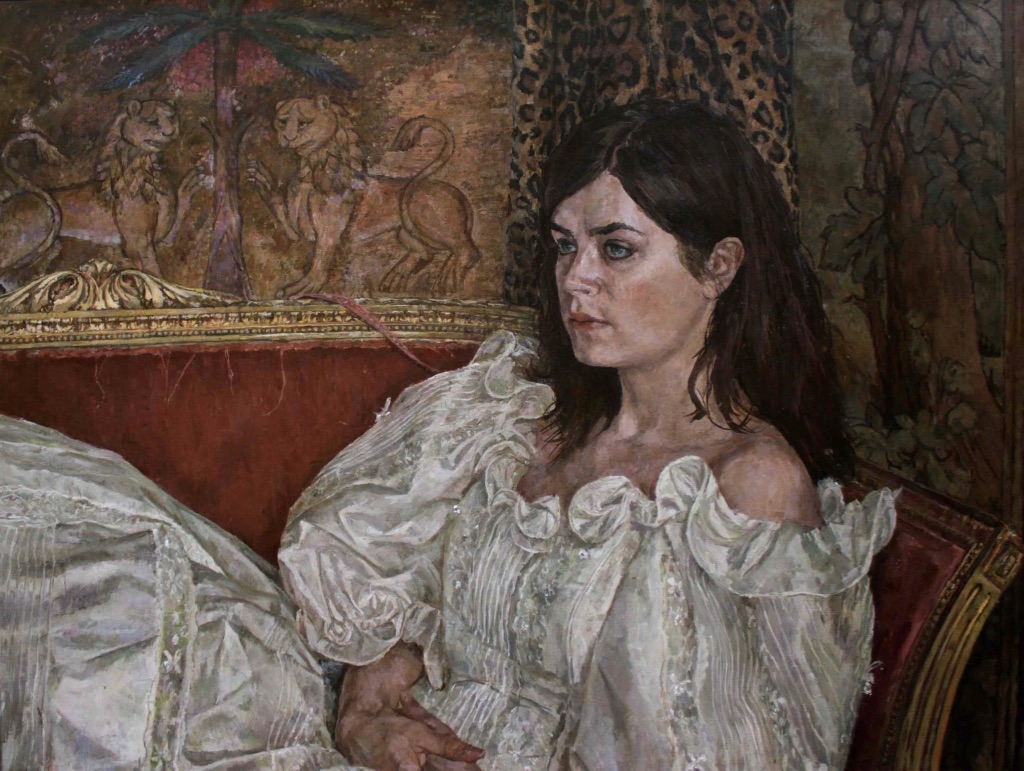
Eleanor was the sitter for the above picture, painted for one of The Francis Kyle Gallery’s exhibitions, which invariably had literary themes. It was meant to evoke Angelica, an important character in Lampedusa’s novel ‘The Leopard’. In that context I also made a trip to Sicily. The background of the picture quotes a mural from a palace in Palermo.
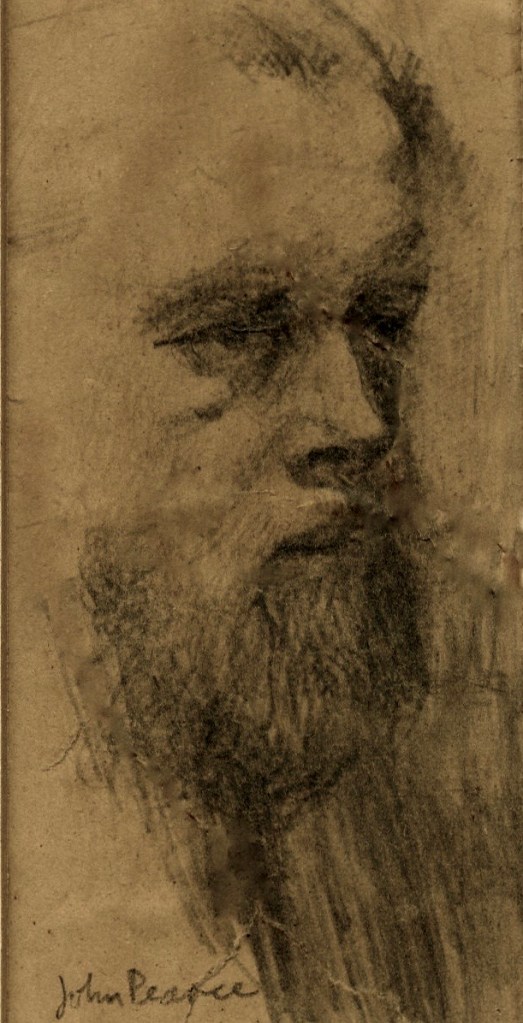
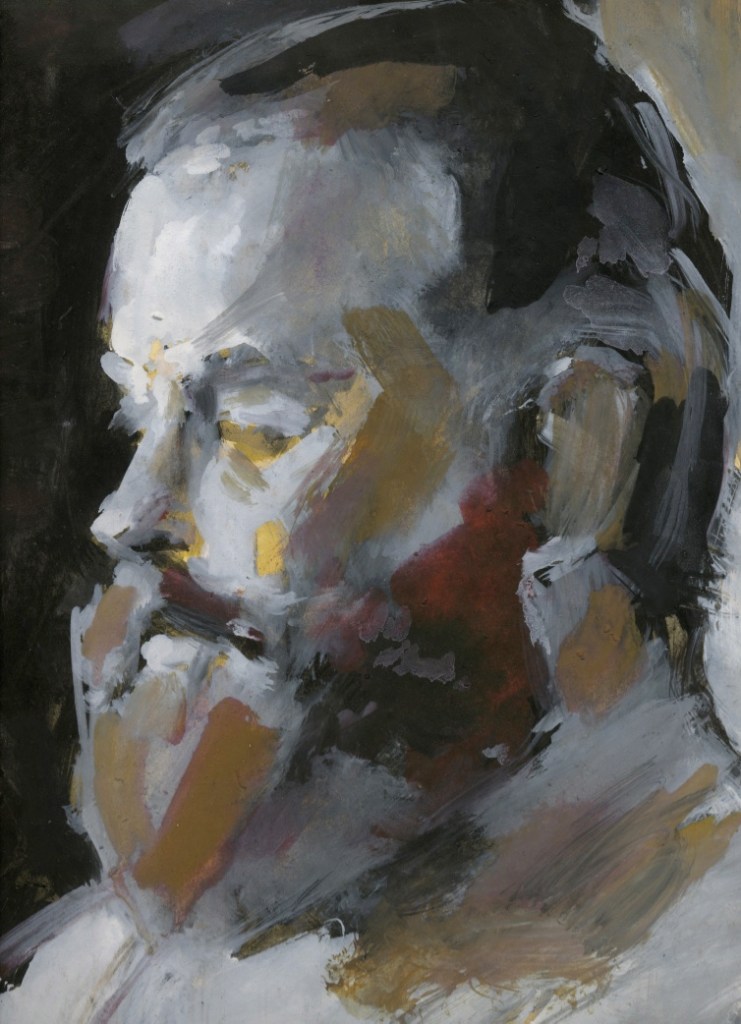
6) Above – Anthony Potter, Cabalist adept & teacher.
Tony was a prominent regular in the saloon bar of The Red Lion and Sun in Highgate Village, to which his group members also repaired after Cabala meetings, and where they could put ‘The Work’ teachings into practical effect.
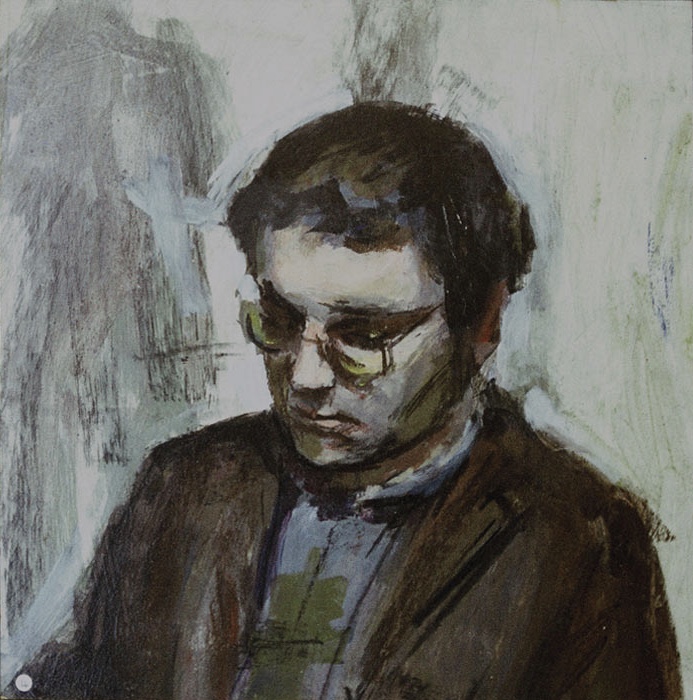
7) Stanley Green – a particularly intelligent and down-to-Earth member of Tony Potter’s Cabala group: ‘The Society of the Hidden Life‘,.
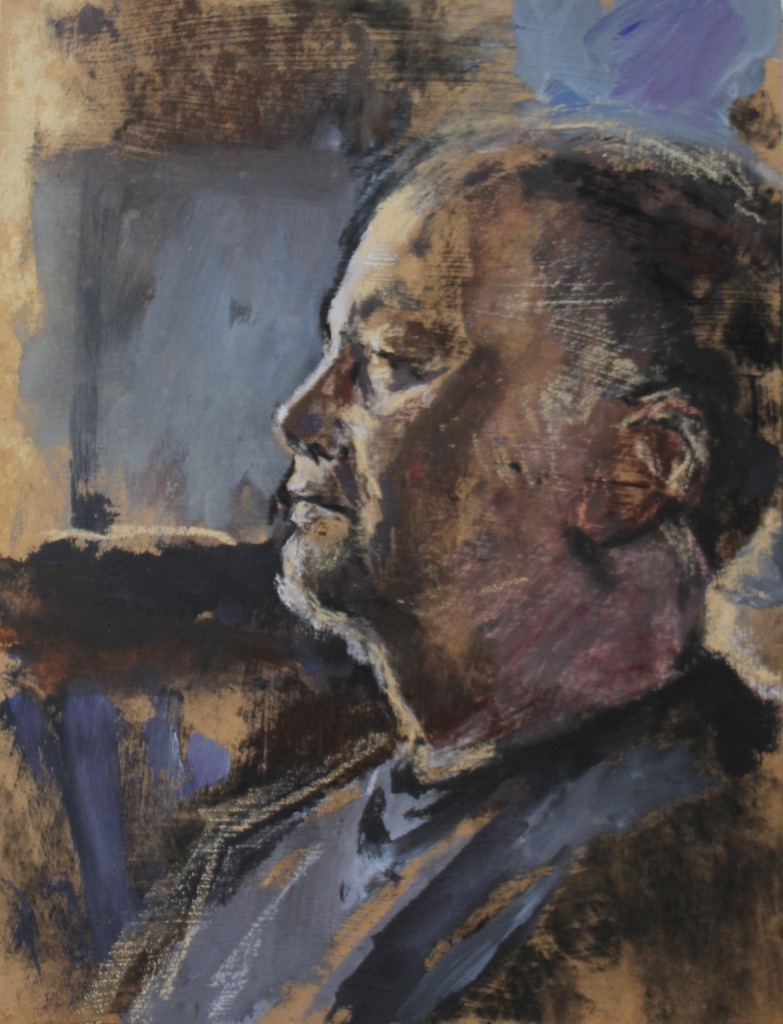
8) Above – Marc Gemin – ‘André’ – artist & curator of Bouillons Kub; also President of ARSOR (“L’art sortir“}, an association of contemporary artists.
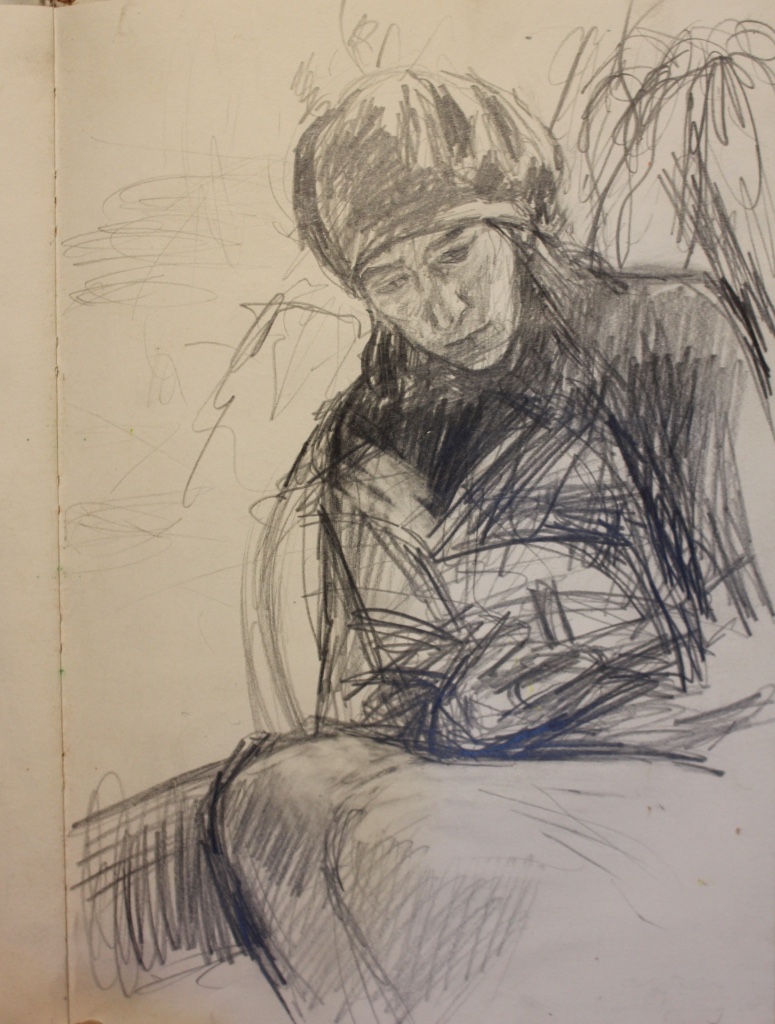
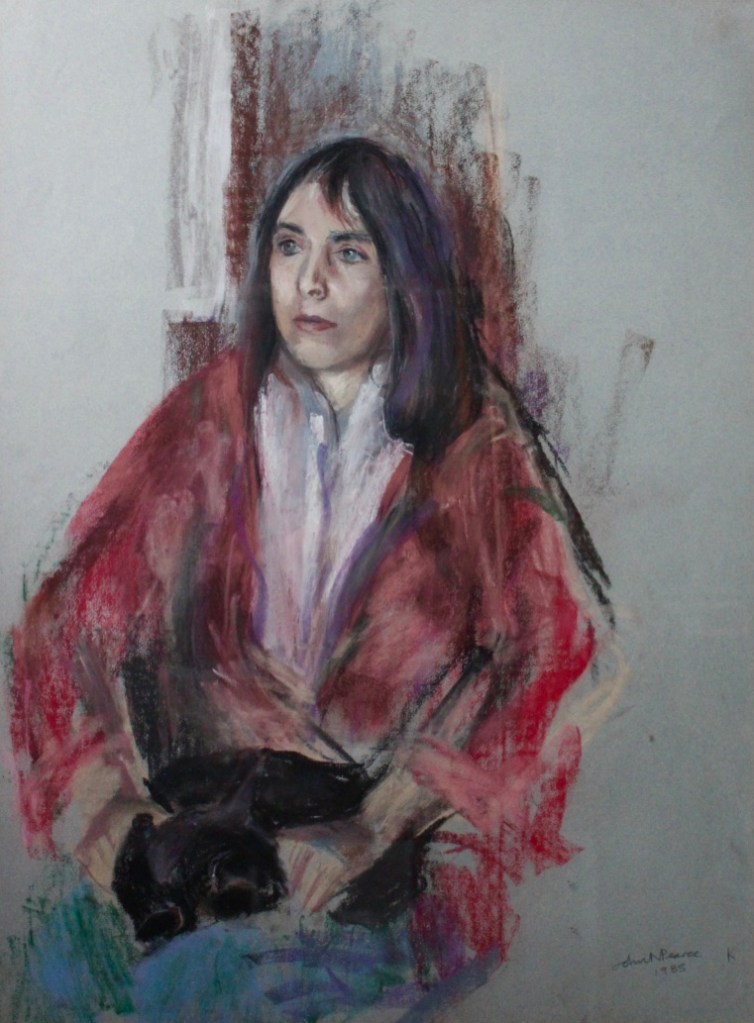
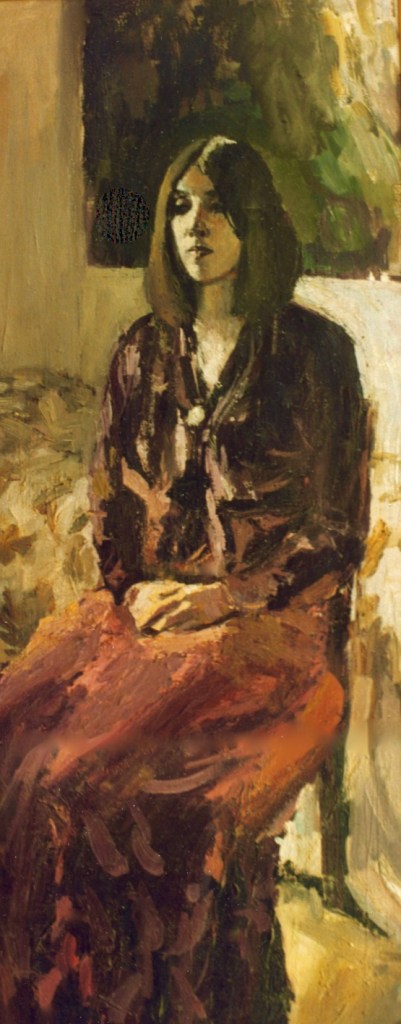
9) Below – six studies of Susan Herivel
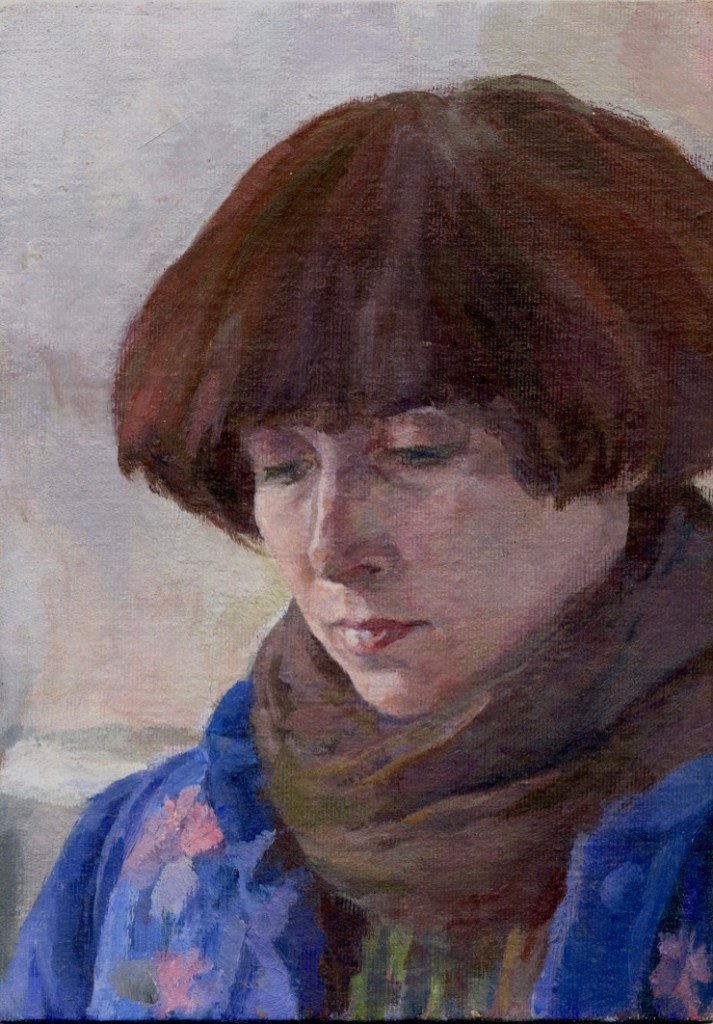

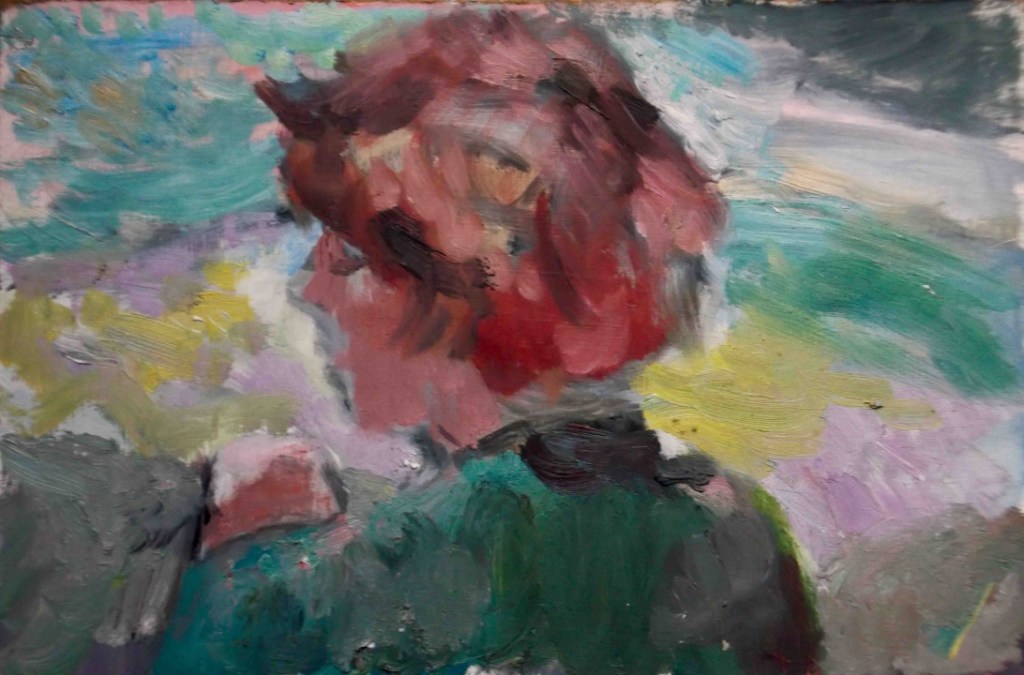
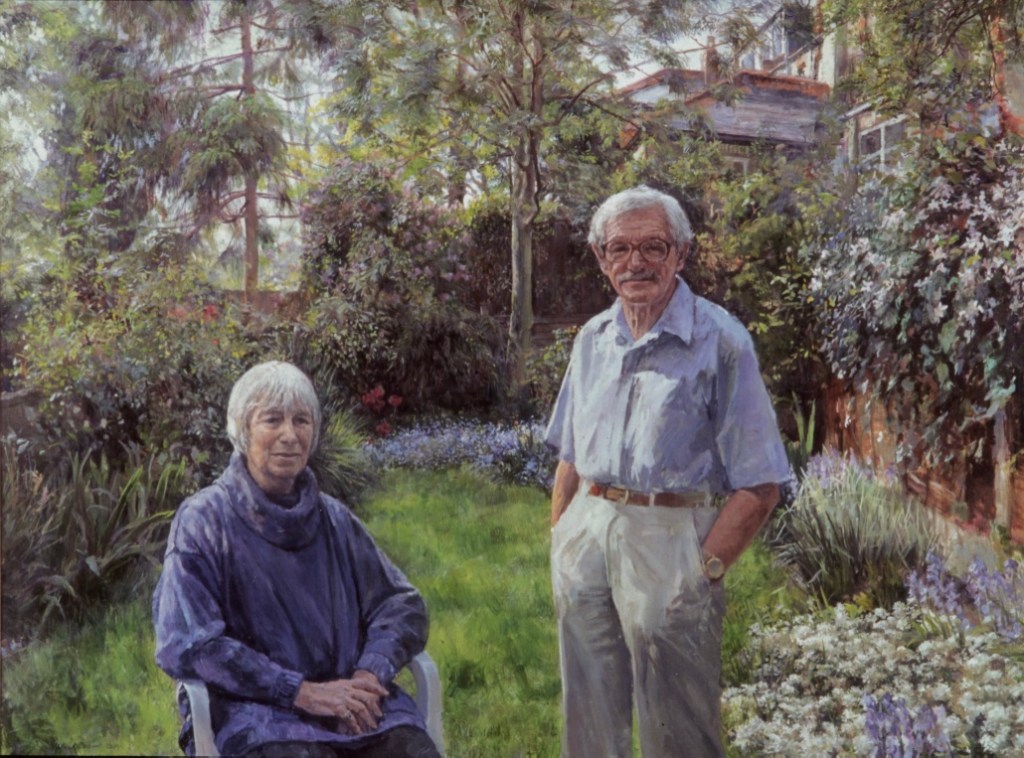
10) The 3′ x 4′ portrait of Heinz and Nettie Lowenstein, shown below, was painted in their garden – at their own behest. It is now in possession of their daughter Anna. Heinz was an actor/director and Nettie a writer.
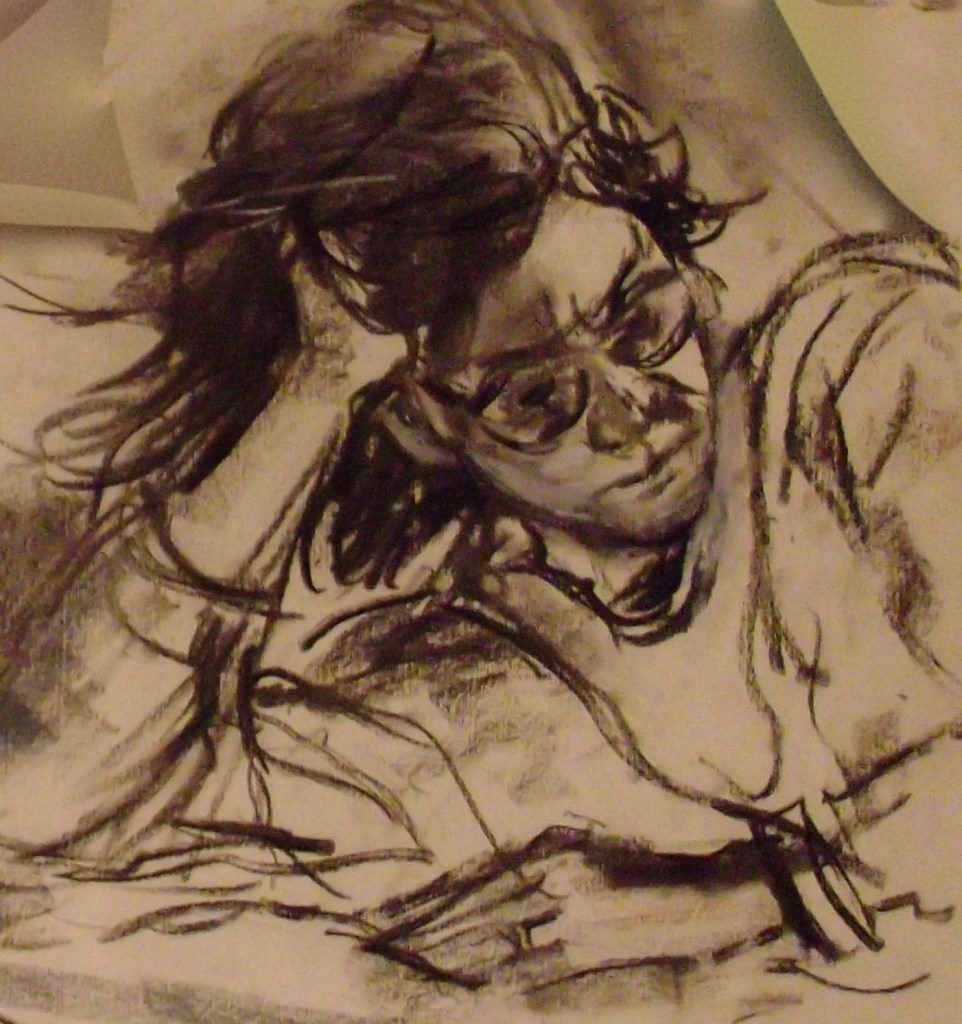
11) Below, two studies of Heinz Lowenstein – the actor/director, better known as Heinz Bernard.
See also: https://en.wikipedia.org/wiki/Heinz_Bernard
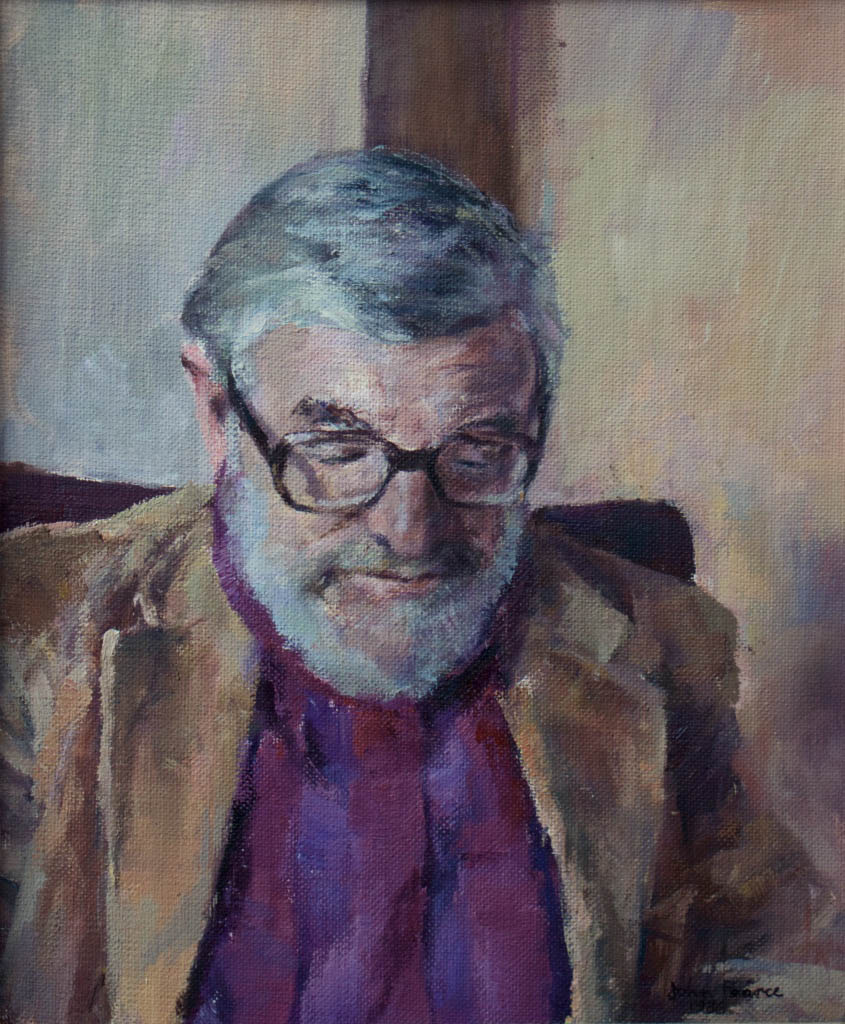
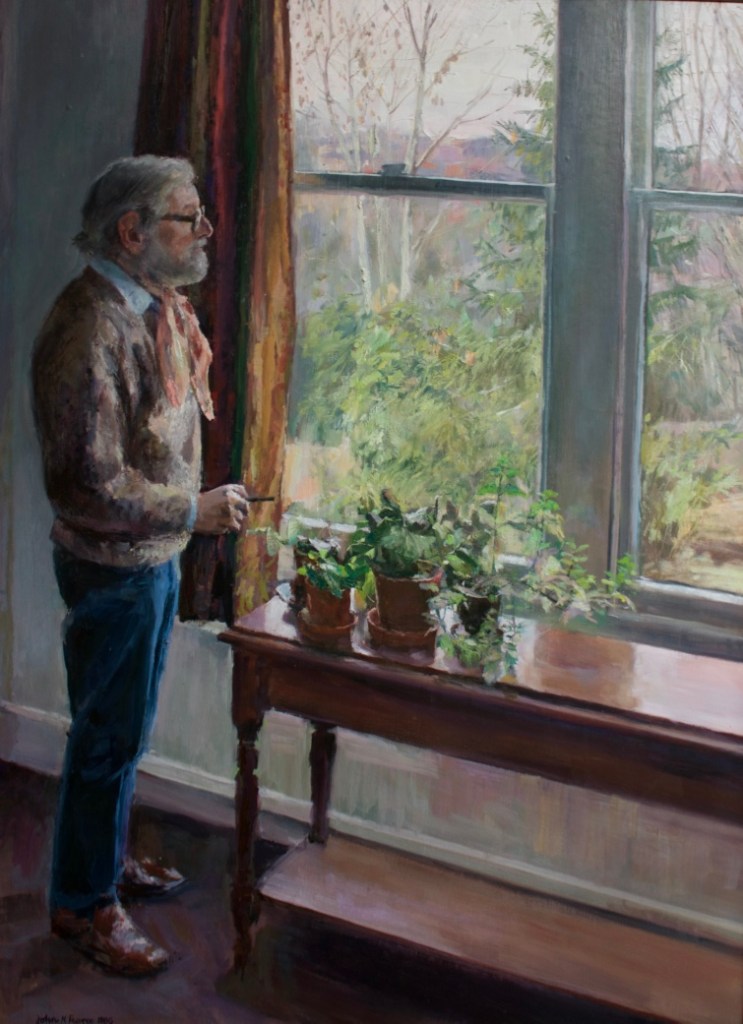
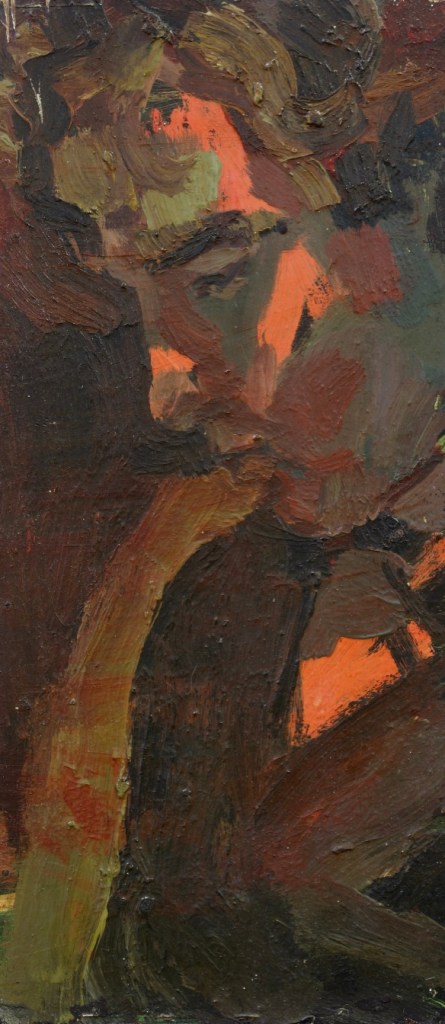
12) Above, a study from the early 1960s – in the light of a coal fire – of my amusing and multi-talented friend Clement Griffith (Writer, artist, wit…).
13) Below, Alan Wilmer – another clever and amusing friend whom I first met when we were both in the Wolf Cubs.
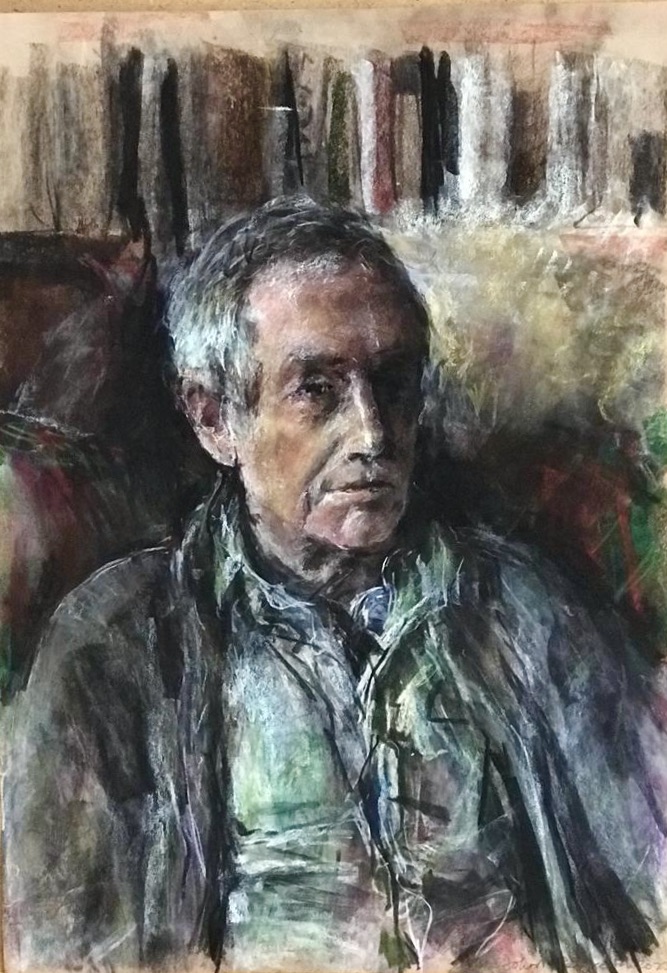
14) Below – Monsieur Bruno Horcholle – stone mason, builder and violinist. Our property in Regnéville, Normandy – barely habitable when purchased – has been greatly enhanced through Bruno’s knowledge, practical experience and creative vision.
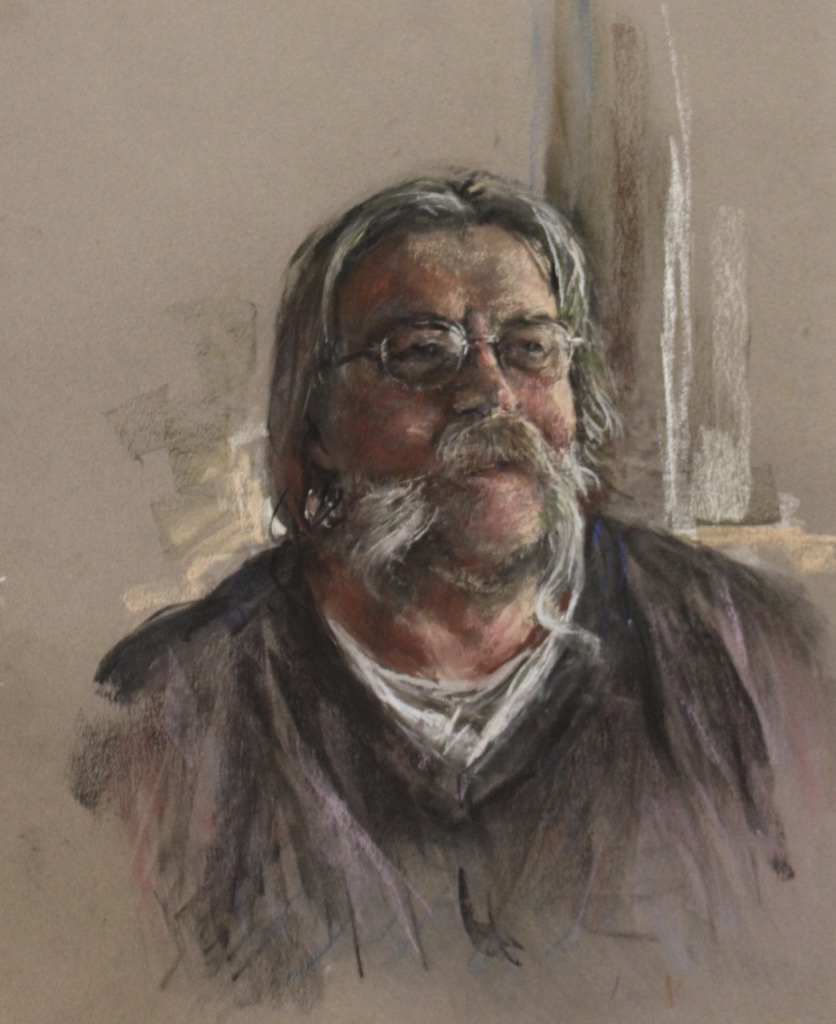
Below: Bruno on violin – accompanied by Yusuf Blayachi on acoustic guitar, and Bruno’s son Brian on electric guitar.
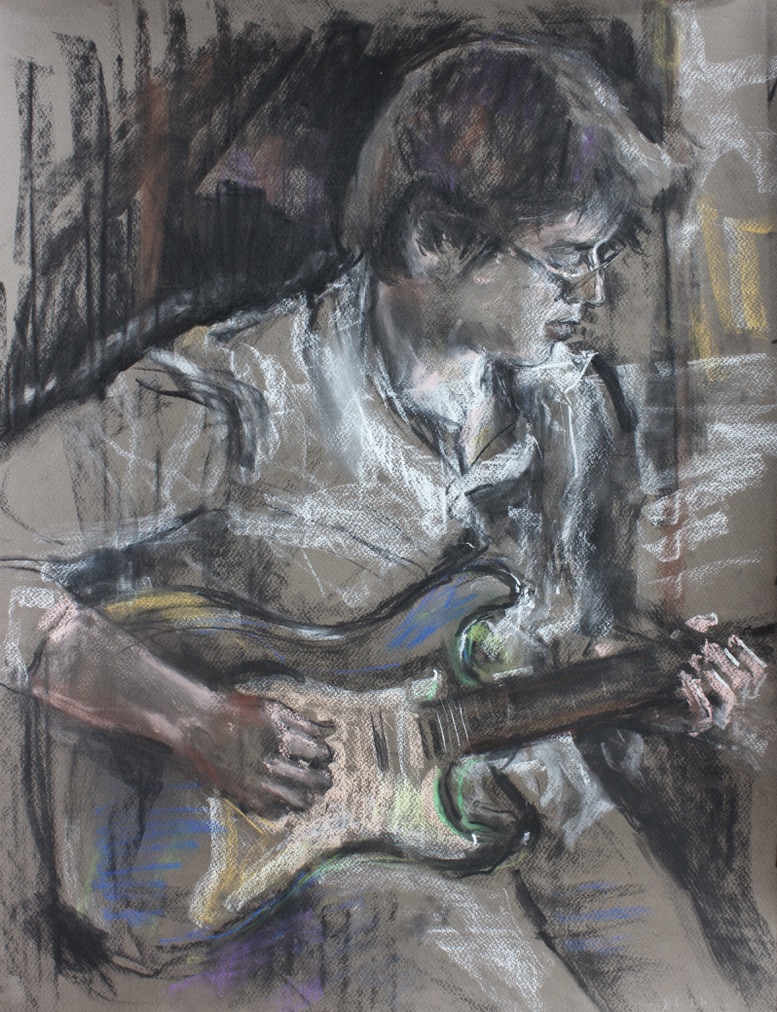
15) Below – Brian Horscholle
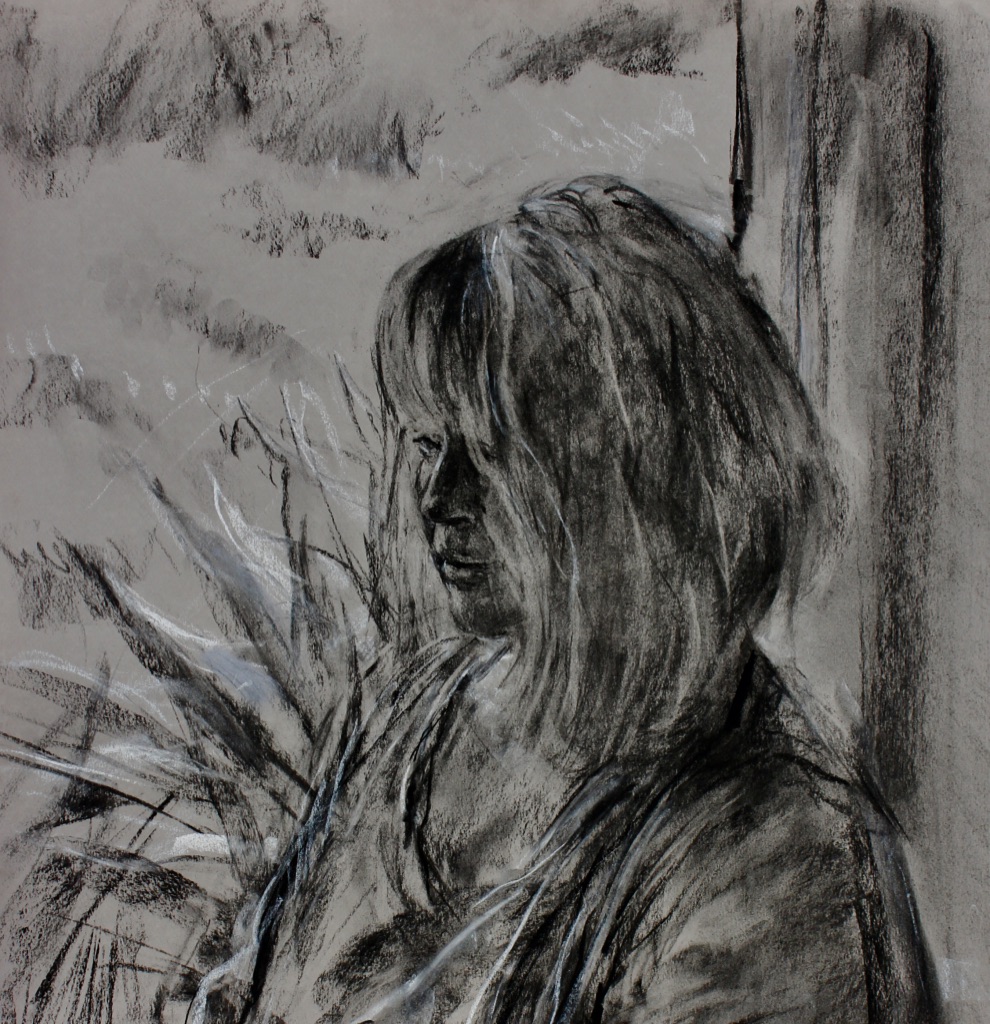
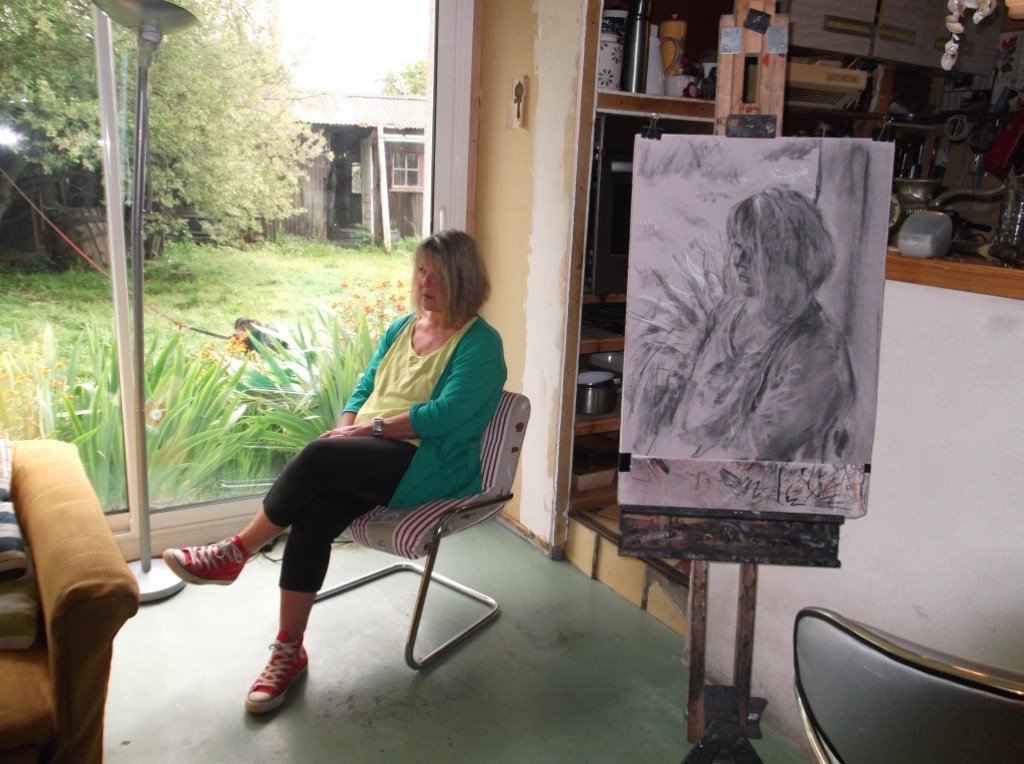
16) Musicality runs in Bruno’s family…. Above, Bruno’s charming partner, Bénédicte – pianist and piano teacher as well as a practicing visual artist.
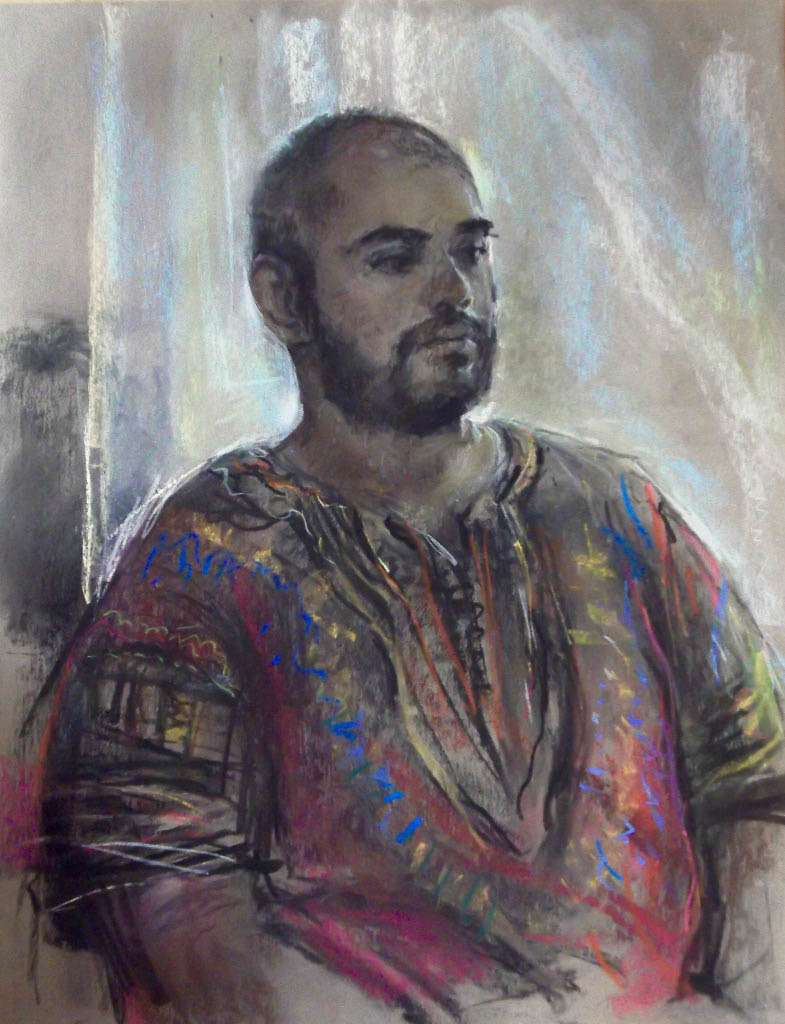
17) Sitters suggested (above) by Eleanor and (below) by some 1960s regulars in The Red Lion and Sun in Highgate Village – Bill and Kate Crew. I consider this drawing – which they asked me to make of their daughter – is probably one of my best.
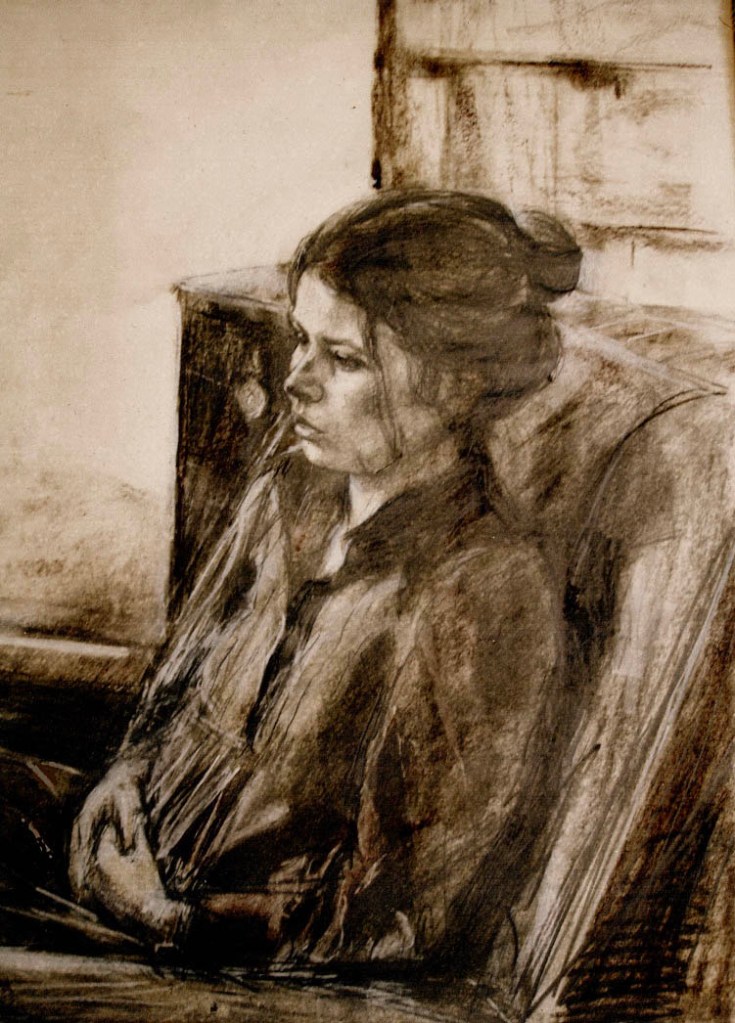
18) Below: June Abbott.
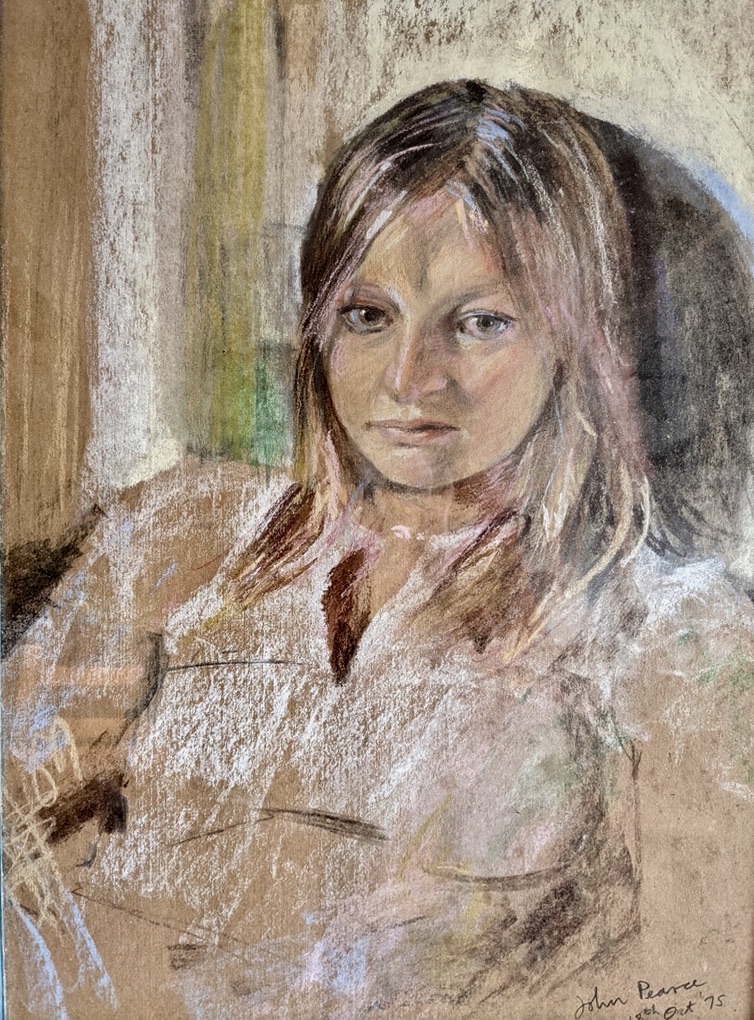
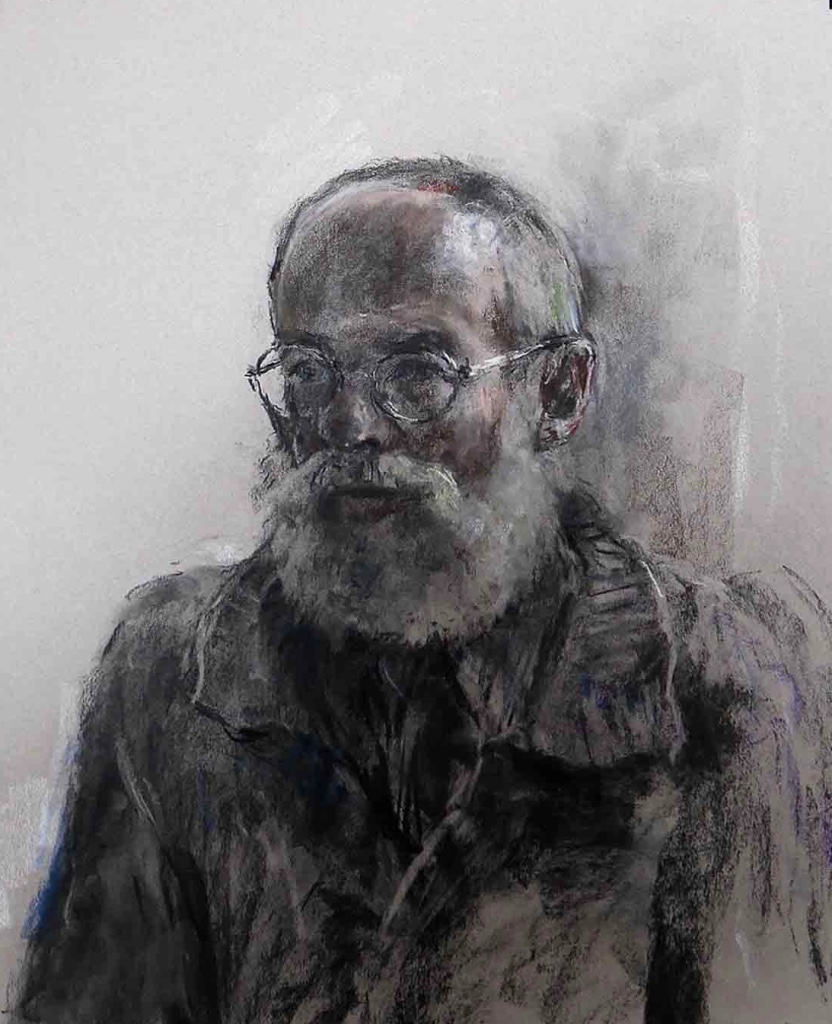
19) (Above) Lloyd Jeans – a friend of my daughter Eleanor. She first encountered Lloyd shortly after moving to Forest Gate, when, one Spring morning, he appeared in the streets as The Green Man! (See the article below.)
https://www.theforestmag.com/articles/lloyd-jeans

20) Above: Olivier, a friend introduced to us by Susan Jeffreys (See No 41 ‘Red Shoes’ below).
21) Below, Mr. Michael Smewing – another of our distinguished Regnéville friends.
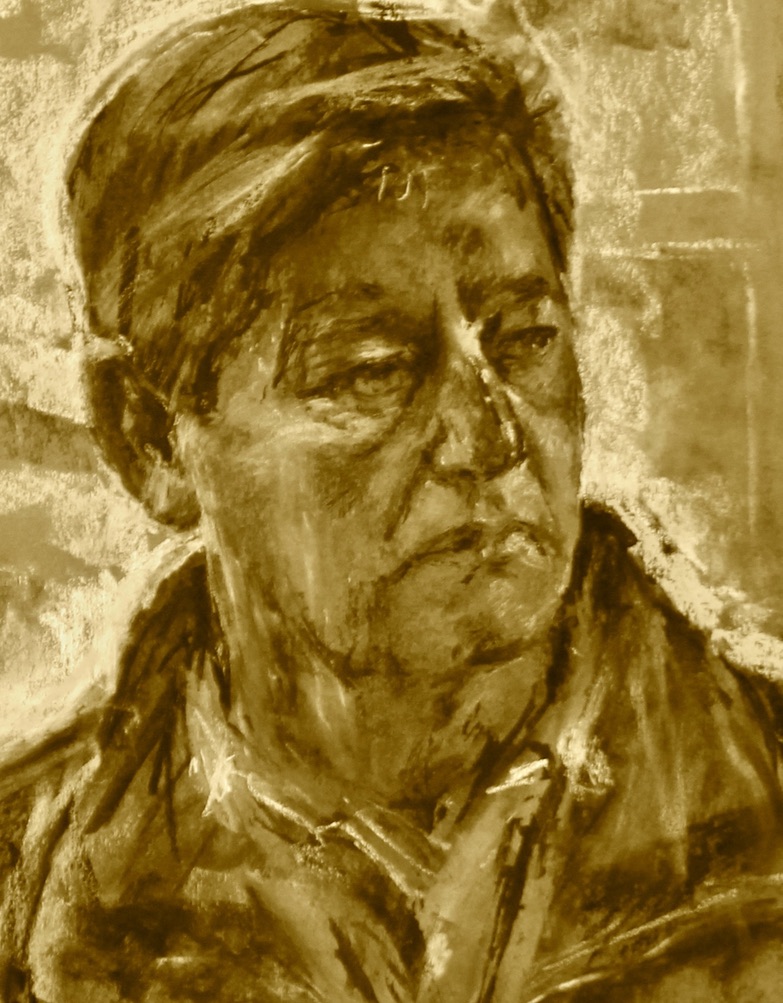
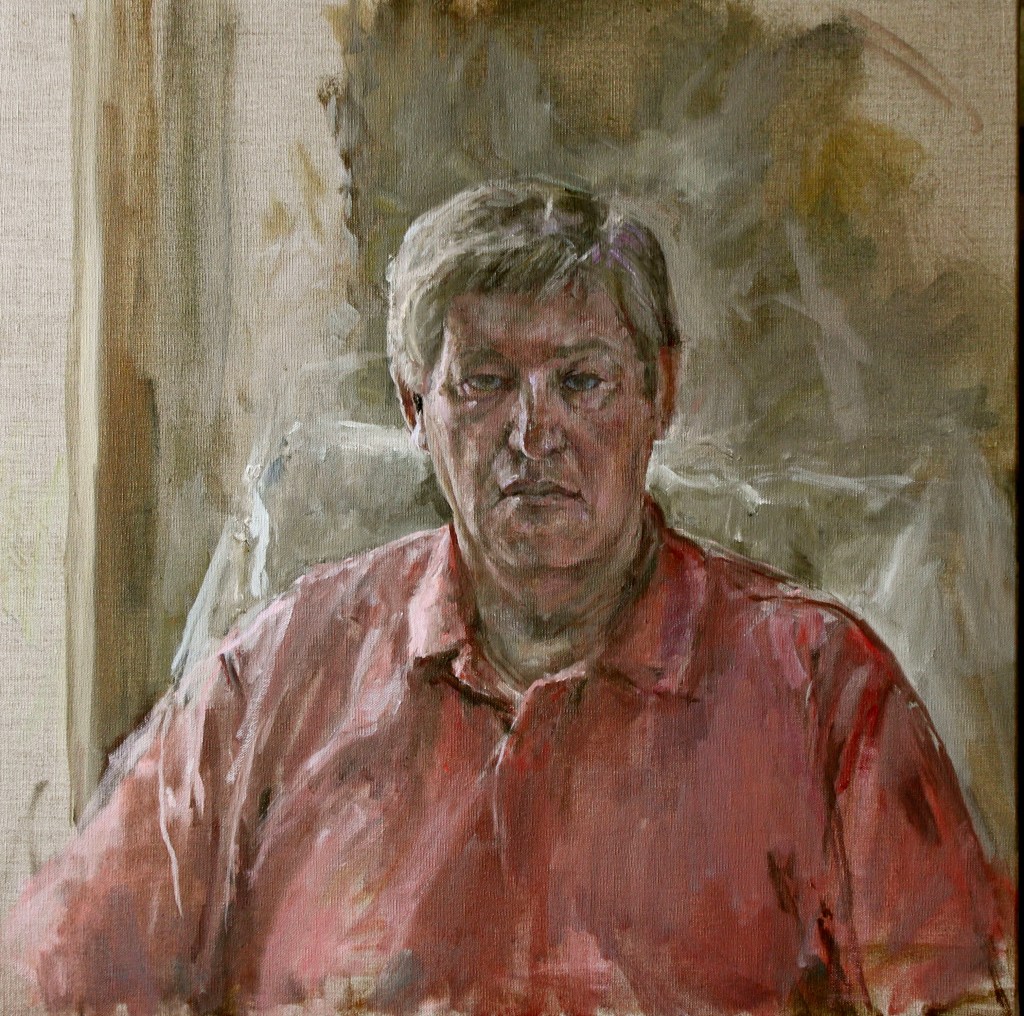
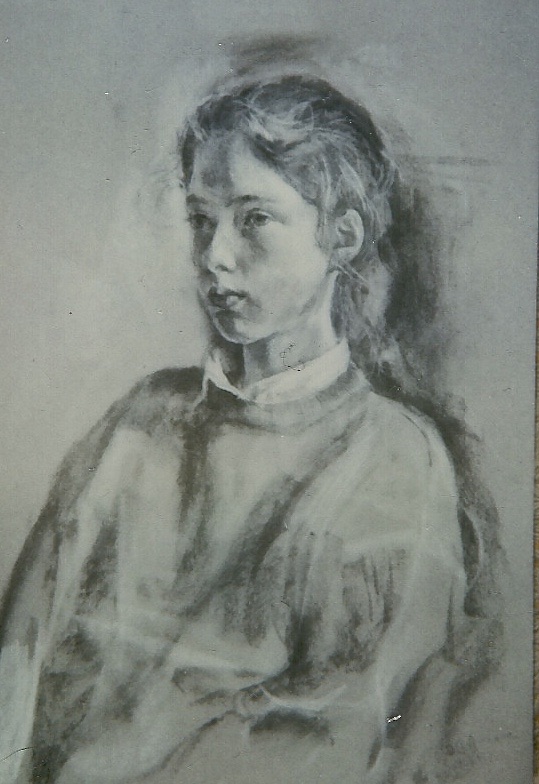
22) Below – commissioned drawings of children.
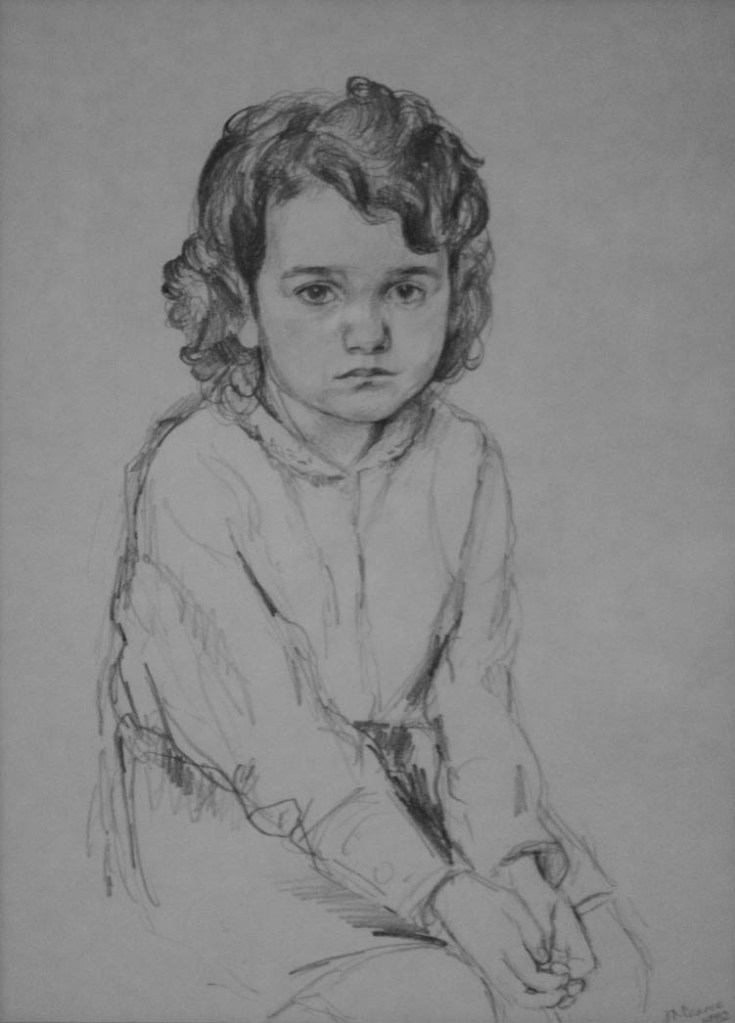
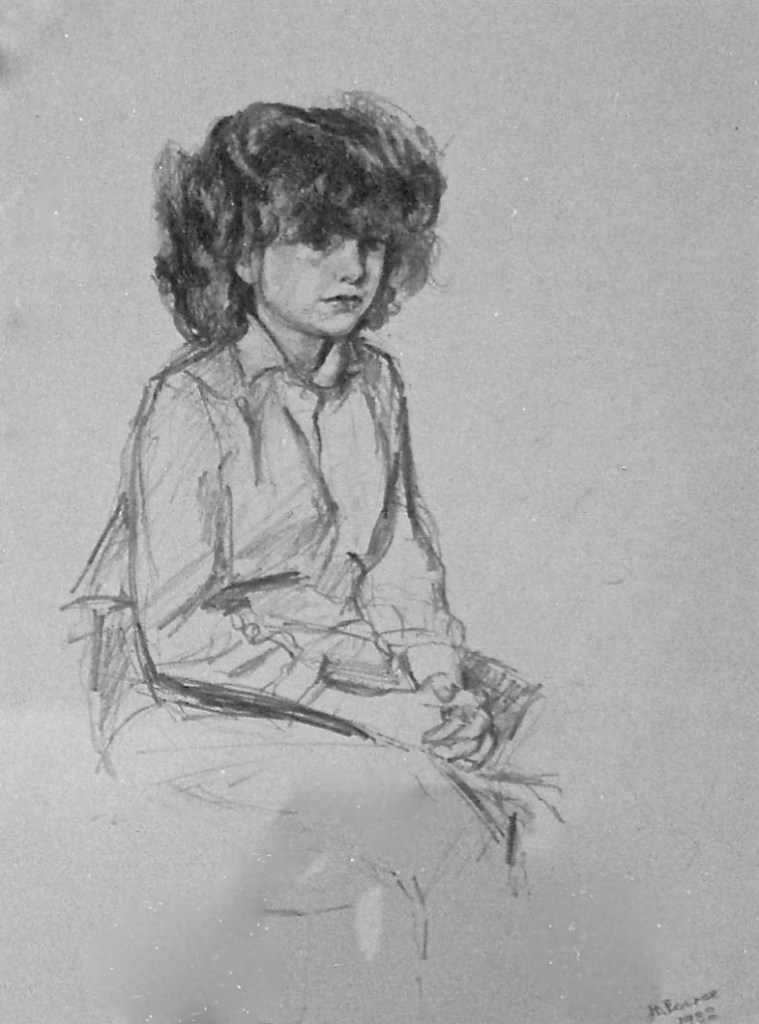
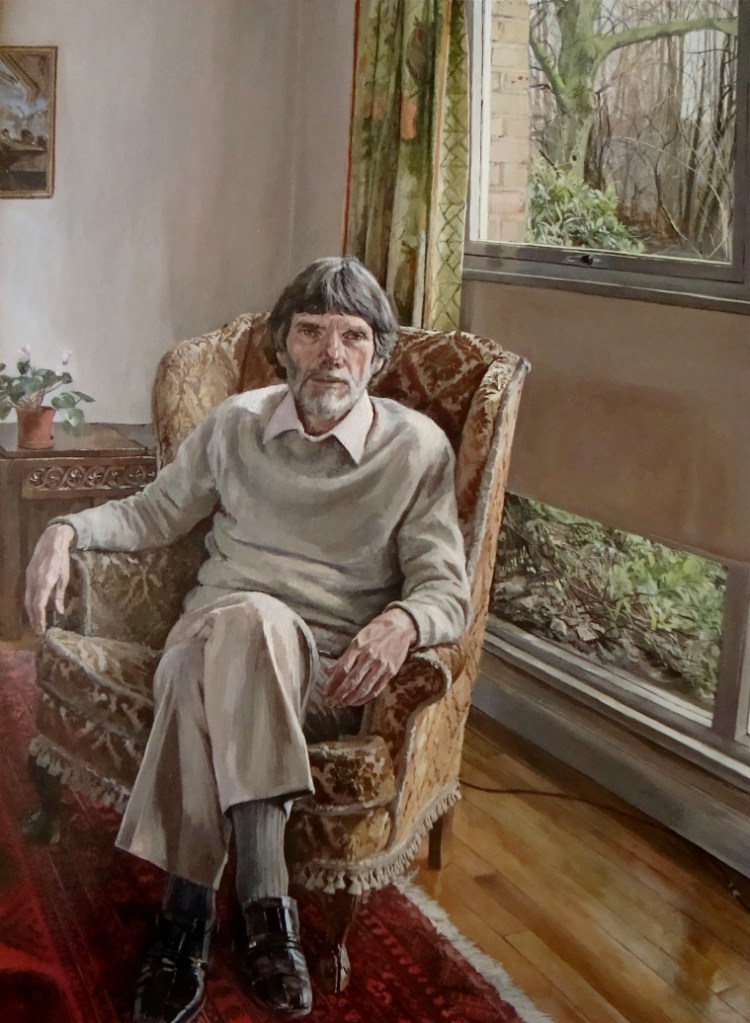
23) Below – the Australian spiritual teacher Barry Long, whose sessions on meditation and inner stillness I had attended – before deciding he could well be an ideal portrait subject! The view through the window is meant to imply an awakened consciousness on the earth’s surface. I entered the painting for a competition at the National Portrait Gallery. It was short-listed for the award and duly exhibited at the N.P.G..
You can find Barry online: https://www.youtube.com/@thebarrylongchannel
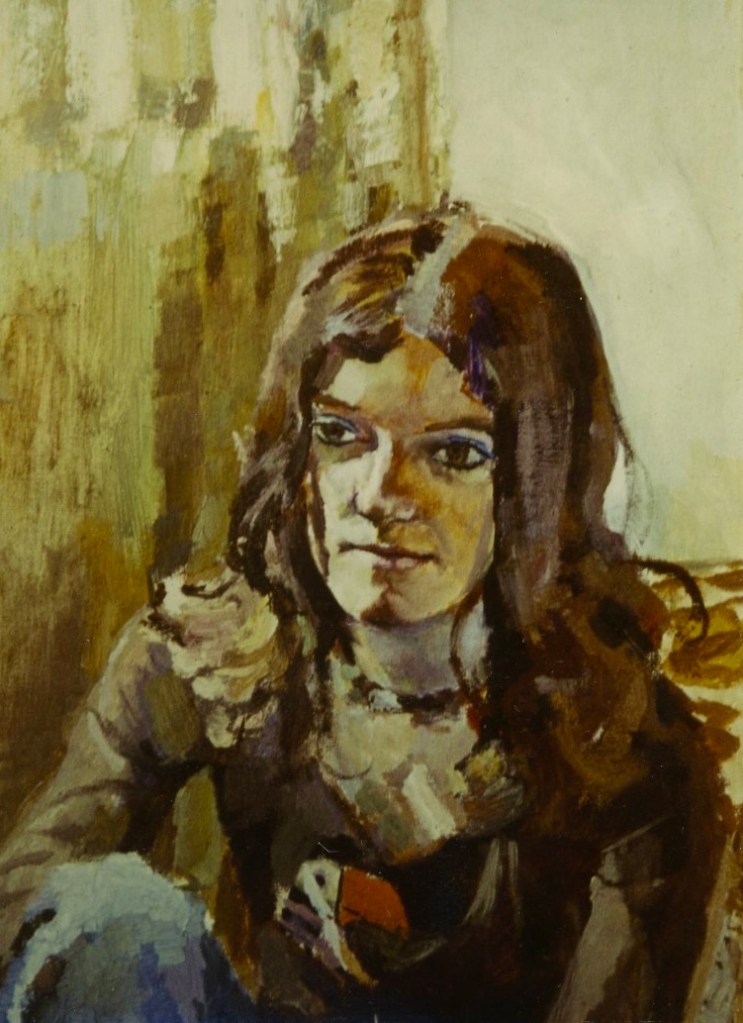
24) Above: Maureen – a lovely young lady whom I met in the context of Tony Potter’s Cabala group mentioned above.
25) Below, Don Chapman. I would suggest that the picture conveys something of Don’s redoubtable personality.
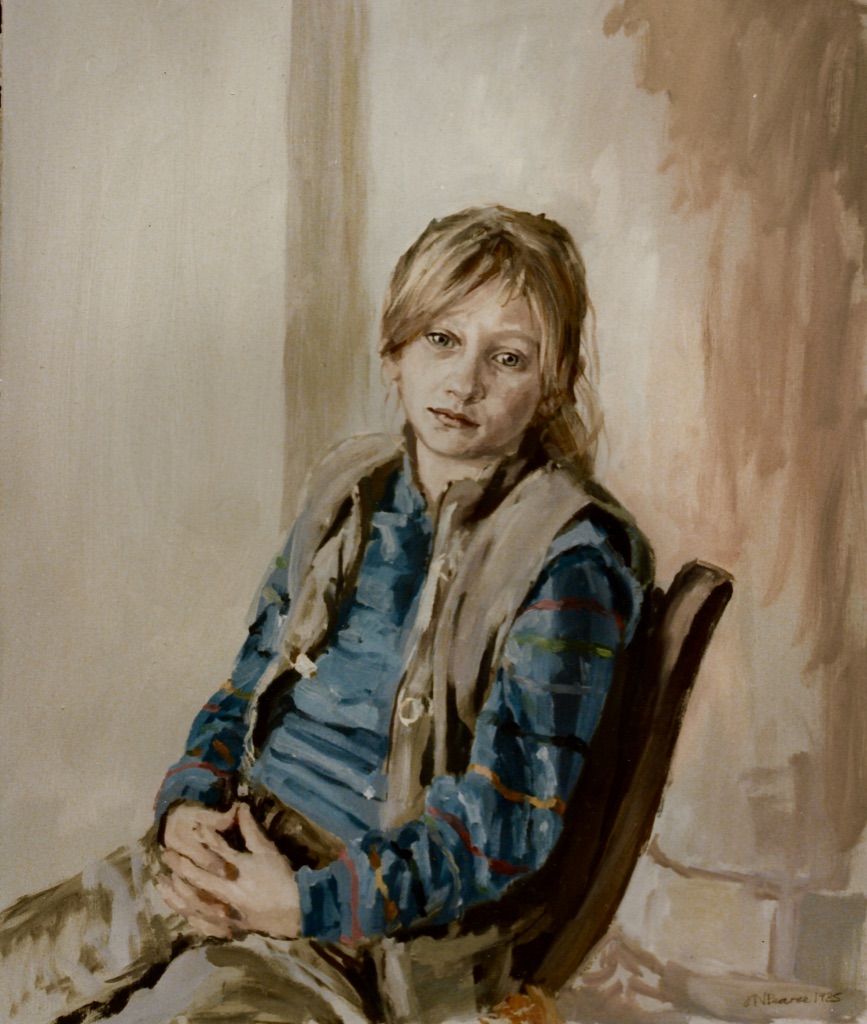
26) Above, a child portrait study, commissioned by a friend of Michael Dickens…
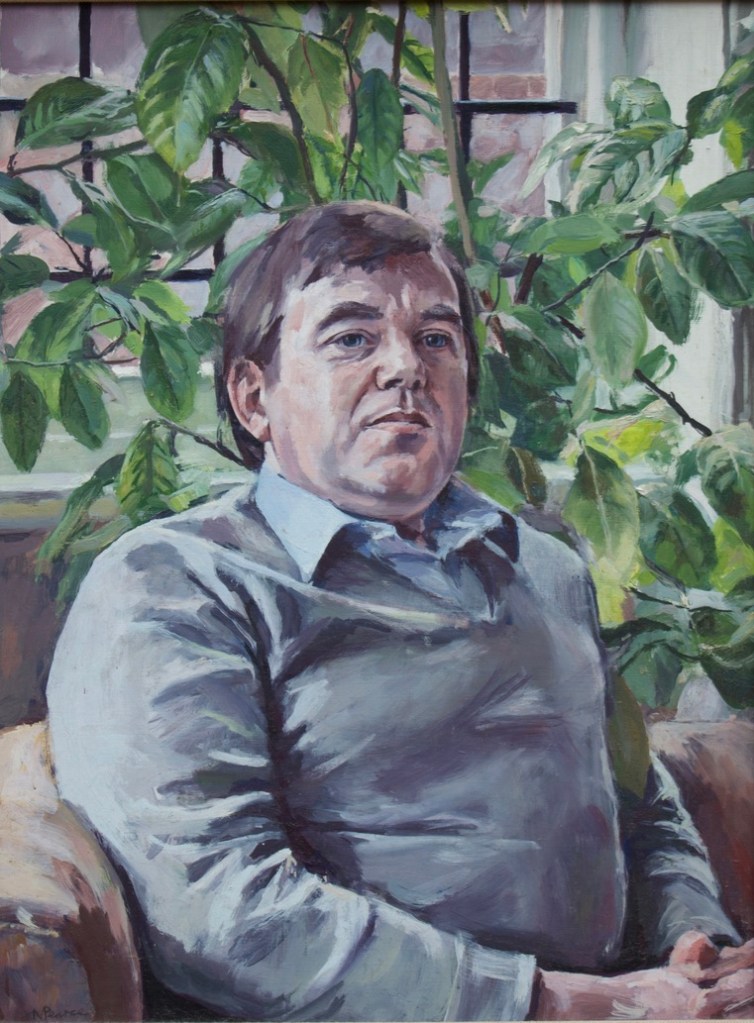
27) Above – Michael Dickens – a scientist turned art collector and dealer, who’s belief in my work helped me in so many ways: commissions, sales, new work-spaces, exhibitions…..
28) Below – Michael’s friend the actor David Bedard.
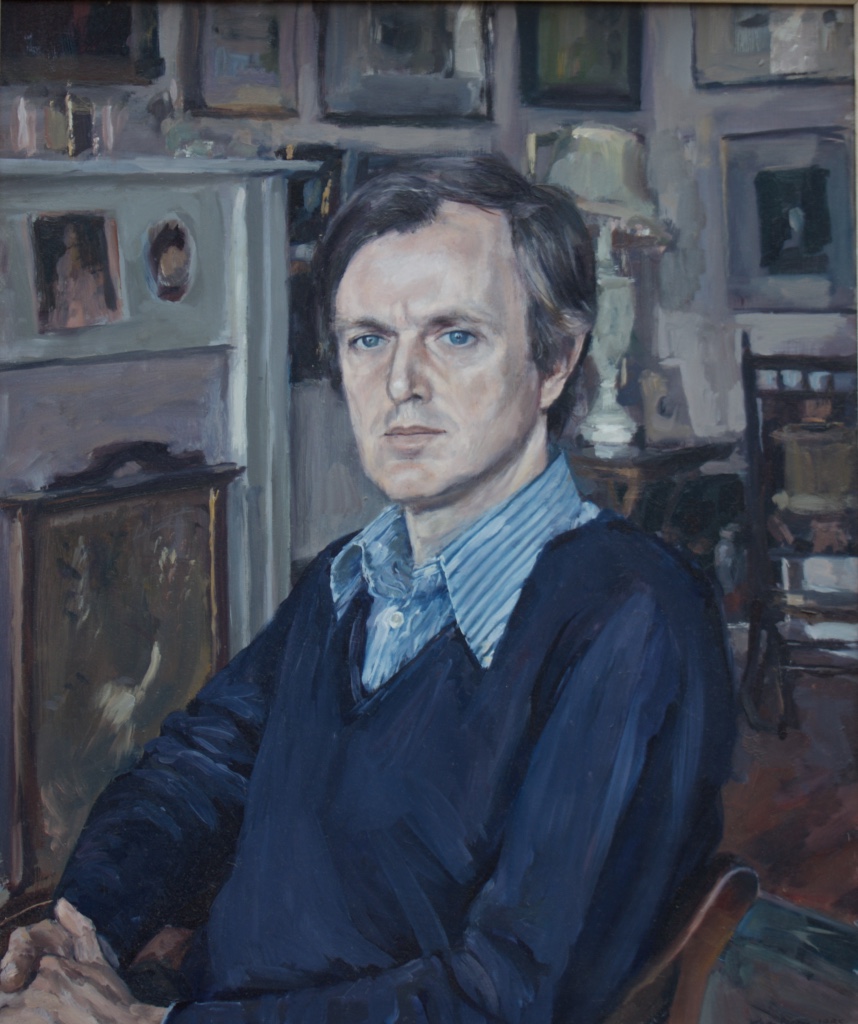
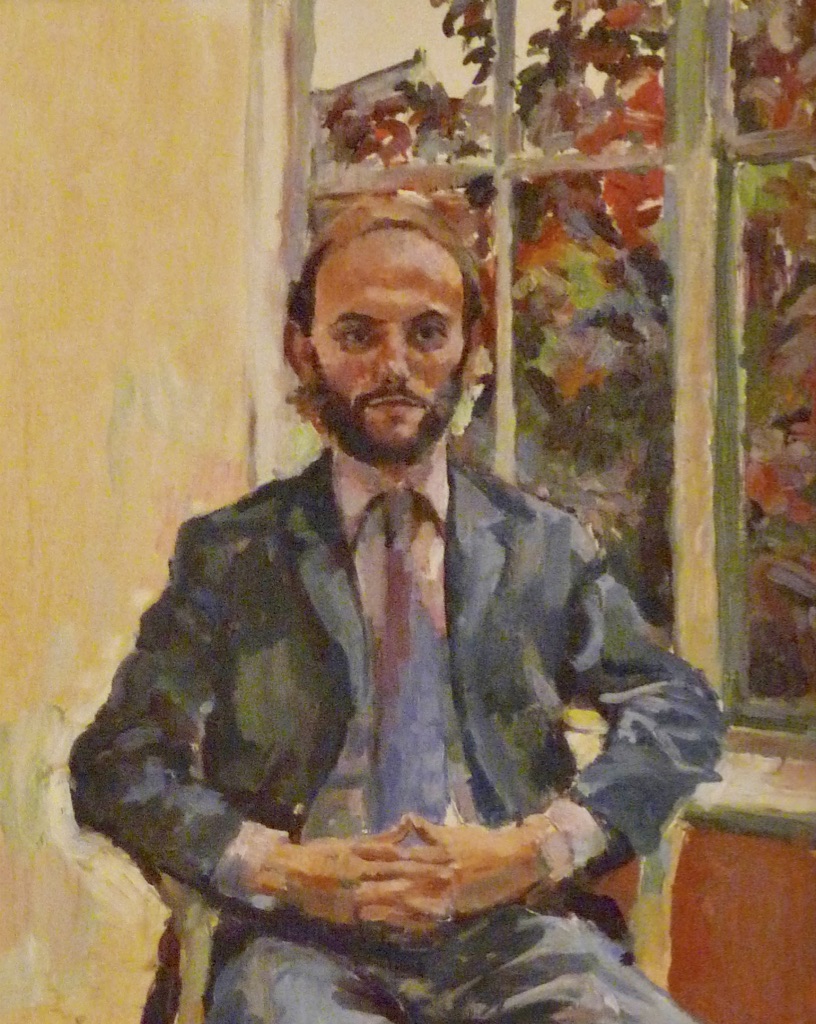
29) Alexander William McPherson – an old school friend.
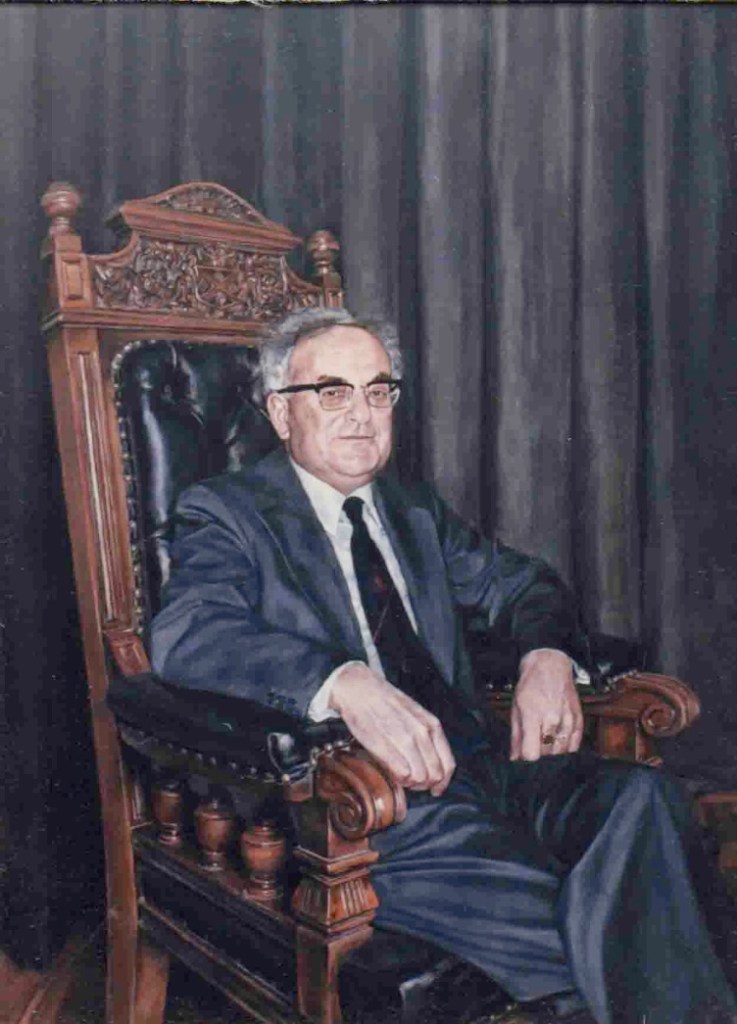
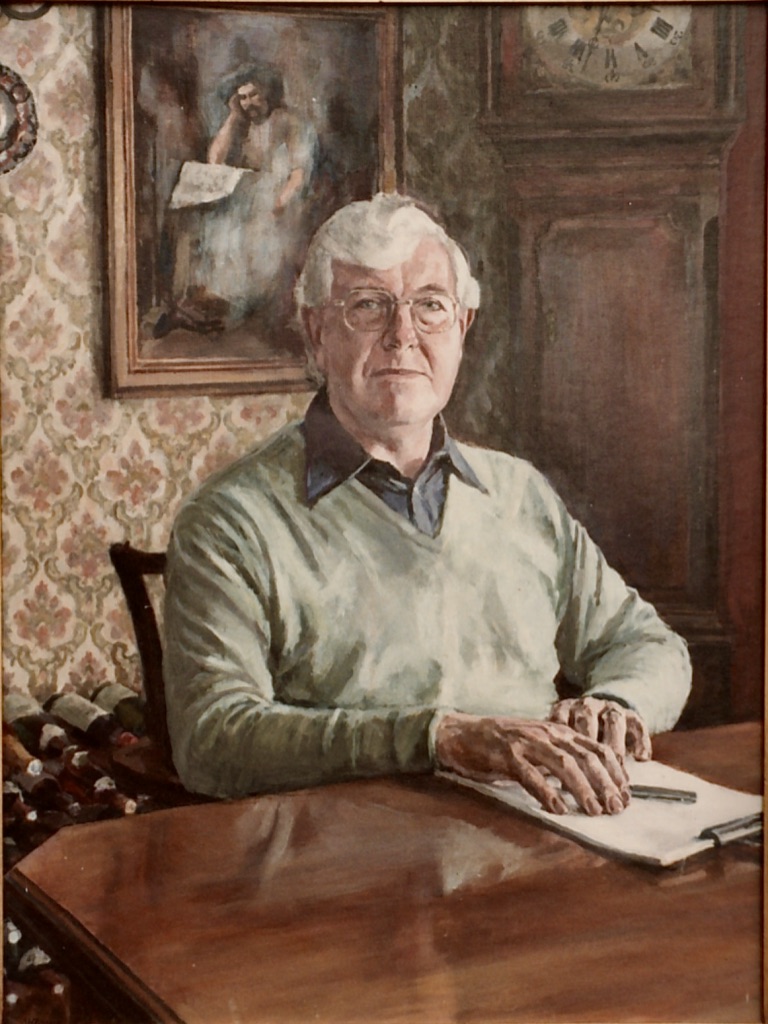
30) Above – Another of my few commissioned portraits: Anthony Jones, Captain of Parmiter’s School (1936–1938), Chairman of the Old Parmiterians’ Society (1955–1956), Vice President of the Old Parmiterians’ Society (1968–1984) and Chairman of the Old Parmiter’s Foundation (1982–1984)
The work is cited and duly attributed (a ‘splendid portrait’…’by John Pearce’) in The History of Parmiter’s Foundation by M. J. Fletcher M. A. Cantab, published in 1987. Elsewhere in Parmiters’ published articles it has been referred to as ‘artist unknown‘. One might have expected an educational institution to be a little more self-aware! After all, how could an artist they themselves had commissioned be unknown to them?
Sadly, Anthony Jones (‘Tony’, as he was remembered) passed away before I was actually able to meet him. Even so, I felt I should and could fulfil the commission. I borrowed items pertaining to his position at Parmiter’s School – such as the ring and ceremonial chair – as well as some snapshots. I also got various of my friends – suitably attired – to sit in his place. At its unveiling I felt the work was well received, not least by Tony’s wife and daughter – for whom the occasion may well have been poignant.
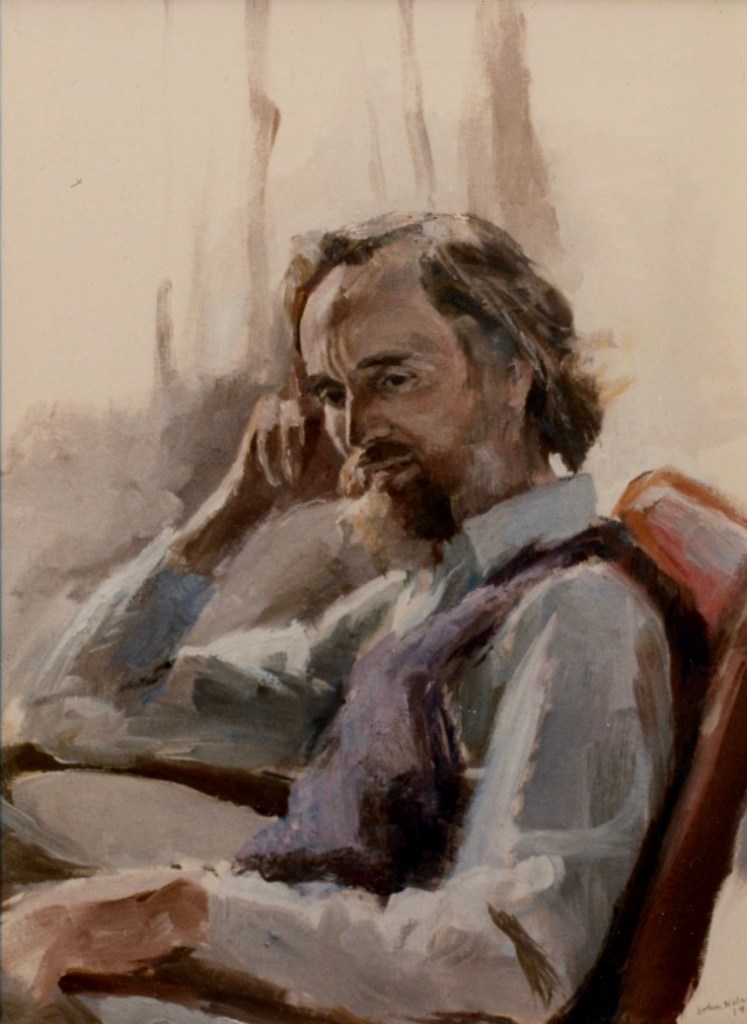
31) Above, the actor James Chalton.
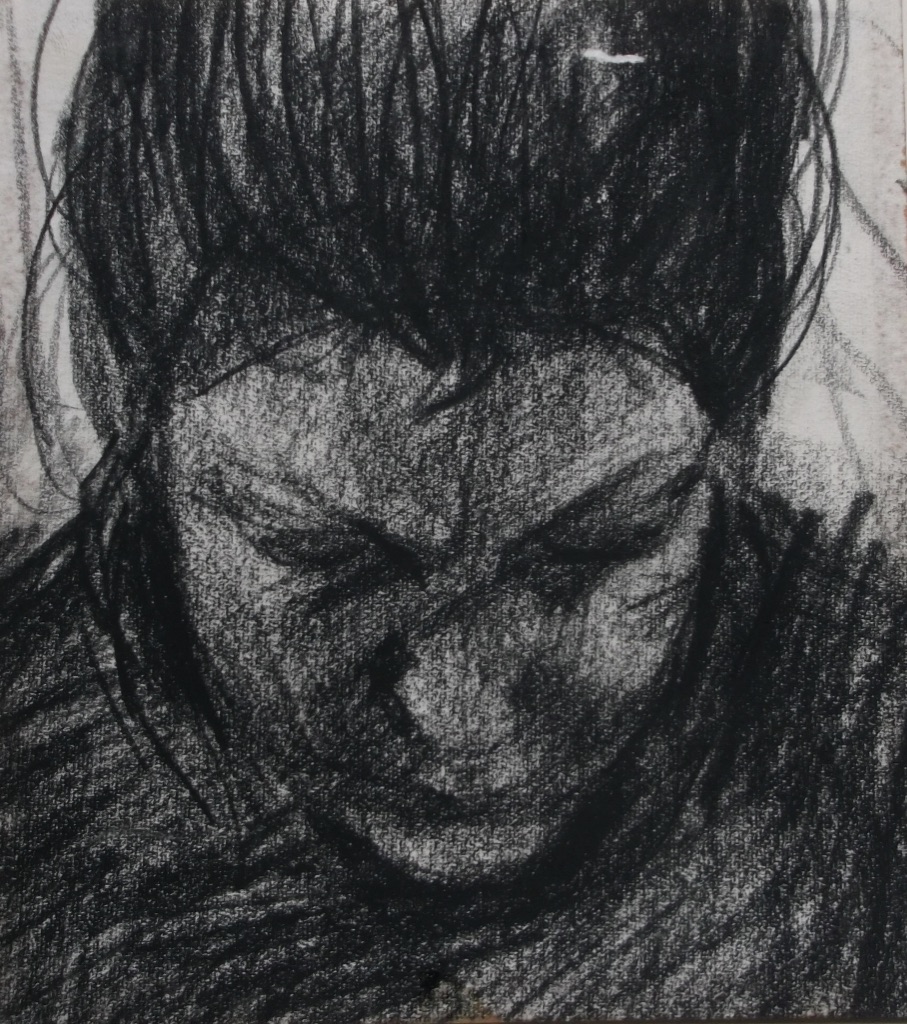
32) Below, four studies of my wife Christina…
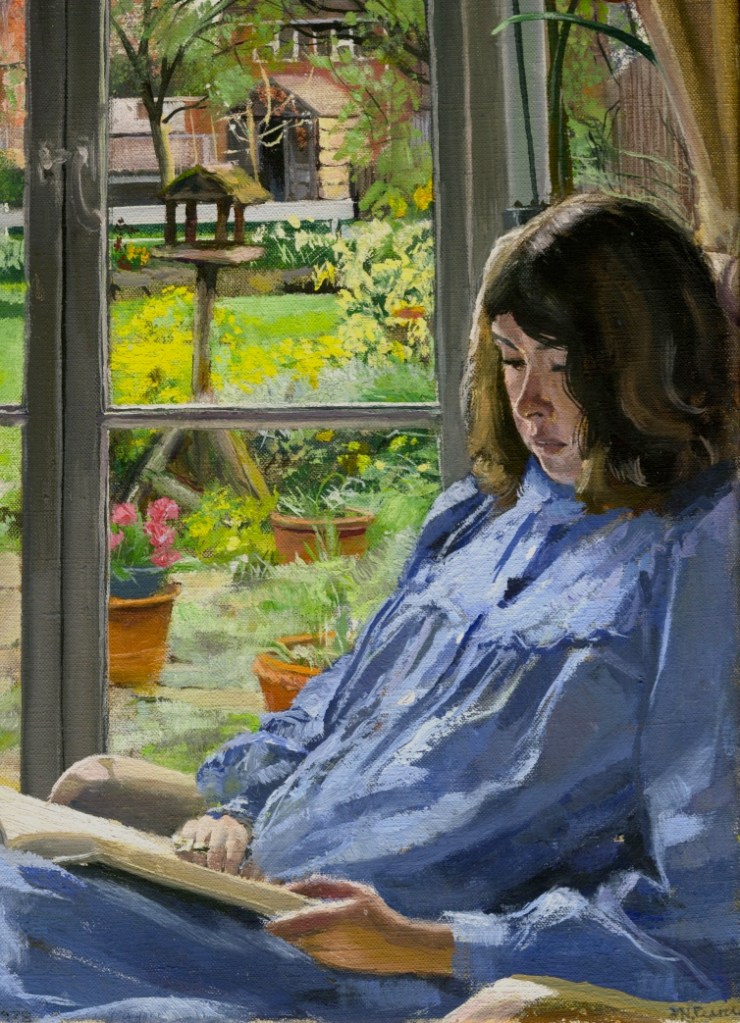
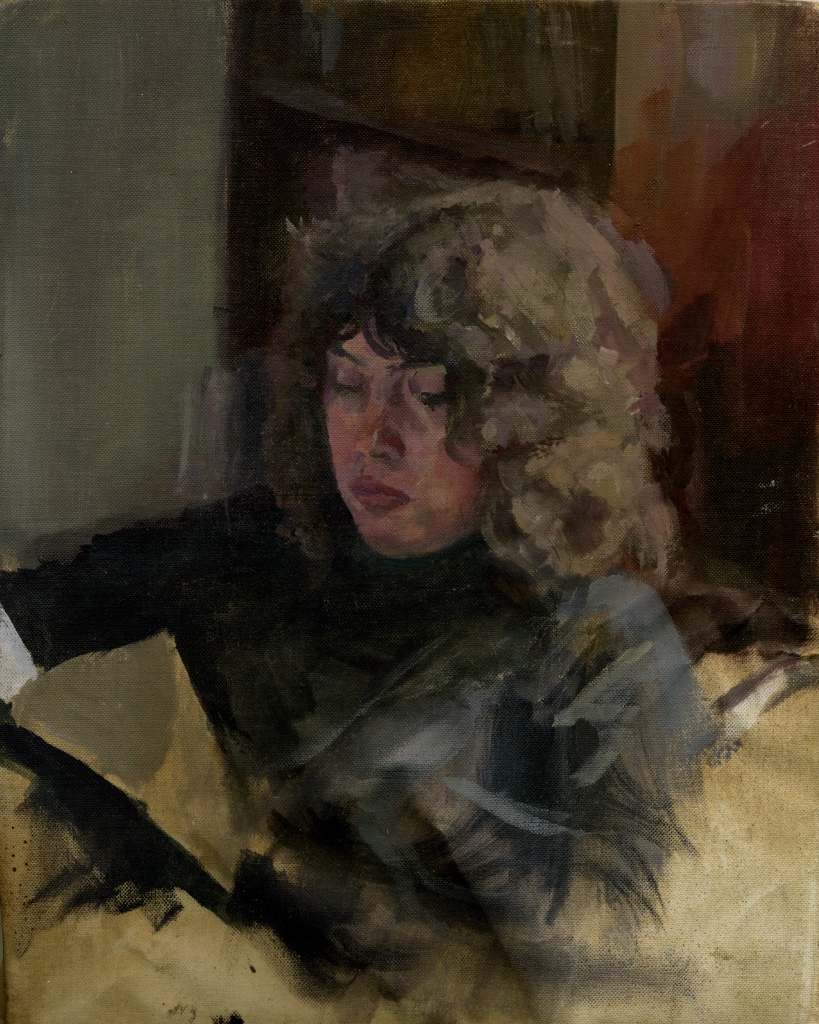
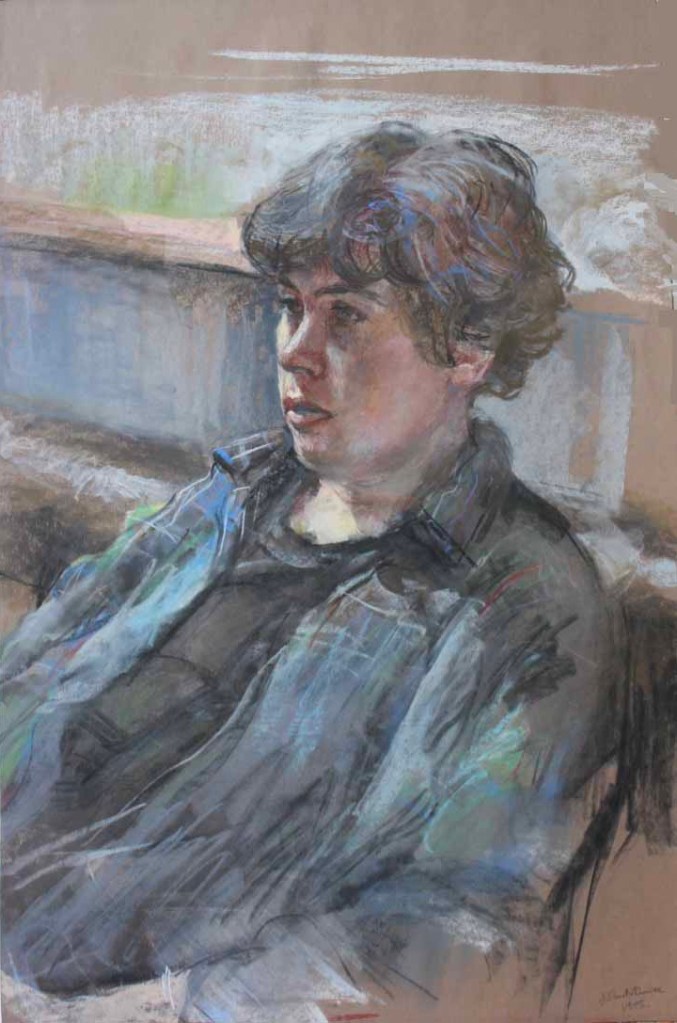
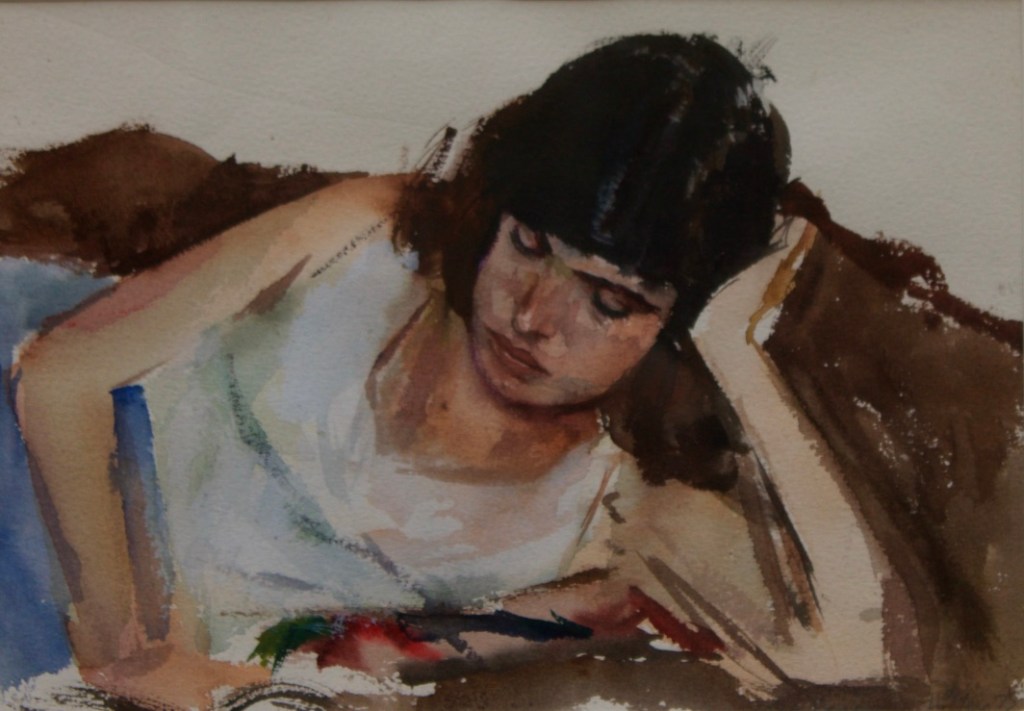
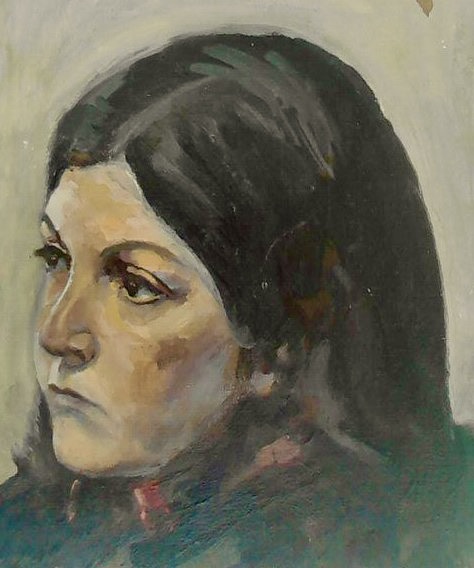
33) Below, my painting and two drawings of another old friend,
the wonderful Beryl Ann Williams
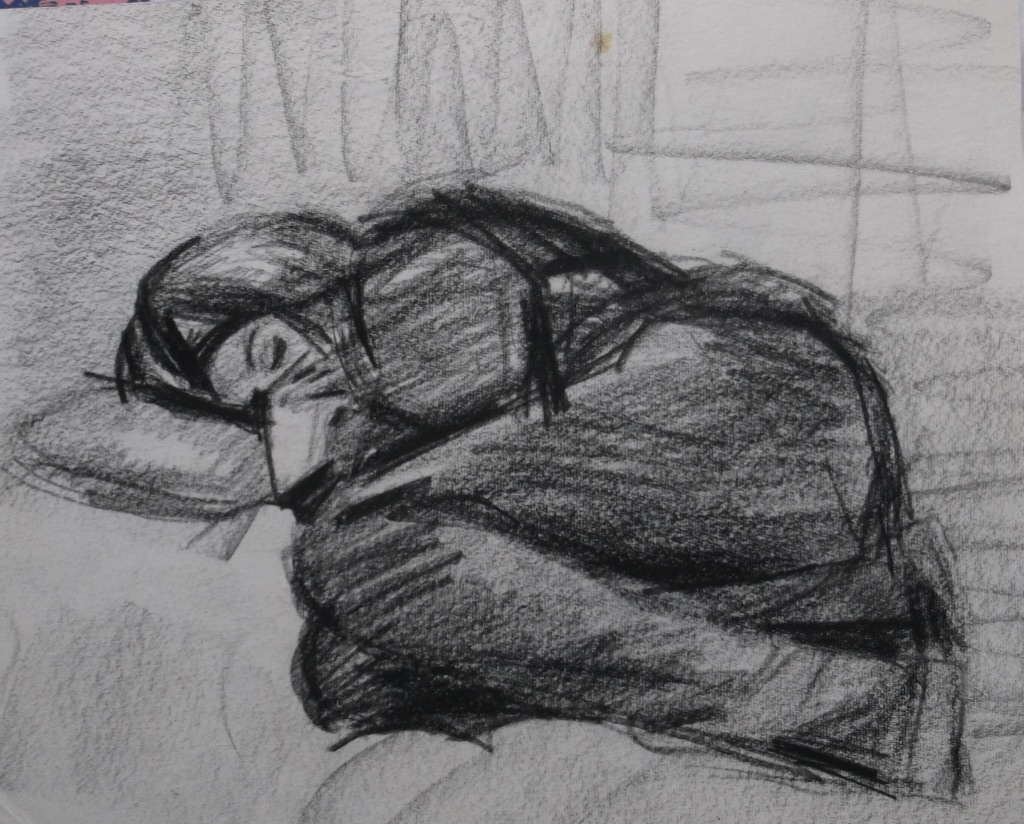
34) Below – a commissioned study…
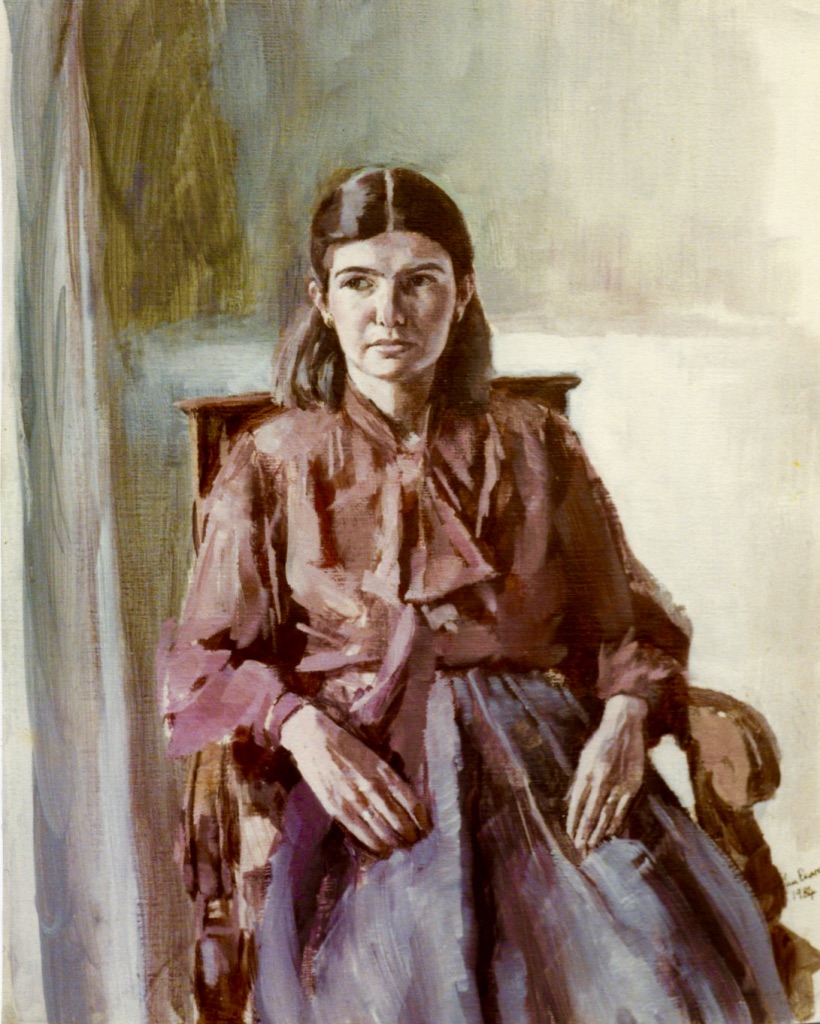
In each of the two paintings below the sitter is seen in a significant context: 34) Jane Wildgoose reclines in a corner of ‘The Wildgoose Memorial Library’ – her home in Crouch End, North London, where she has developed a collection pertaining to the world’s traditions of mortality and remembrance.
(9th Feb 2025 – I am still working on the Jane Wildgoose canvas, being convinced that the illustrated condition will not do….!)
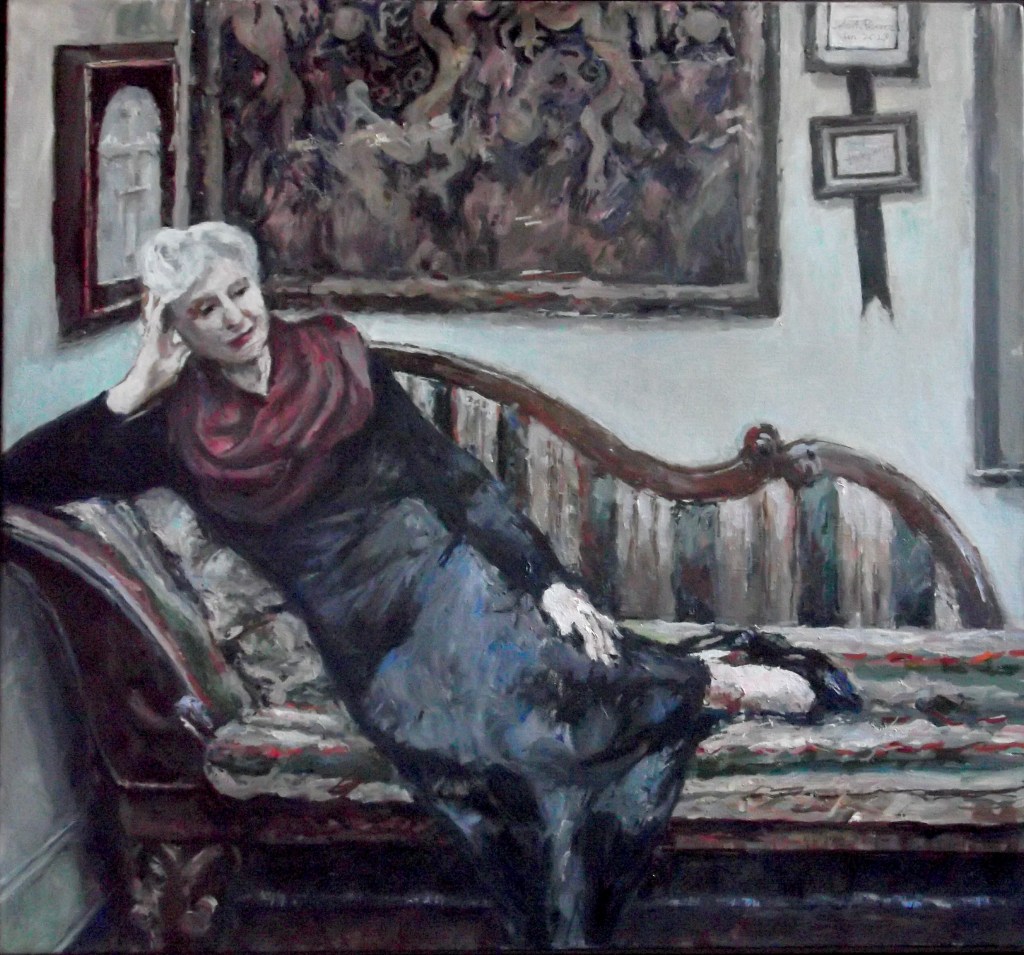
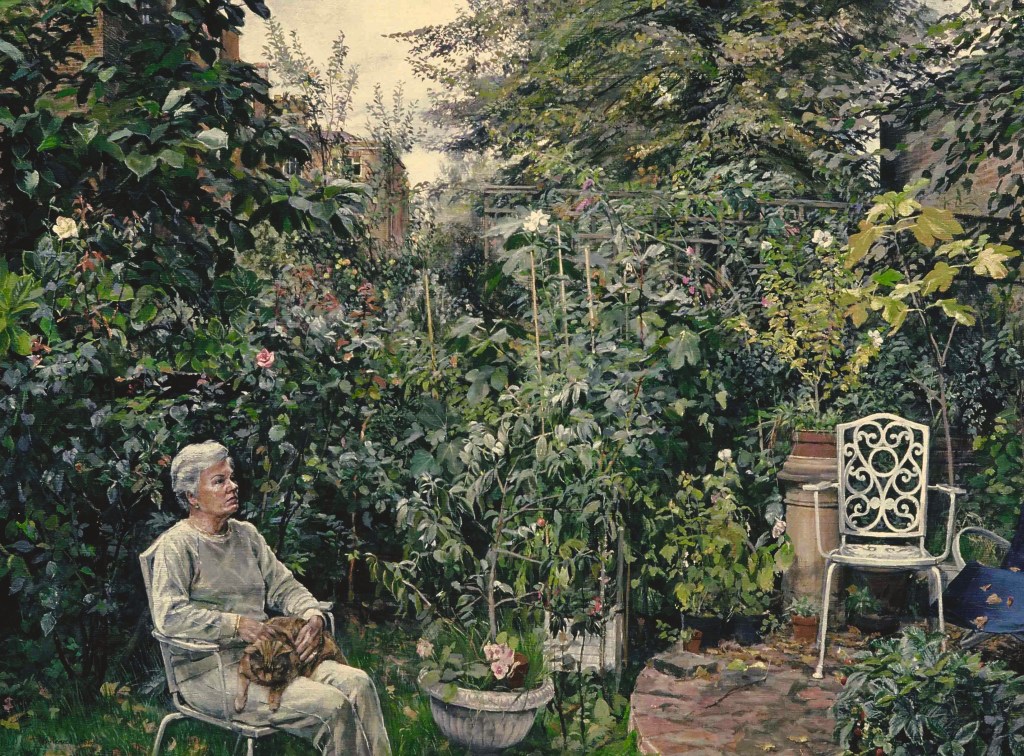
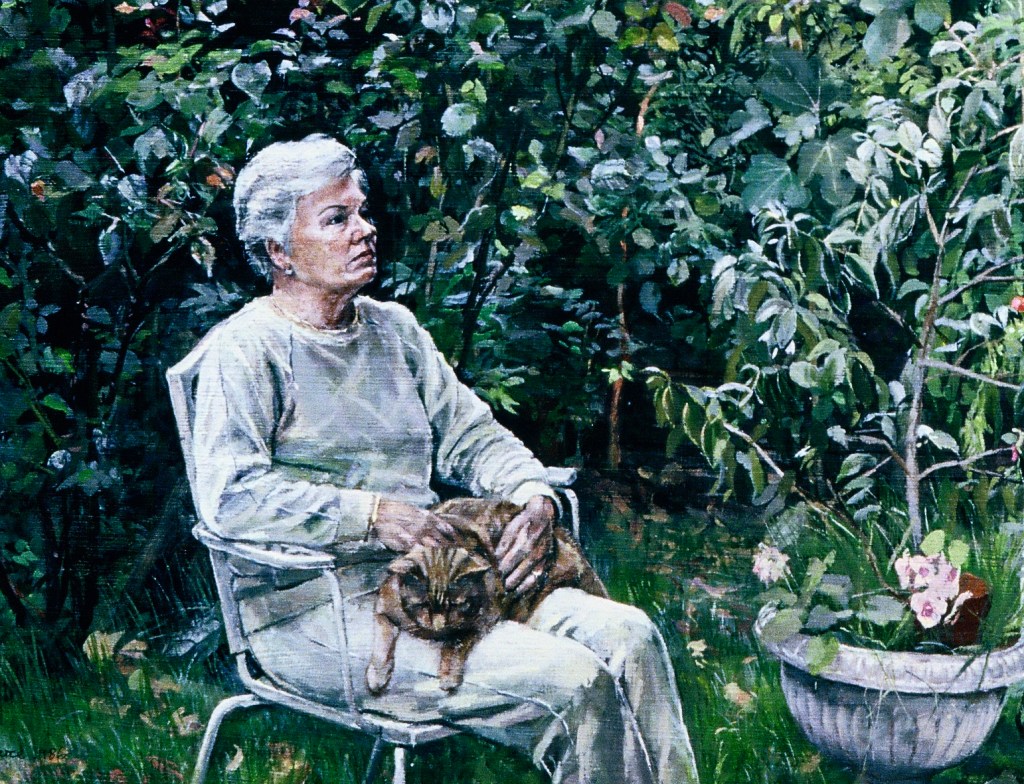
35) The picture above entitled ‘Joan in The Garden’ depicts Joan Foa, a former friend of the painter Michael Ayrton, and the subject of his 1945 picture ‘Joan in The Field’. Michael Dickens, who had met Joan, arranged that I paint ‘Joan in The Garden’ – her own garden at Holland Park – implying reference to, and perhaps comparison with, the earlier Ayrton picture.
A cat appears in both paintings – in Ayrton’s it’s a tiny kitten. It seems Ayrton and Joan shared an almost fanatical regard for cats!
https://www.independent.co.uk/news/people/obituary-joan-foa-1381086.html
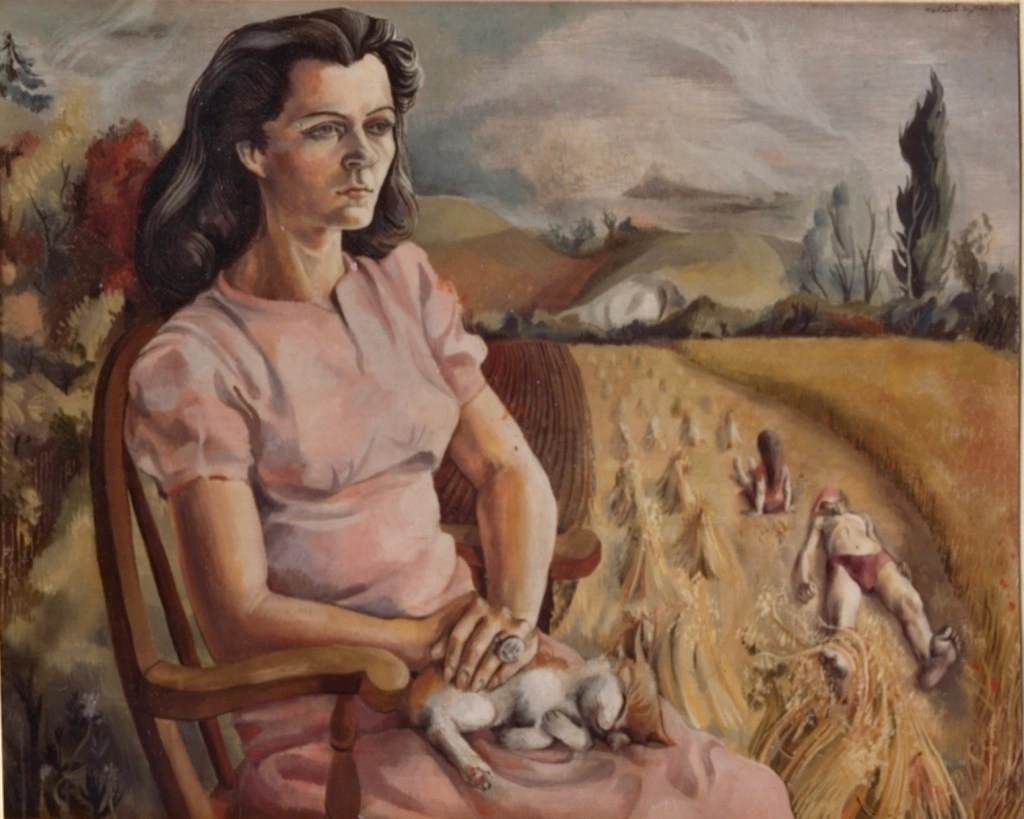
Joan and I of course conversed – one could hardly ignore the works of art around her apartment, including one or two of Ayrton’s small, intensely powerful bronze Minotaurs holding their own amid the clutter of a window sill. Also a painting of John Minton (I’m not sure by whom – possibly Ayrton himself?). As with other portraits of Minton, it made him look somewhat downcast, and it seems from his biographies that he was indeed rather a troubled soul. Nevertheless Joan strongly objected: according to her, Minton was always ‘great fun’!!
Michael Ayrton had a half-sceptical flirtation with the occult. He once met his contemporary Aleister Crowley and was neither impressed nor very convinced. Joan may have taken Crowley more seriously – having become aware of my own harmless occult interests, she opined that the self-styled Great Beast’s magic was, by contrast, ‘very black’.
36) Below – as a teacher in Tottenham I sometimes drew my pupils during break-times. My drawings were the basis of my first one-man show, held in the gallery at Hornsey Library.
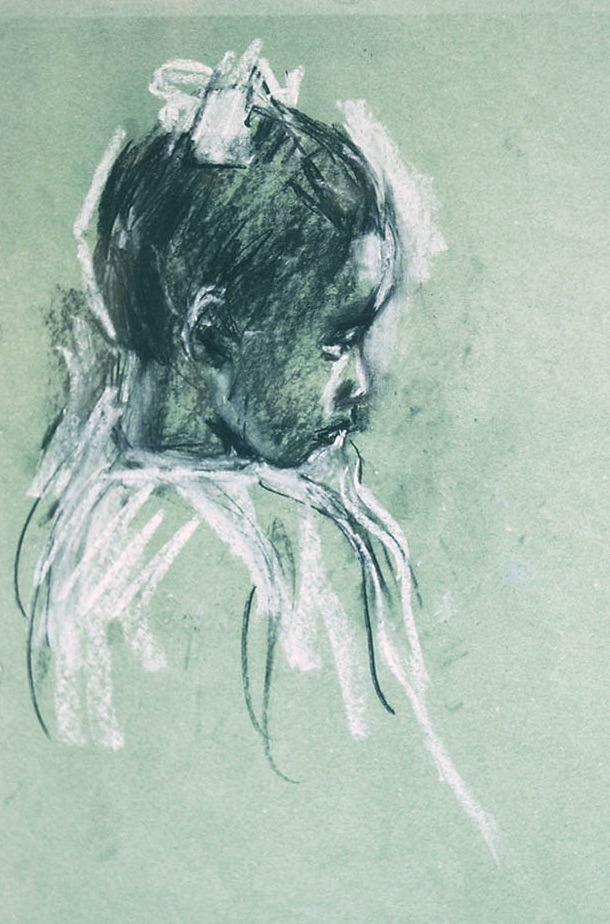
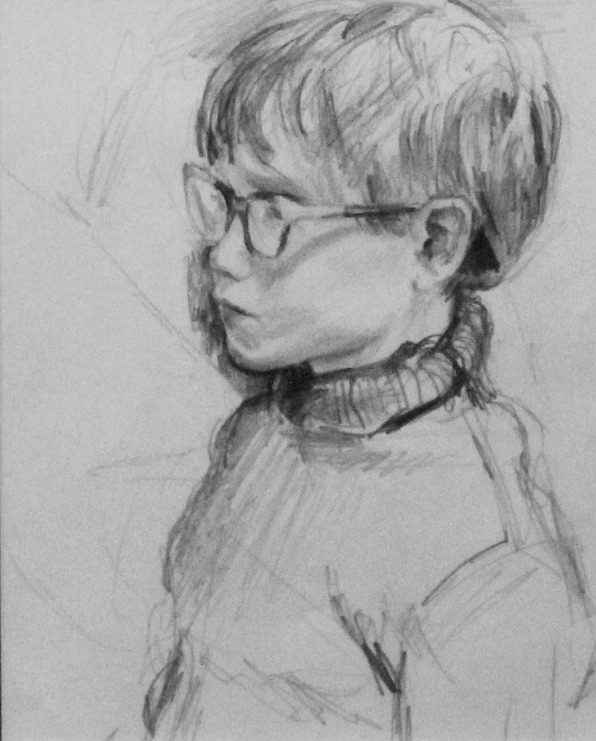
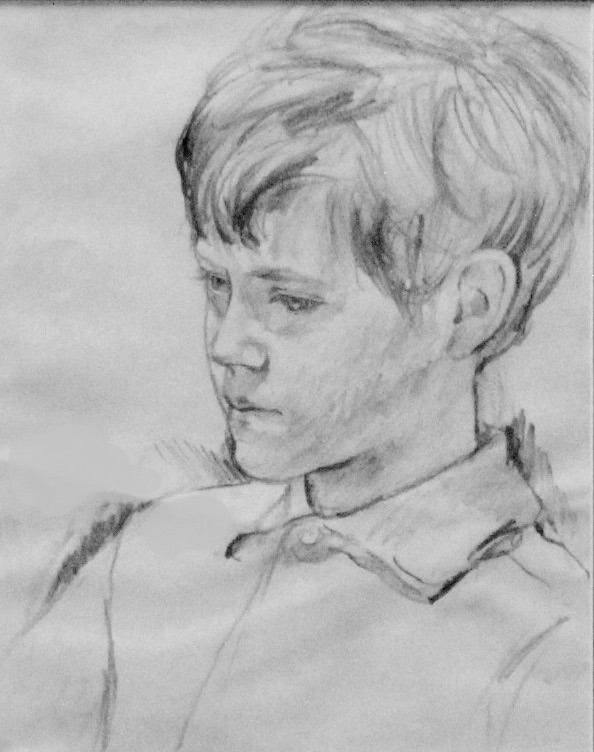
37) Below – Jamie Broadbent.
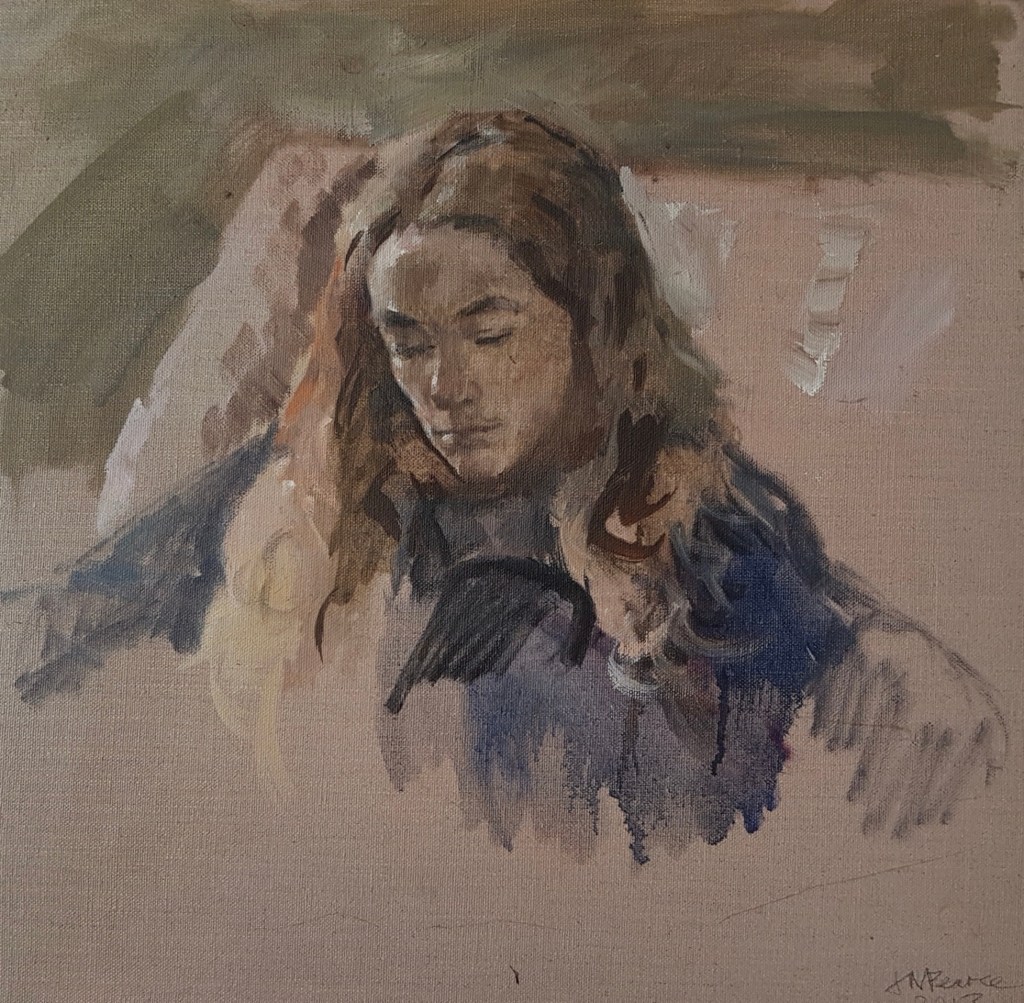
38) Over the years, Susan Herivel has permitted me to use a room in her house as a studio, and some of her other tenants have sat for me. Barbara (below) was one such. She also was – and perhaps still is – an animal rights activist. At the time of painting she had recently served a short prison sentence.
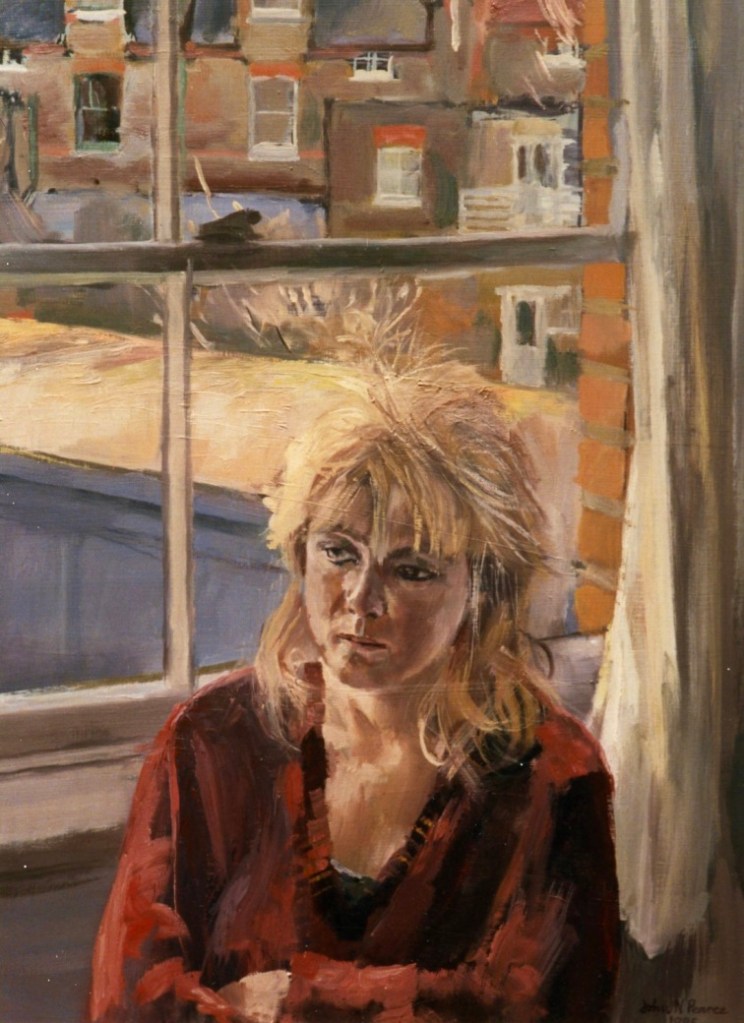
39) Leslie, a young American pictured below, was another of Susan’s tenants.
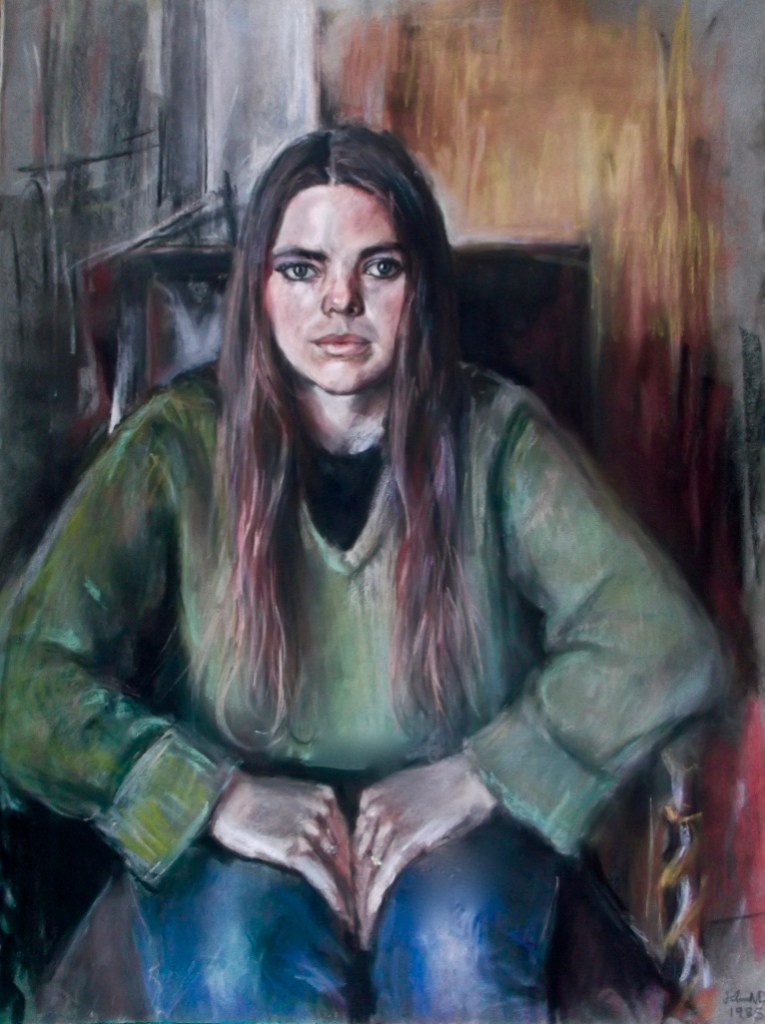
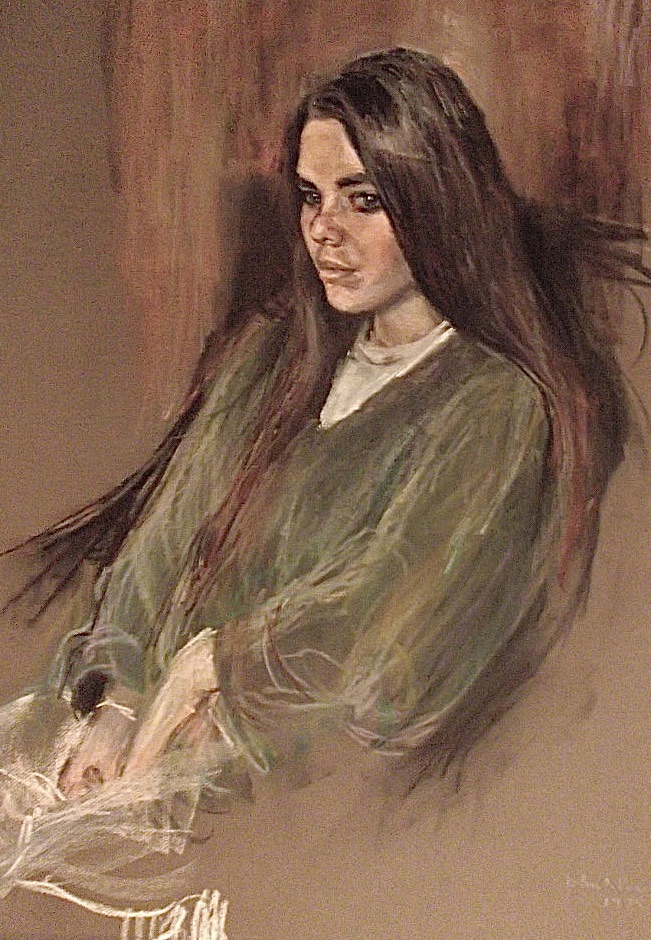
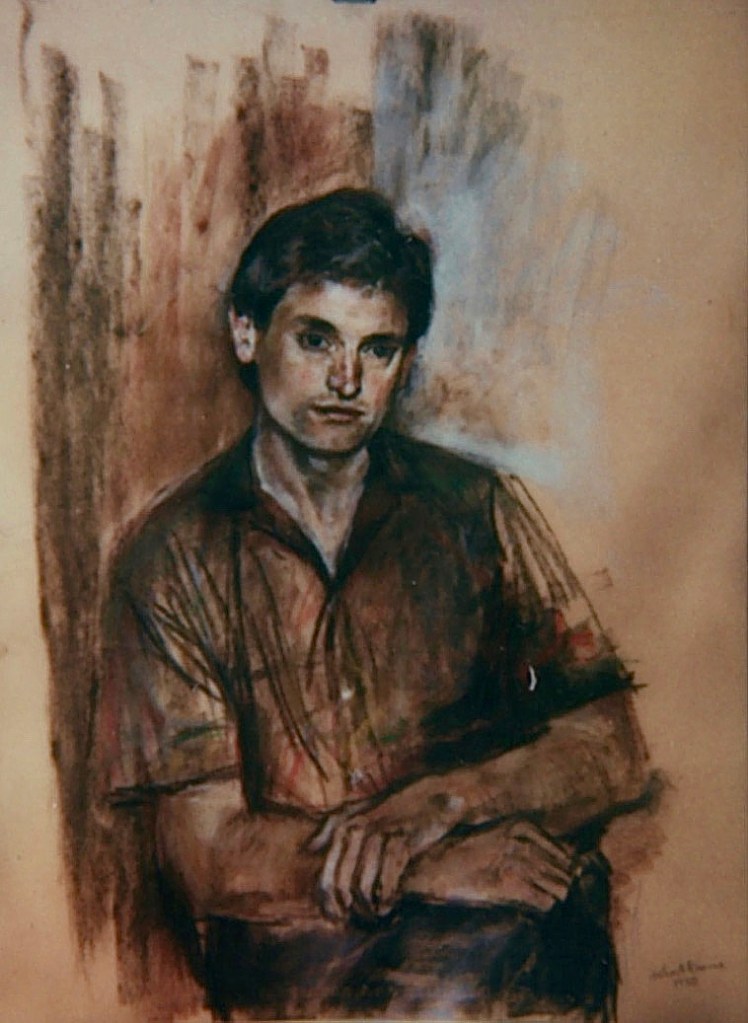
40) Above, Michael – at the time another of Susan’s tenants.
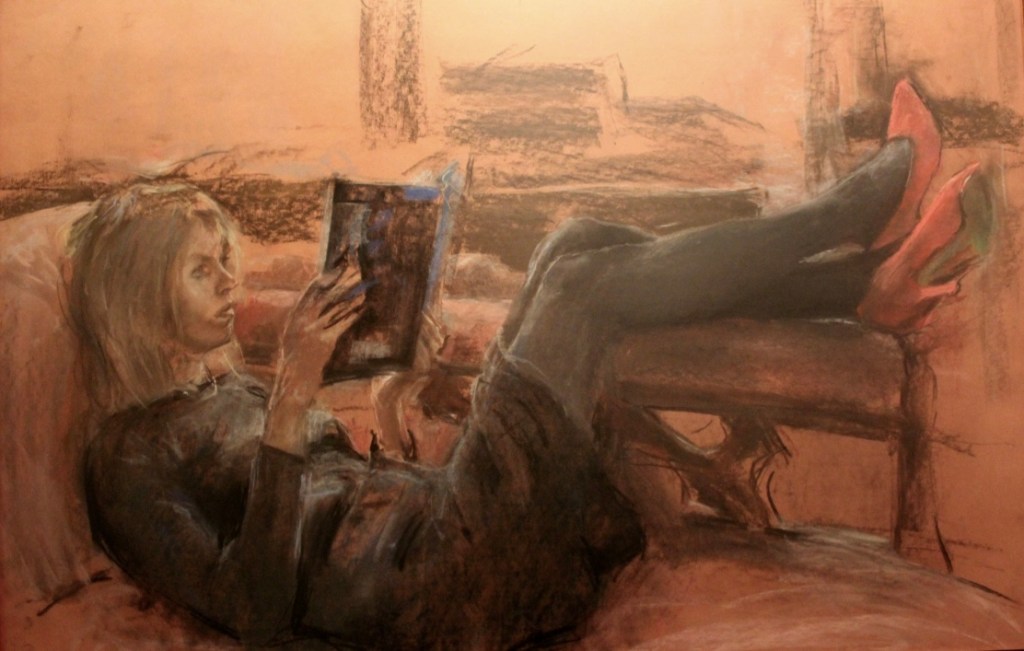
41) Below – ‘Red Shoes’ – a pastel/charcoal study of the writer Susan Jeffries.
42) Below: Two studies of my cousin Loraine Blaxter – a rapid watercolour, and a pencil drawing of her sitting on our conservatory steps.
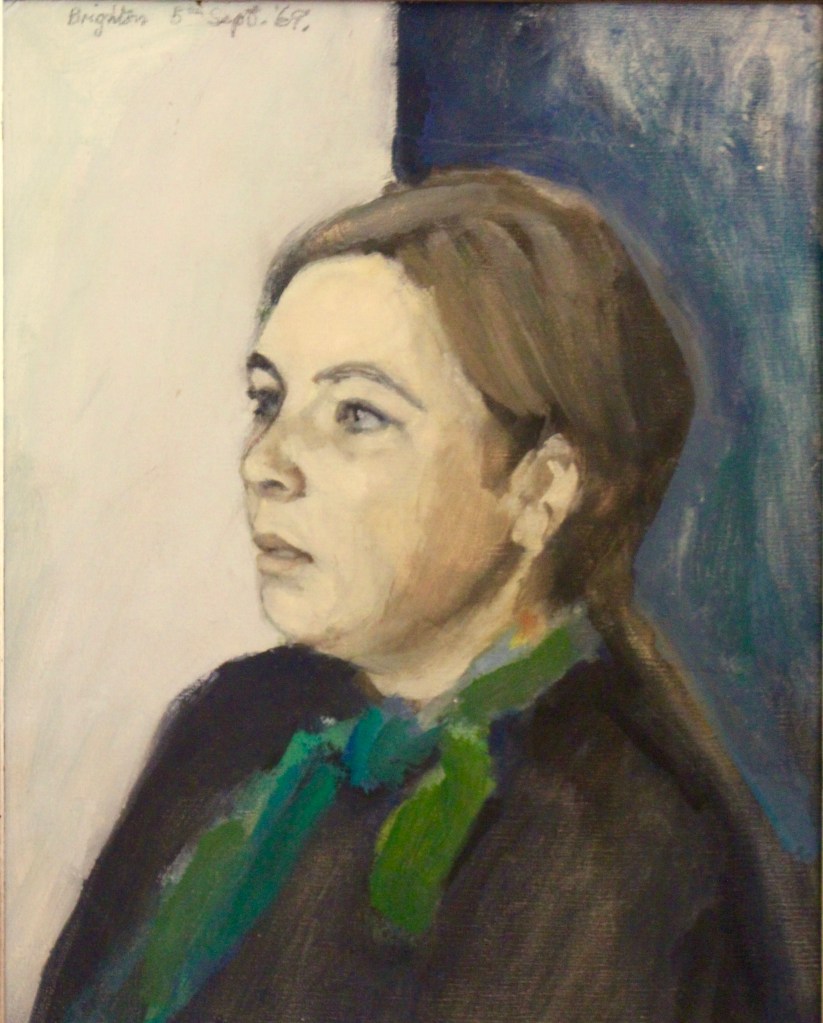
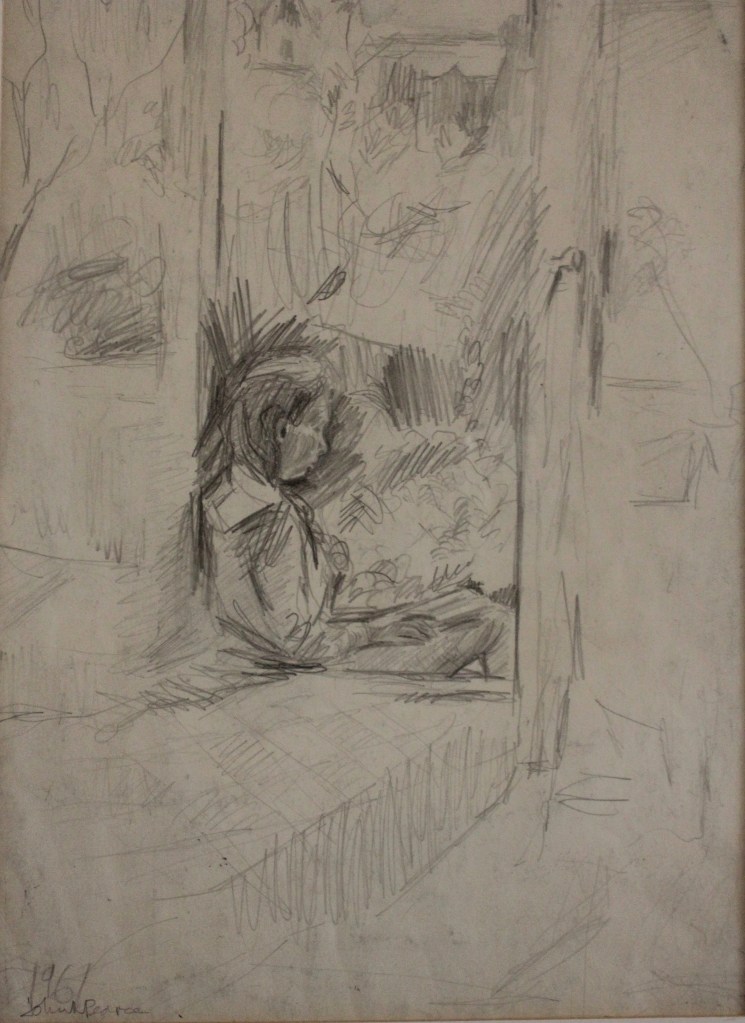
43) Below – Meg Fabian-Peacock (Margaret Gellay) an important schoolfriend of my sister.
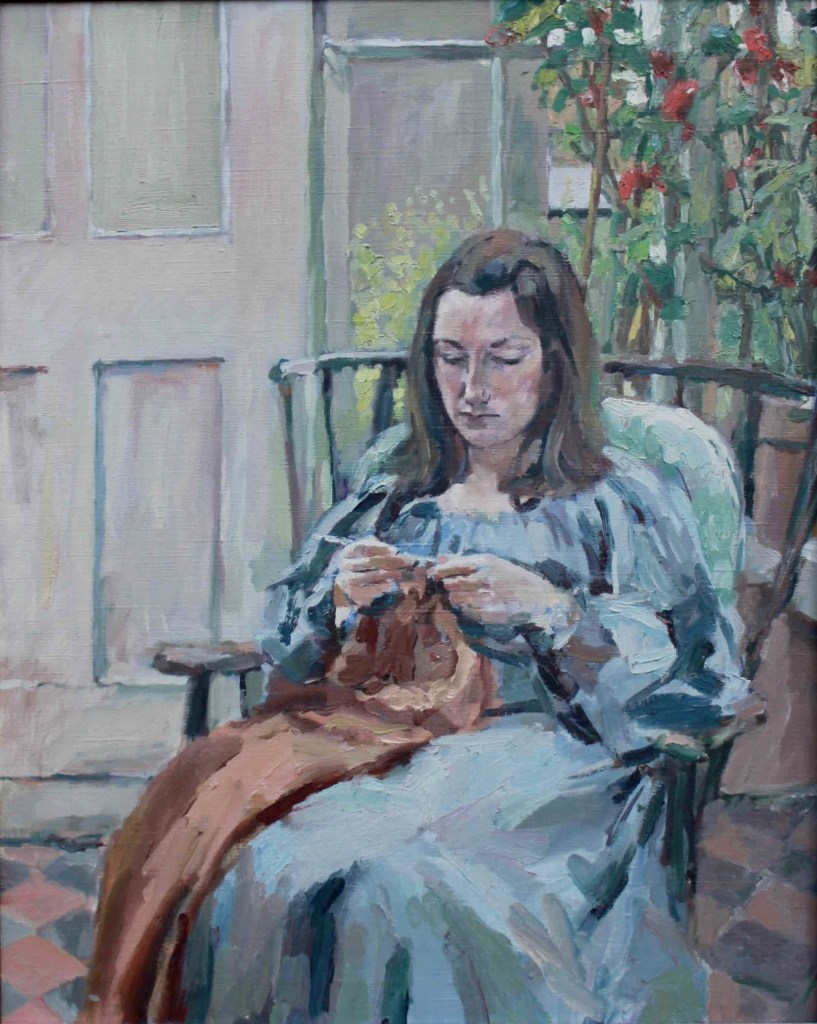
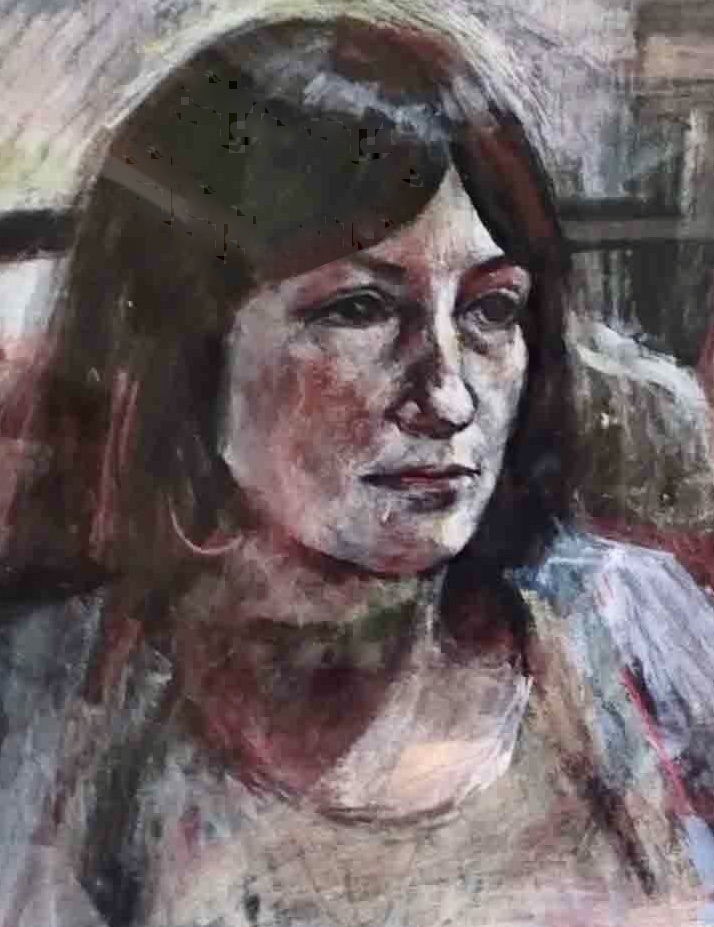
44) Below – a drawing and a pastel sketch of a gifted friend and colleague – Kim Slater.
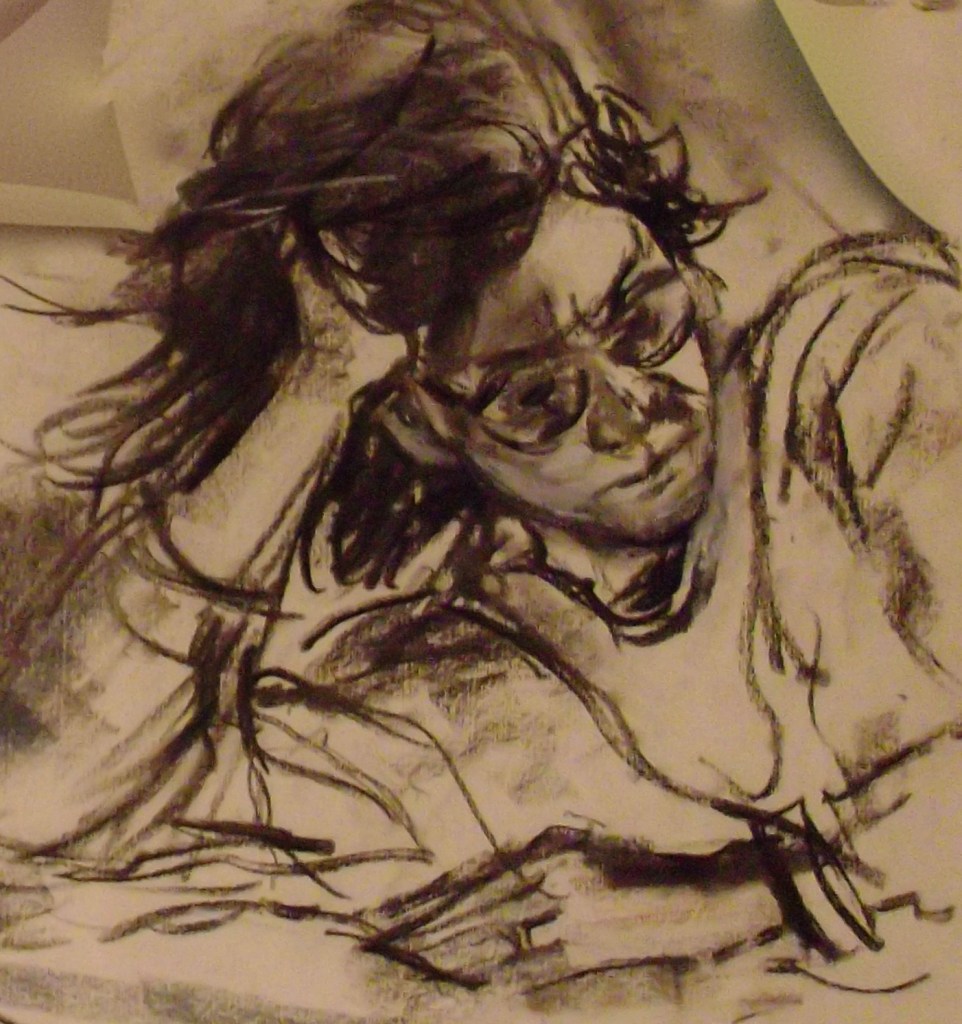
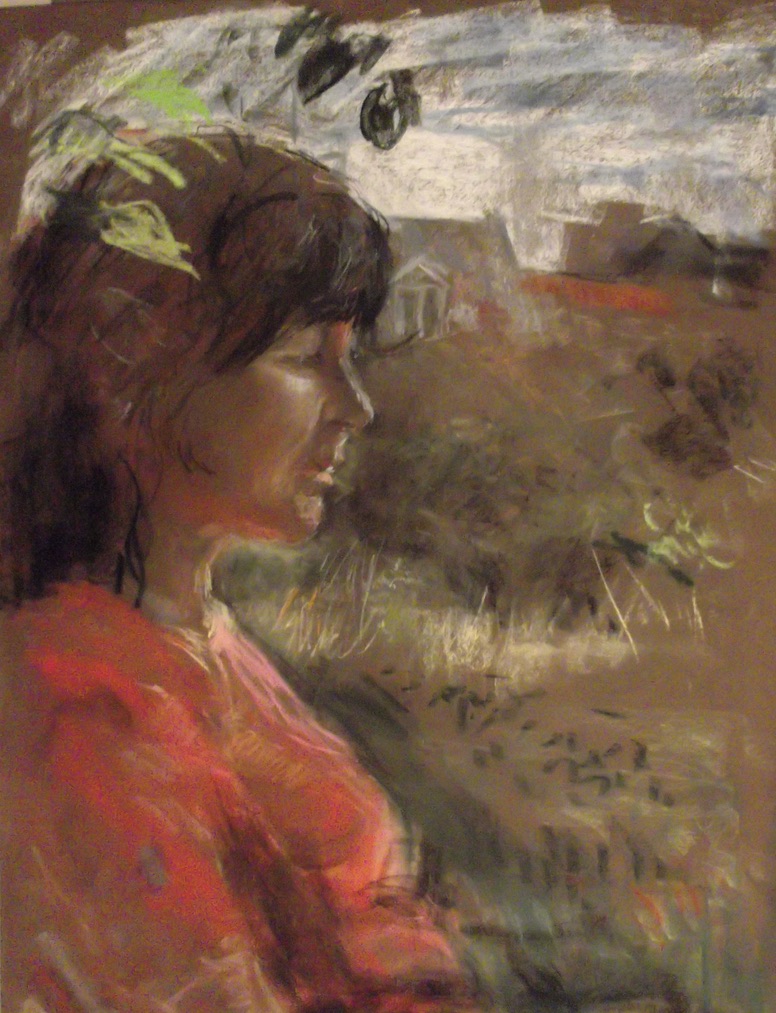
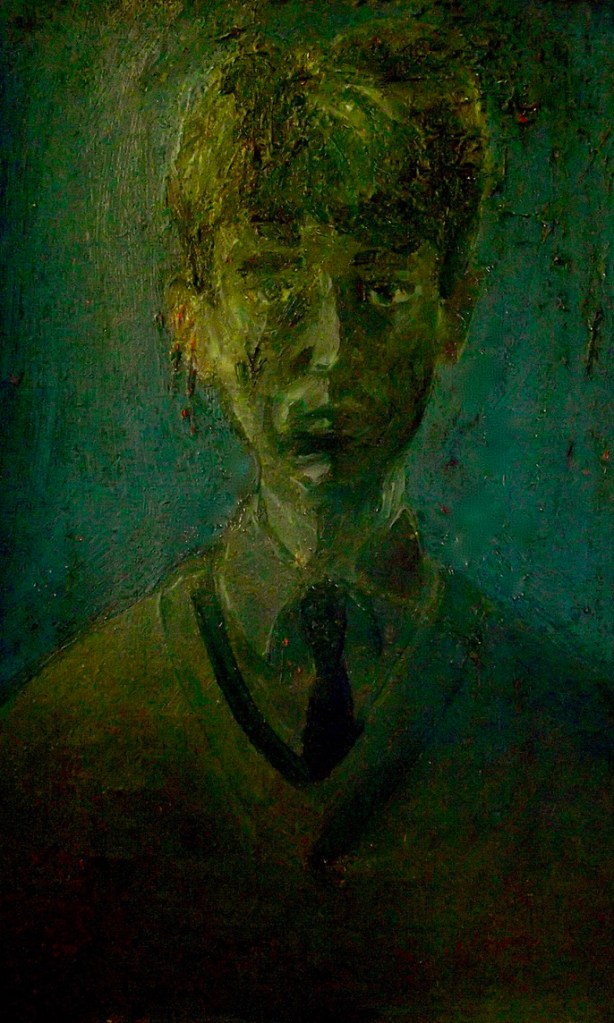
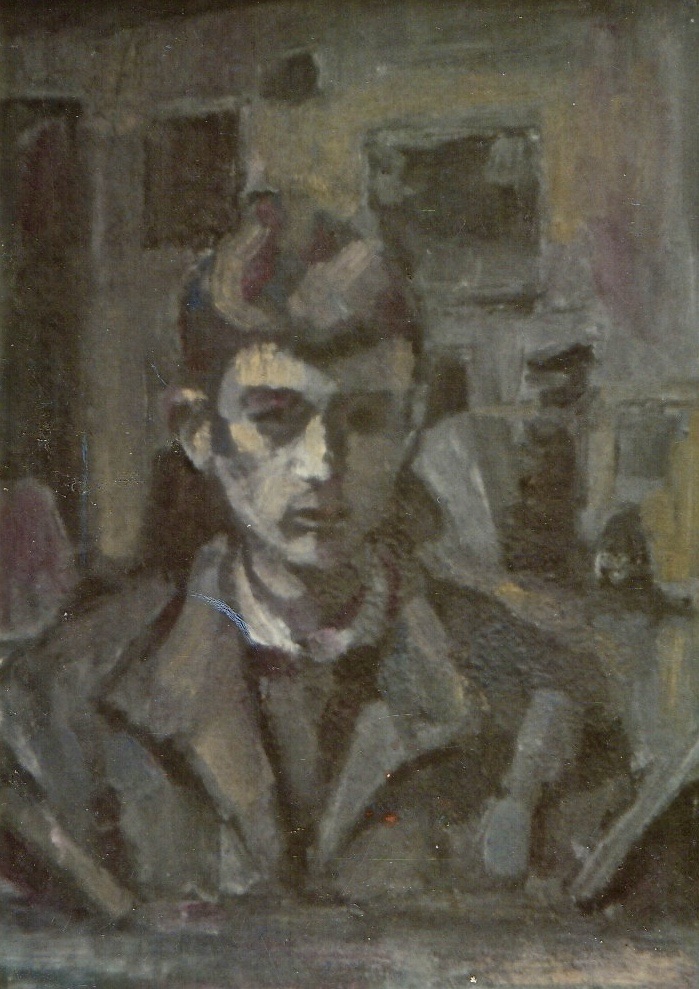
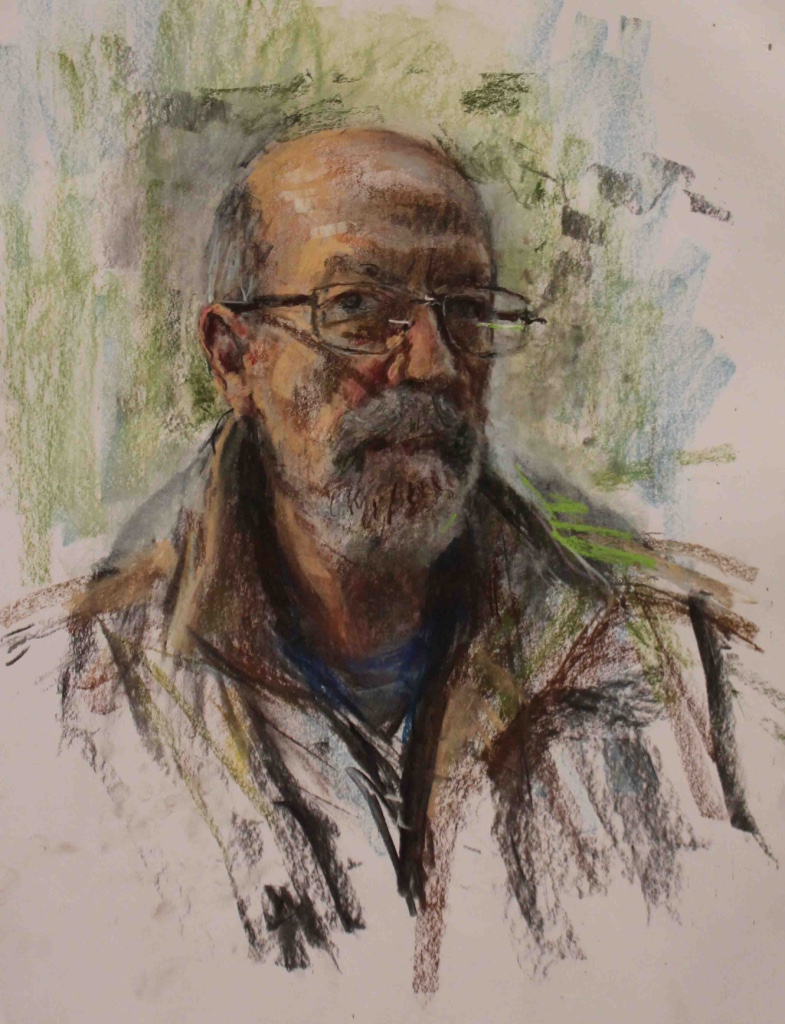
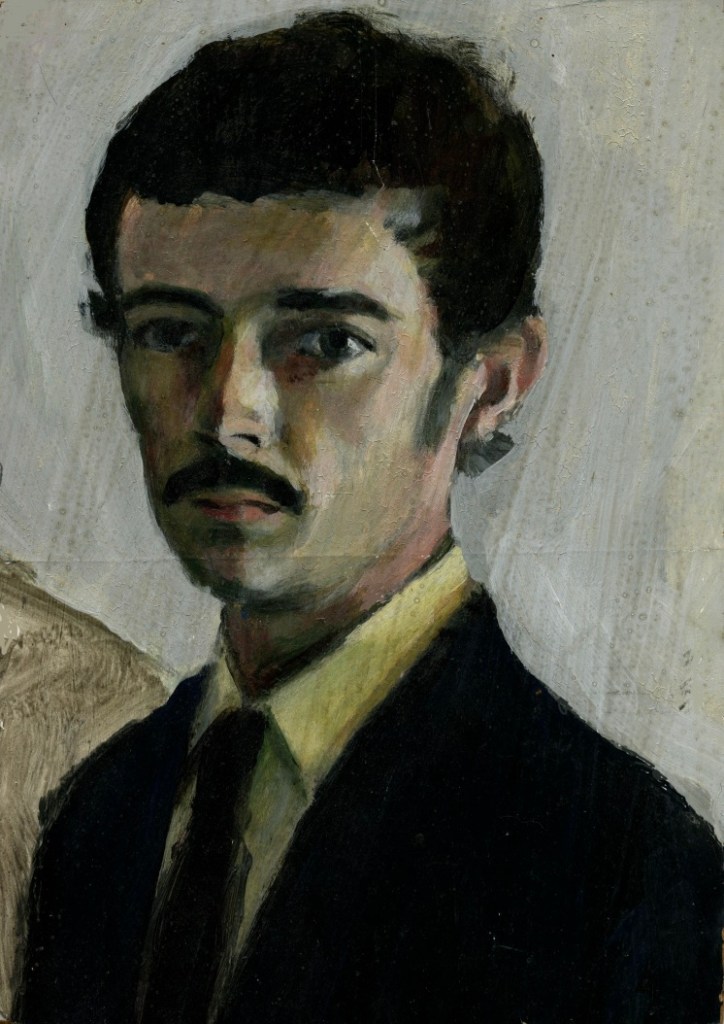
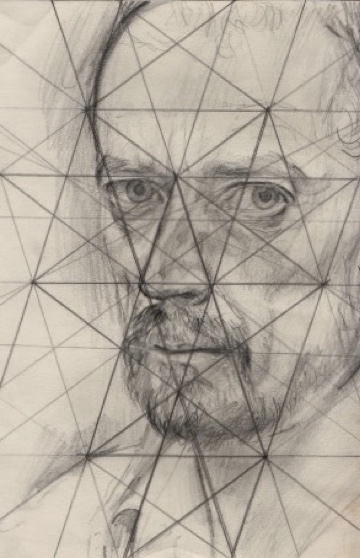
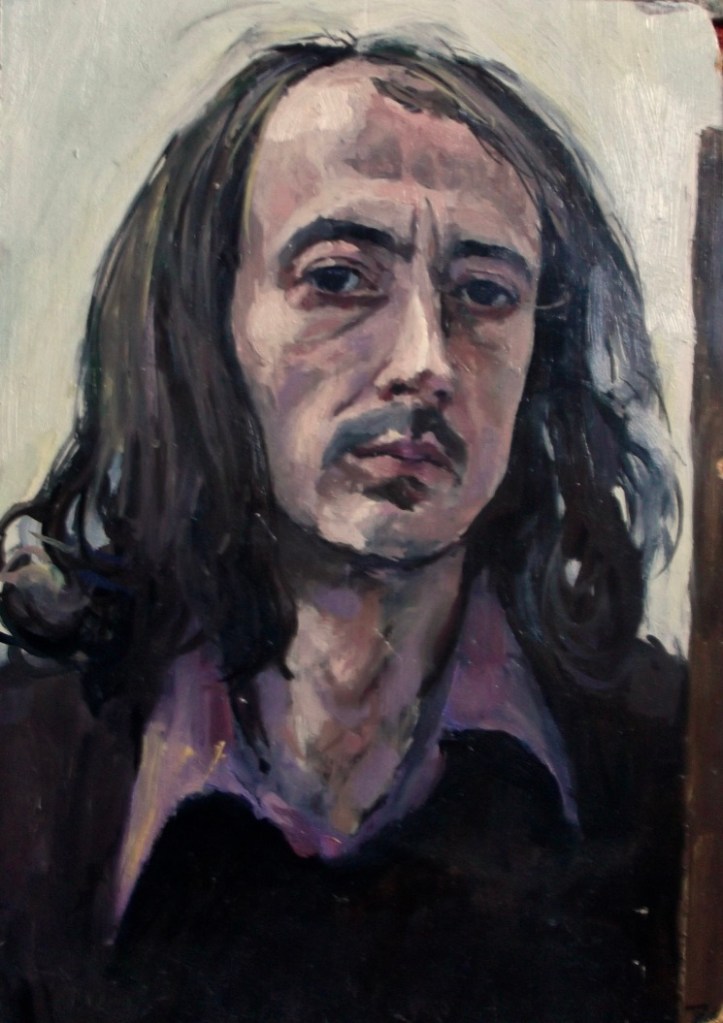
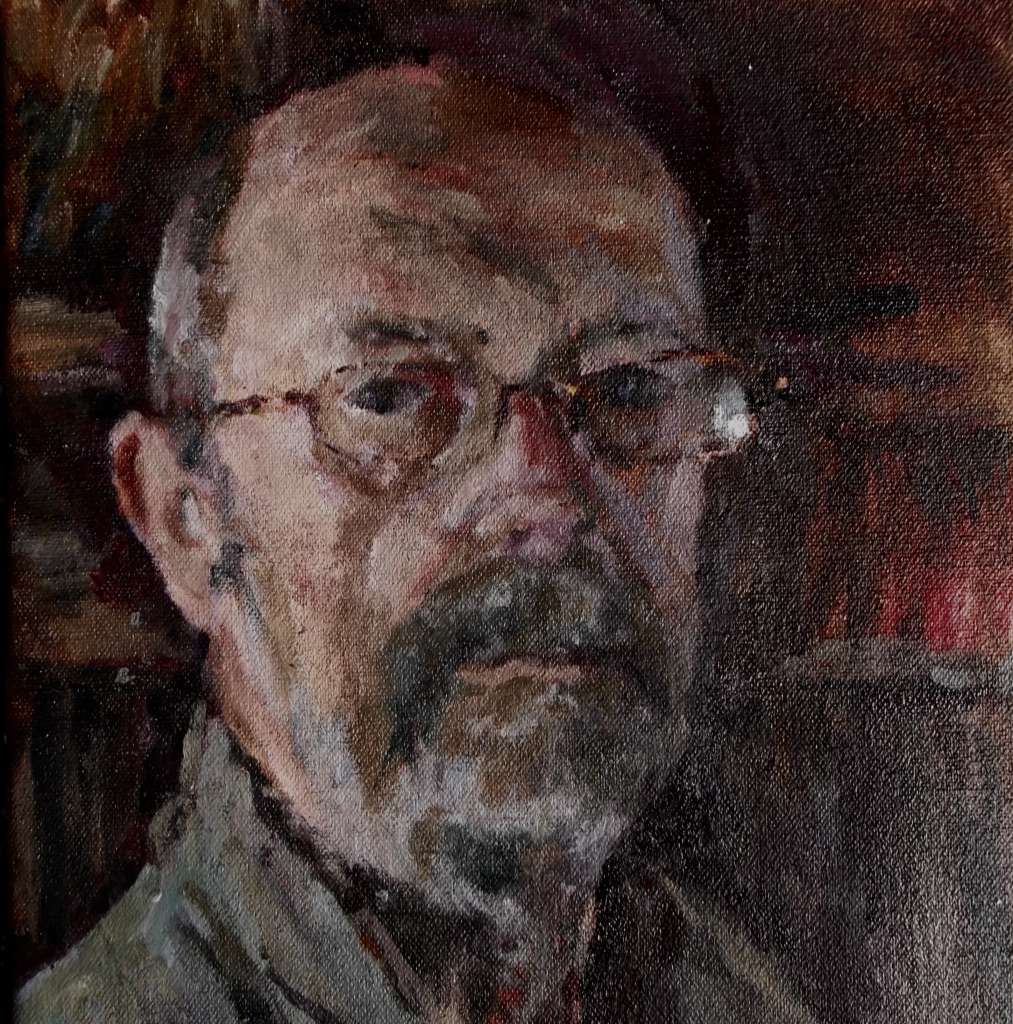
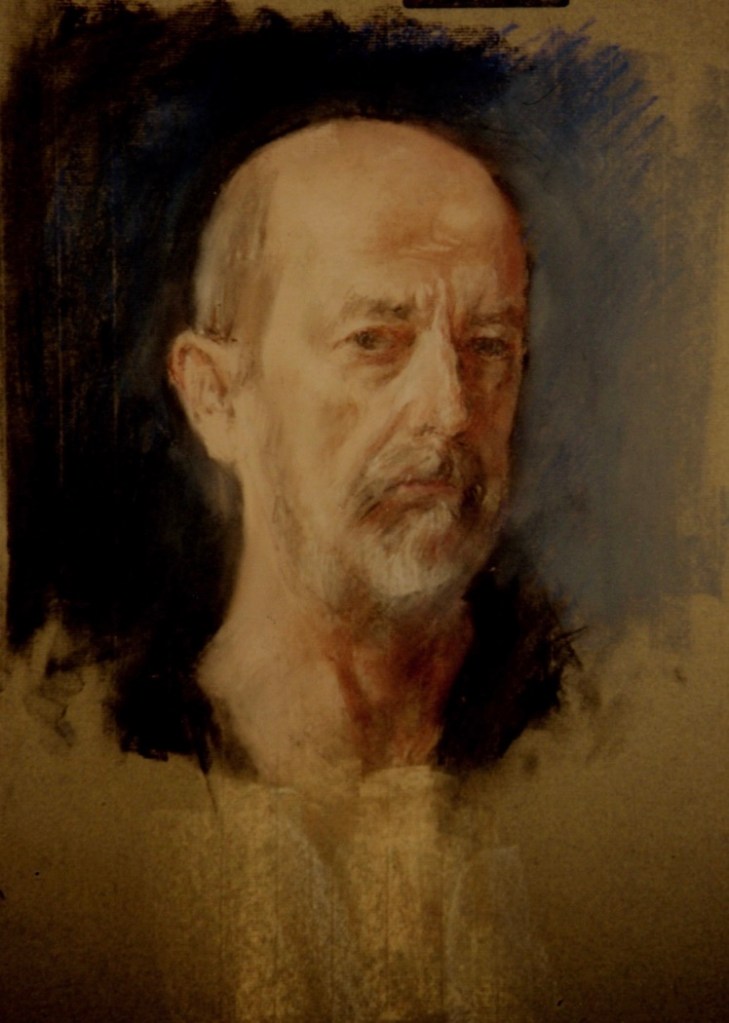
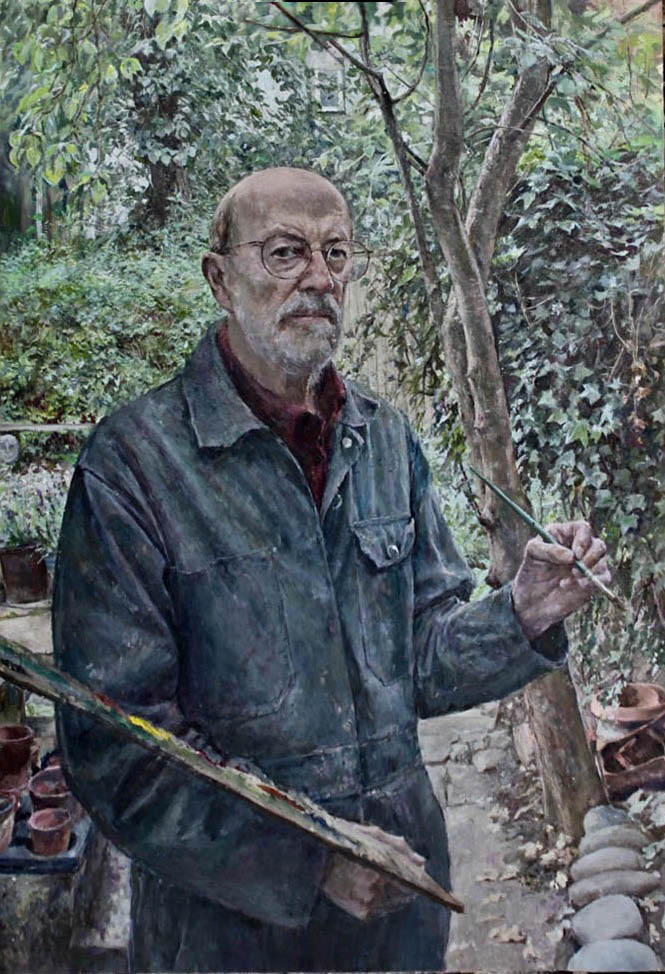
Below: Self Portraits – The earliest, top left, is from 1960. The most recent, bottom right, was painted in 2021, under the conditions of the Covid crisis lockdown. It was exhibited at the Mall Galleries with the Royal Society of Portrait Painters.
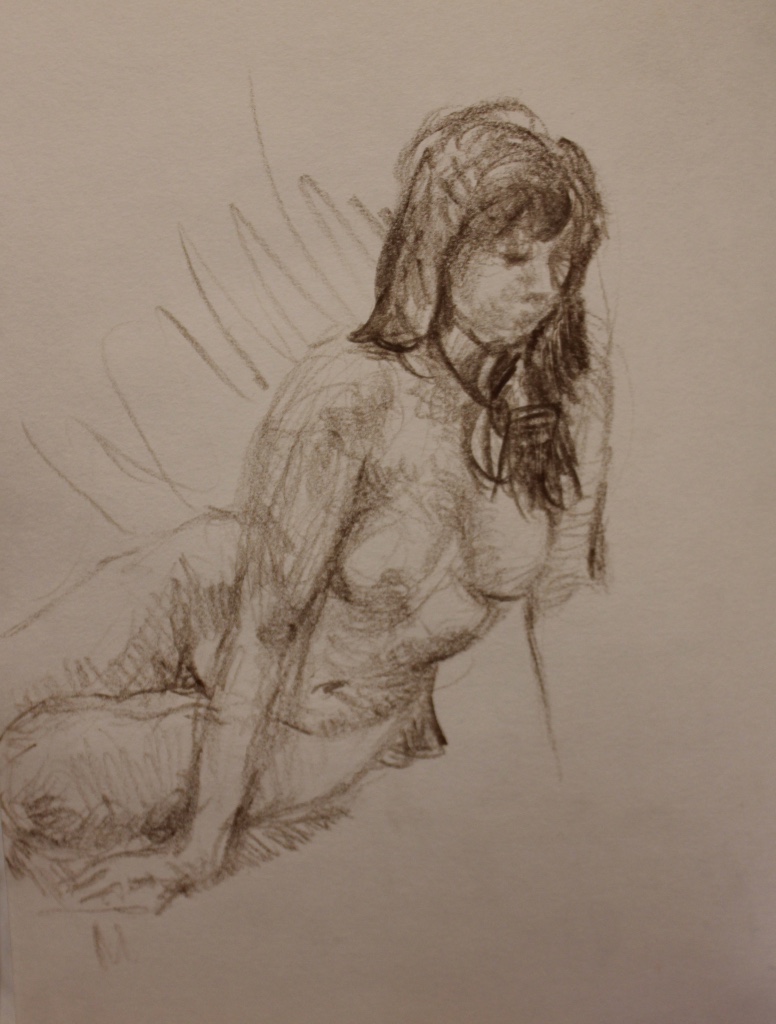
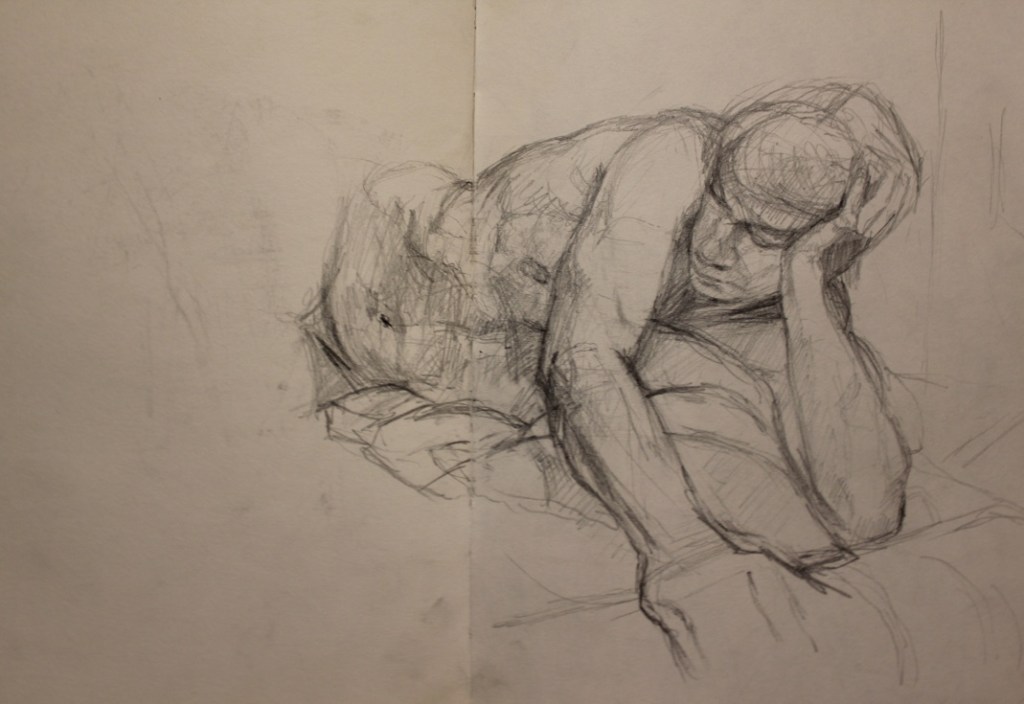
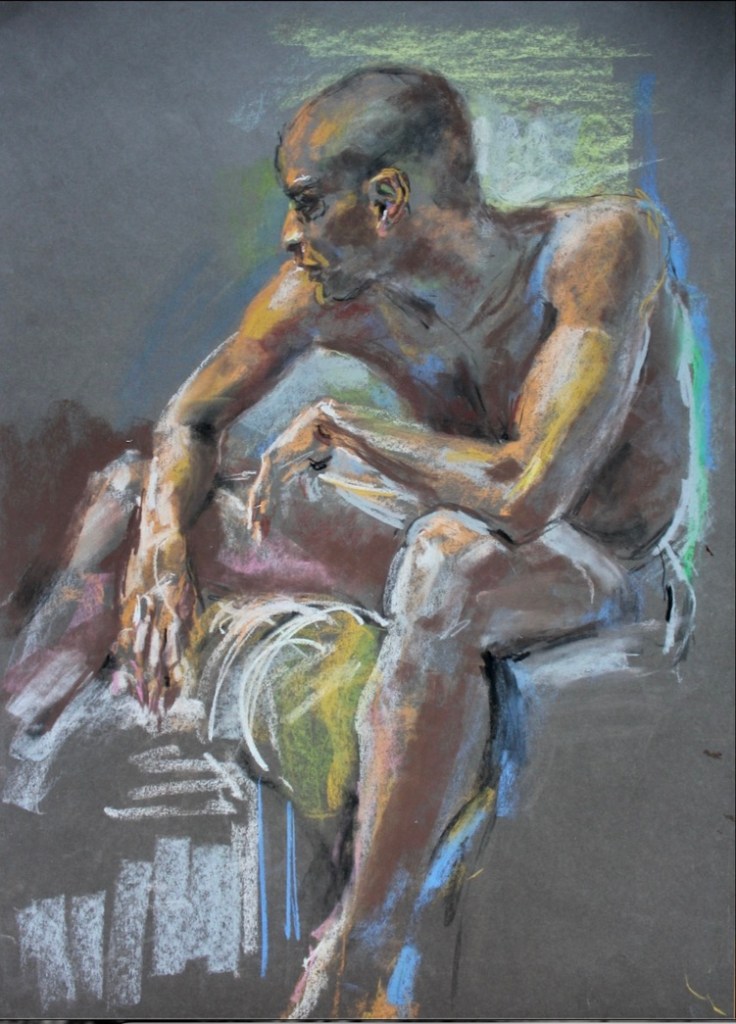
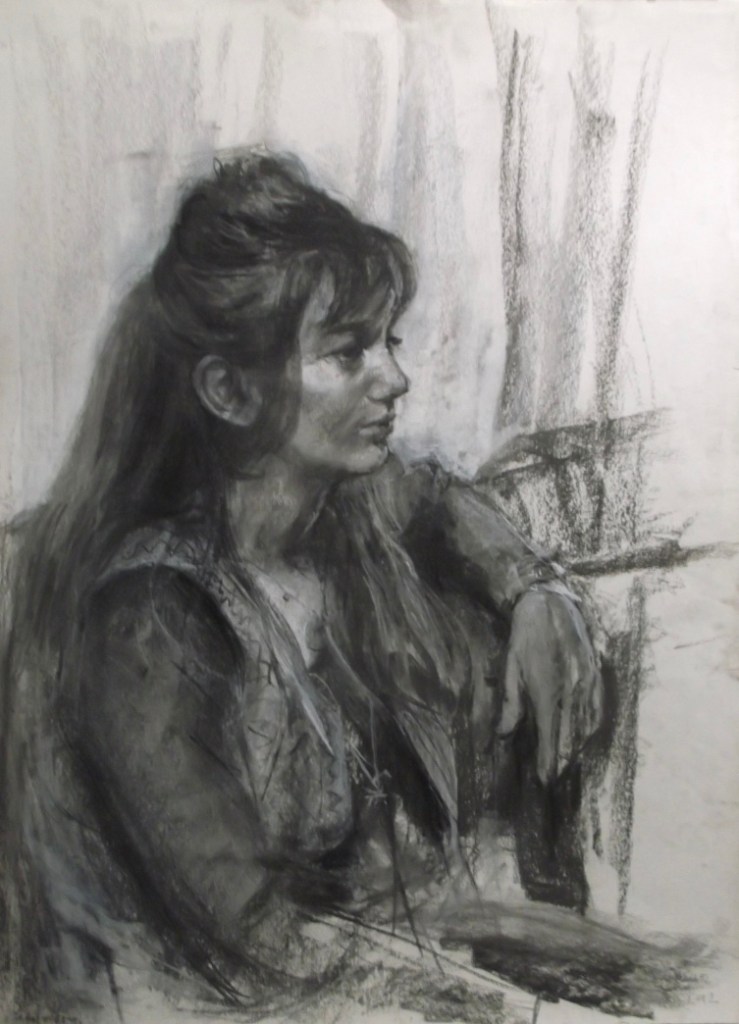
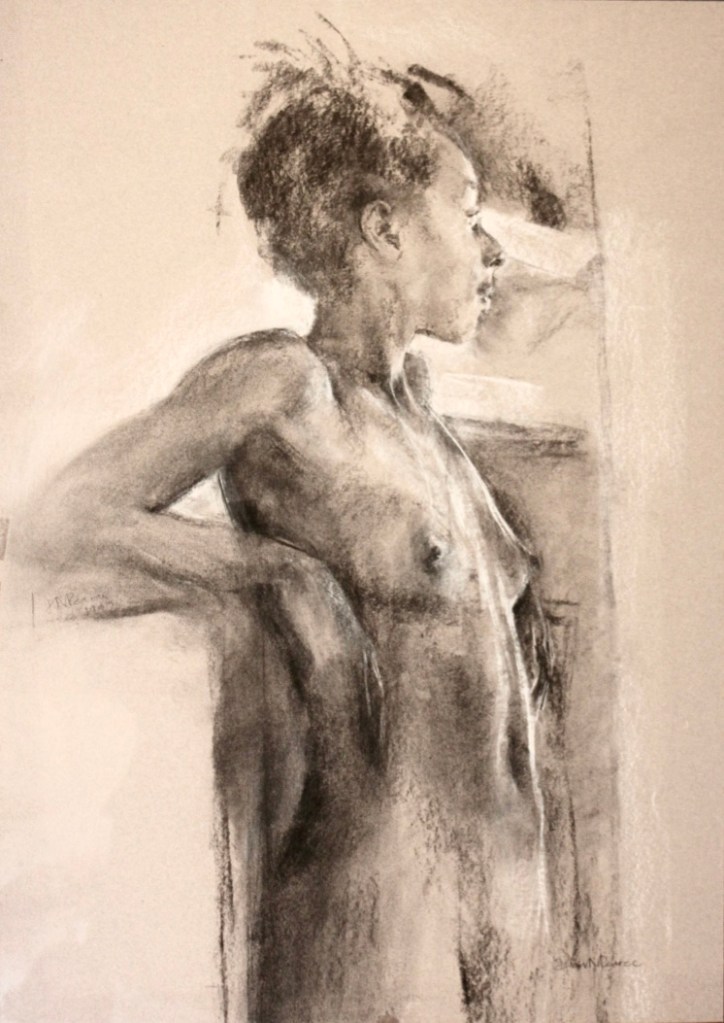
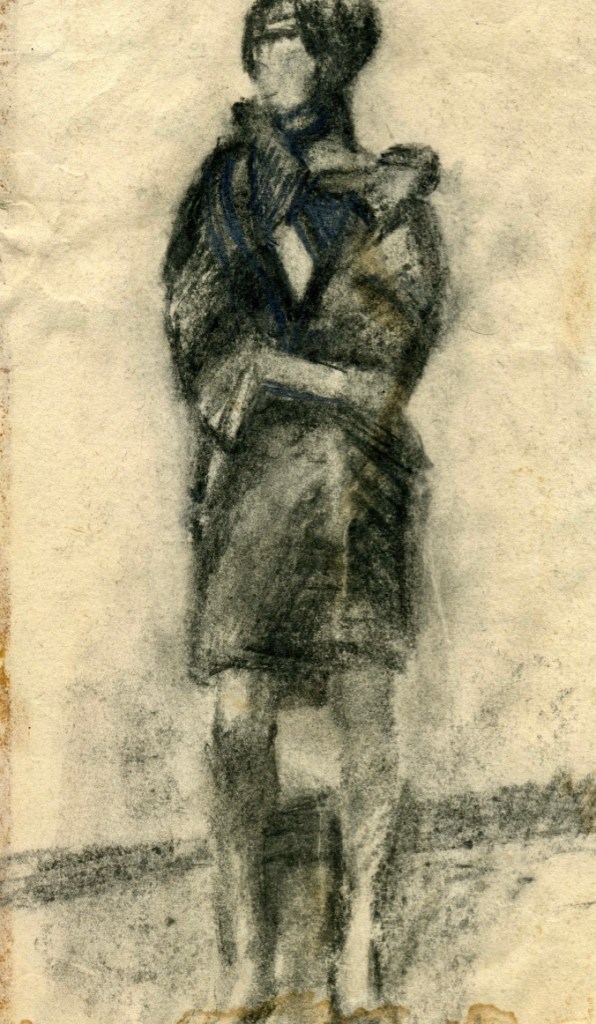
Below – a few studies done at locally organised life-classes.
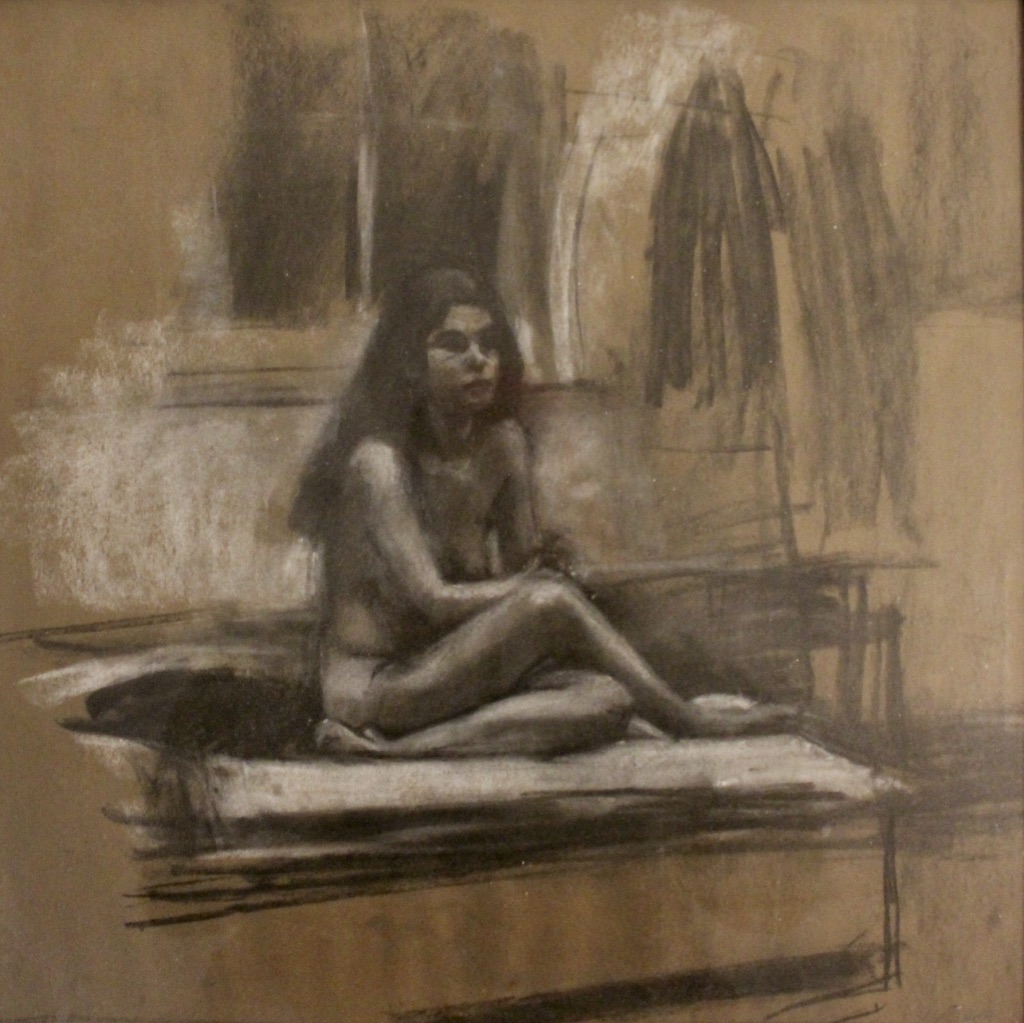
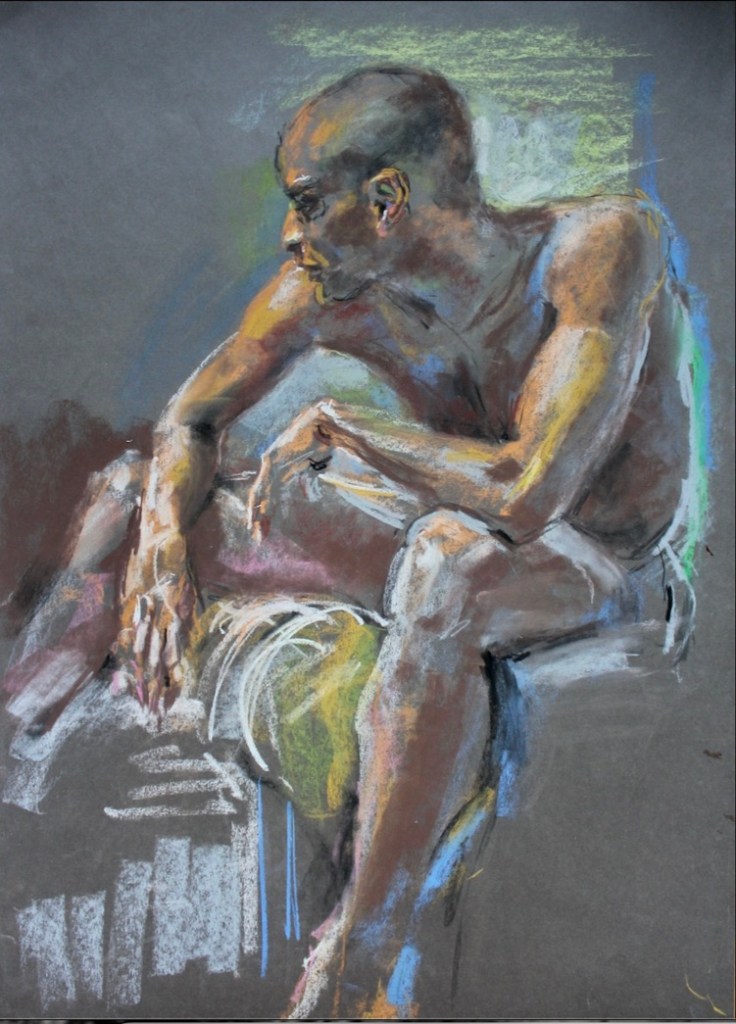
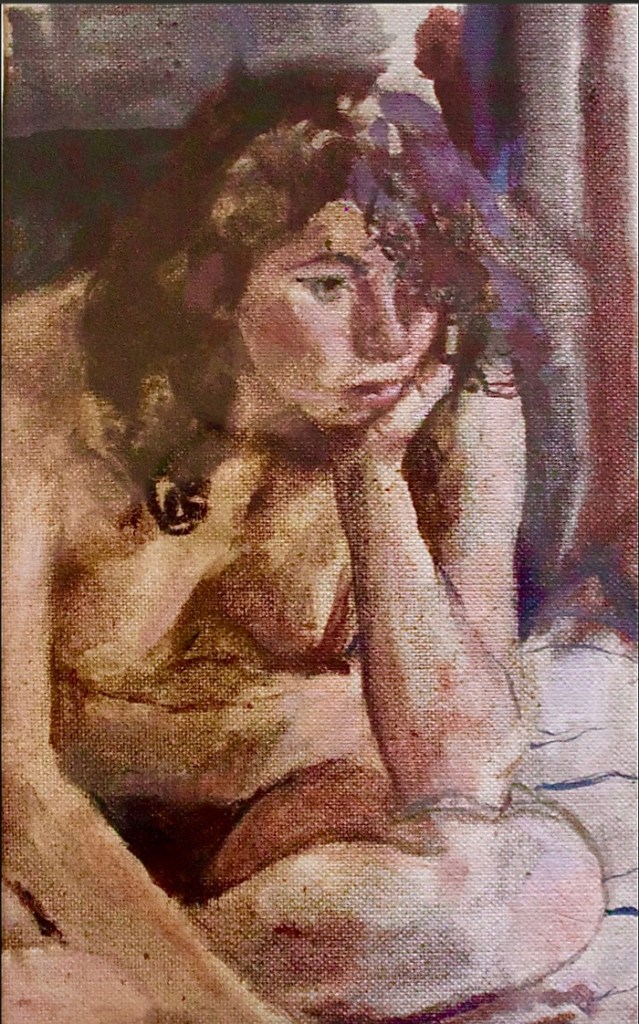
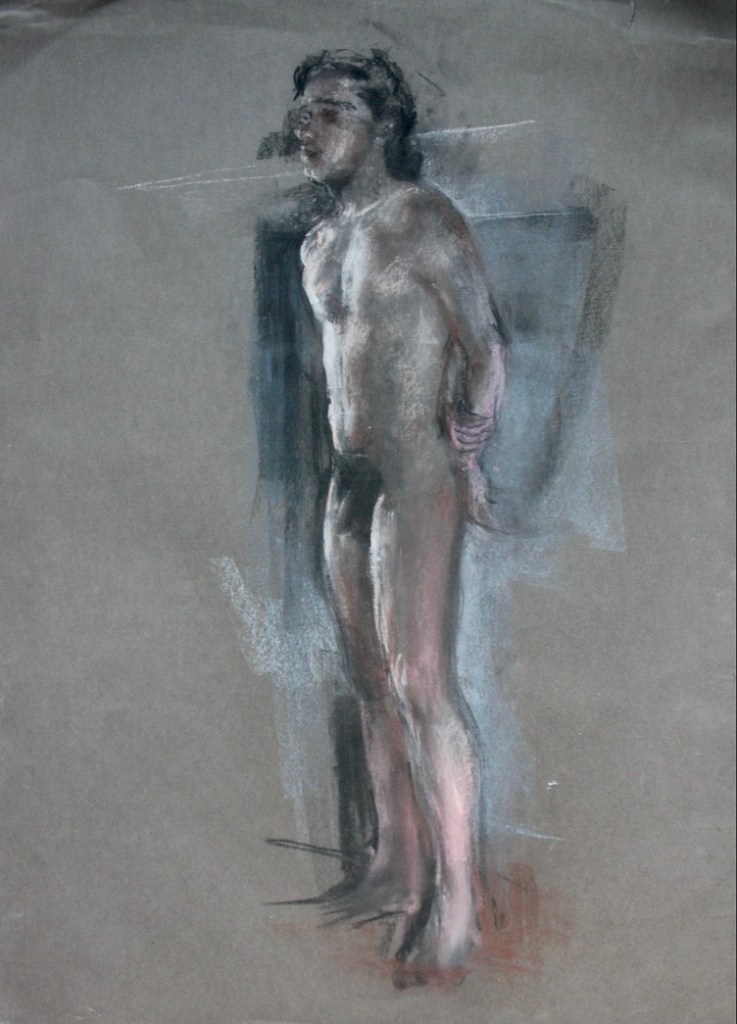
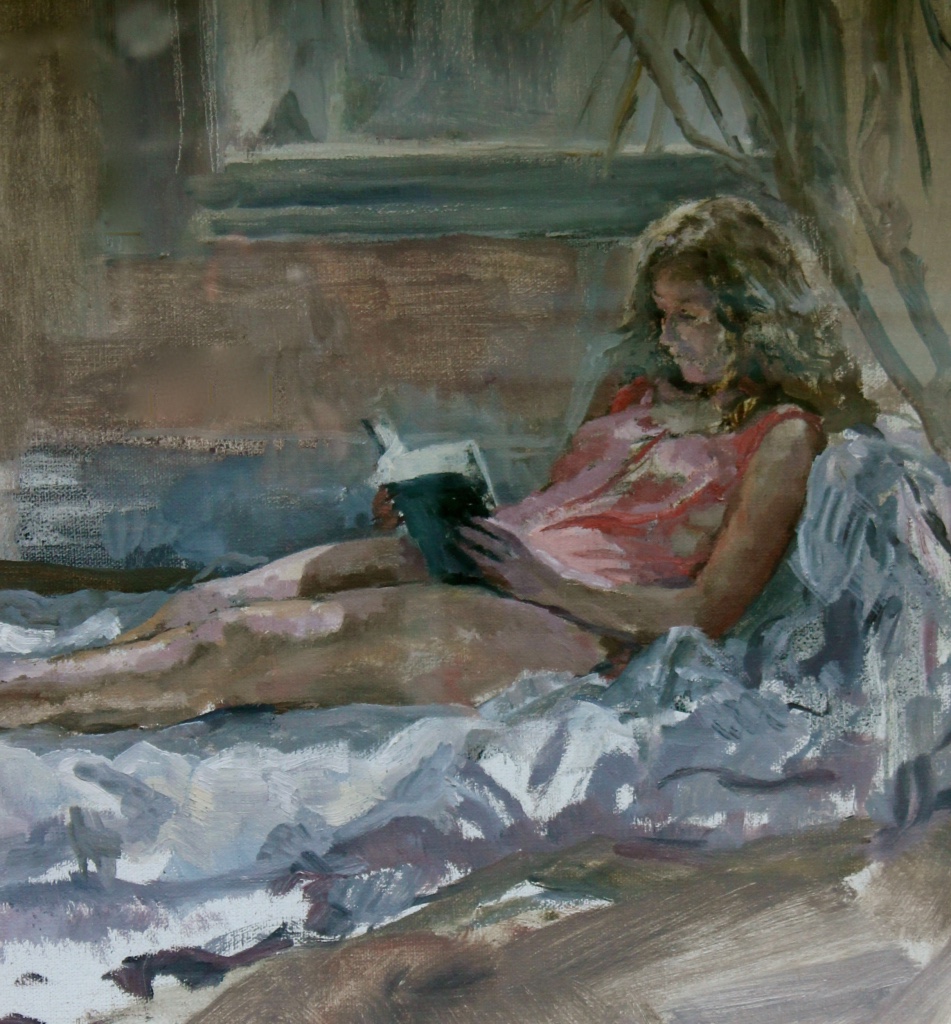
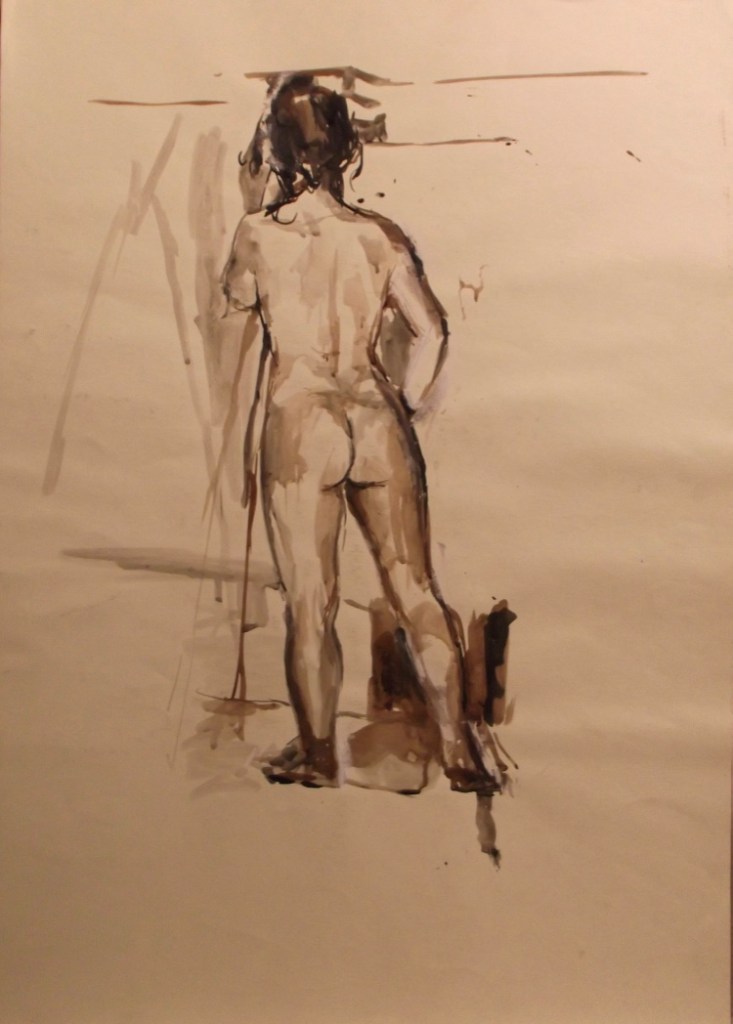
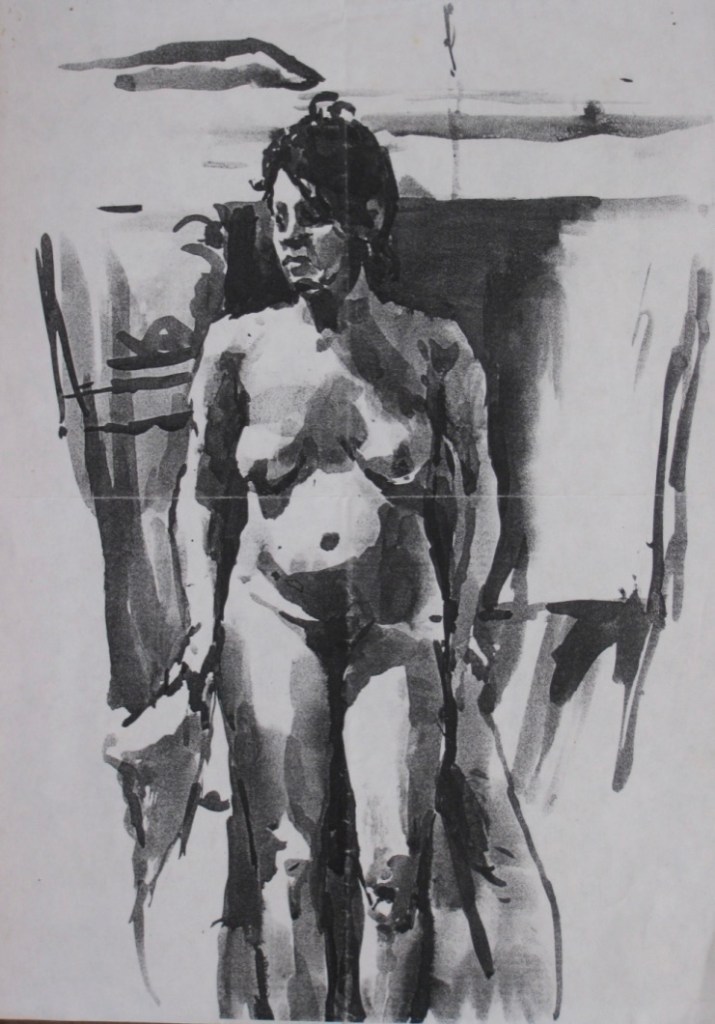
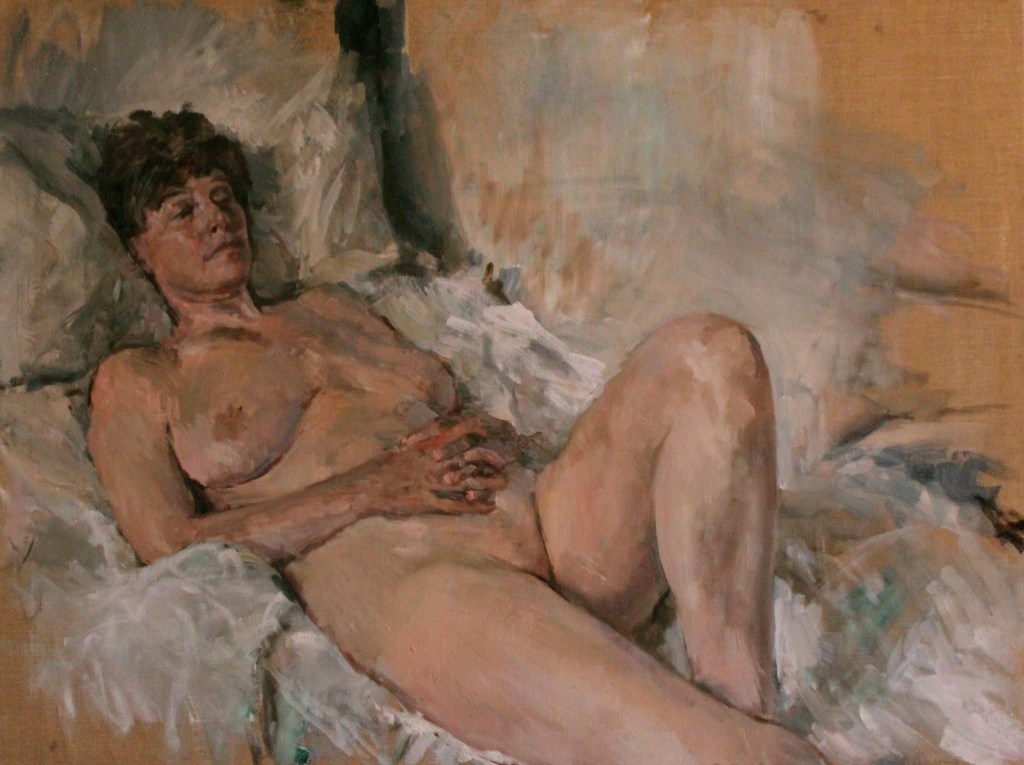
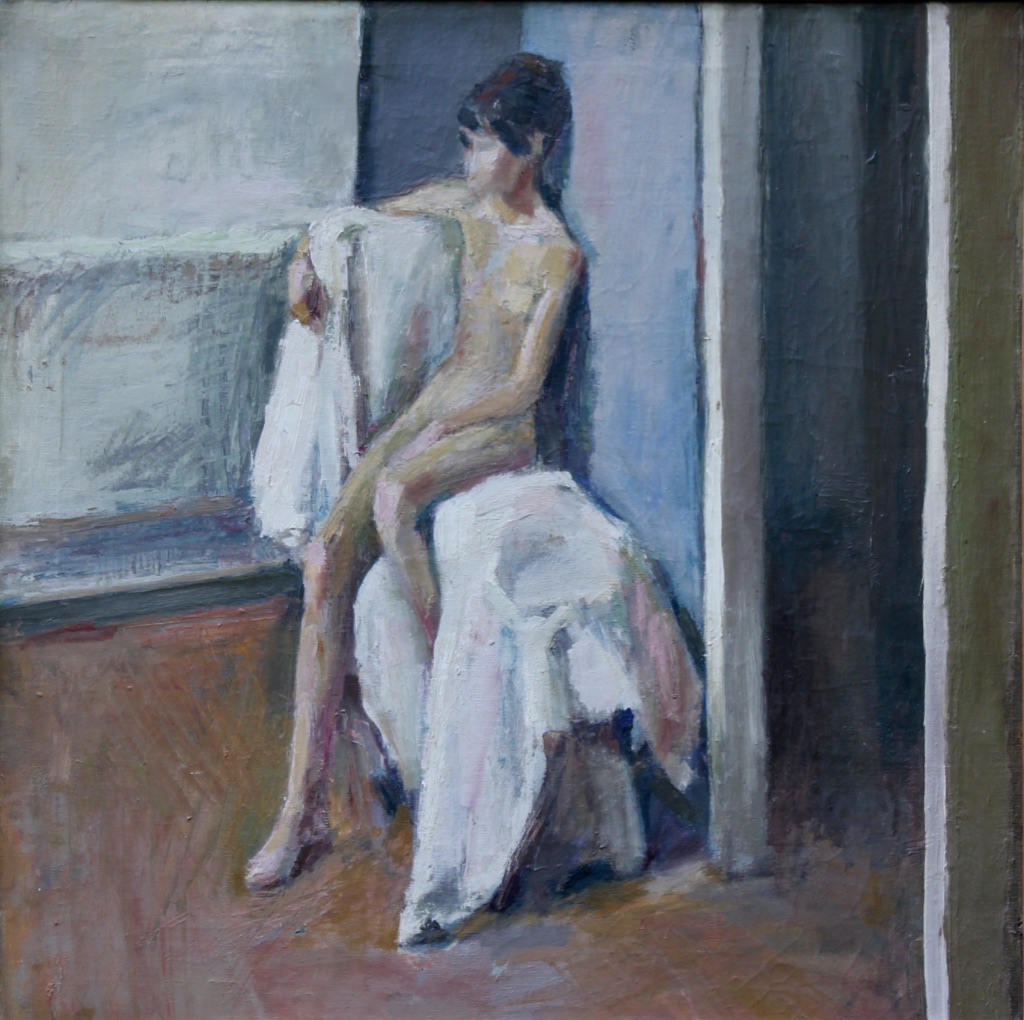
I did the above oil painting as a full time student at Hornsey College of Art. It was one of my few to which our revered life drawing teacher, Jesse Dale Cast, responded with any approval! (“Jolly good, old chap!” – but leaving me little the wiser as to what aspect he particularly endorsed..}
 J.N.PEARCE ARTIST