Introduction: The Extended Tree – Discovery and Revelation
A Cabala group, which developed in London’s Soho in the 1950s, was established by Alan Bain, Tony Potter, Glyn Davies and others. (see http://www.soho-tree.com/) Both Bain and Davies developed – or rediscovered – versions of the Cabalist geometry that became known as ‘Jacob’s Ladder’ or ‘The Extended Tree’ or ‘The Ladder’.
Tony Potter was a pupil of Bain and established his own Cabala group in Highgate, North London in the 1960s. I became a member of Potter’s group, ‘The Society of the Hidden Life’ in 1964, and in effect I remain a member, though group meetings under Potter’s leadership ceased in the early 1970s. In expounding the ‘Doctrine of Worlds’, as one of the basics of Cabala, Potter made passing reference to a way of interlacing four Tree of Life diagrams, each representing one of The Four Worlds. This is the rationale of ‘The Extended Tree’.
Warren Kenton, a pupil of Glyn Davies, was present when Glyn first revealed his version of The Extended Tree. Kenton went on to found the international and widely respected Kabbalah Society, and wrote numerous books under his pen name Z’ev ben Shimon Halevi. His work even gained the attention of the British heir apparent, is acknowledged by Jungian Psychoanalysts and has a multi-faith appeal. The Ladder features in his teaching.
The Poet/scholar Kathleen Raine writes of Warren’s work: “A feature of this author’s system not found in others (although doubtless it is traditional though not universally taught) is the beautiful way in which the interfaces of each ‘world’ overlap with the one above (or below). Thus, the highest experiences of the physical world overlap the lower part of the next world (the psychological): and again psyche’s highest experiences of the individual soul coincide with spiritual regions of the transpersonal world of universal forms. So from illumination to illumination, we reascend the ‘ladder’ by which each of us ‘came down to earth from heaven.” (https://en.wikipedia.org/wiki/Z%27ev_ben_Shimon_Halevi)
Besides representing both the human psyche and the cosmos, the Tree and the Ladder show stages of conscious development, reaching from the unique point of time and space into which one was born in the material earth – ‘Malkuth’ – to a level of self-knowledge and individuality in the context of an absolute being and unity – ‘God’, if you will – while still existing in the same world and standing on the same earth as everyone else.
Diagram Zero – The Gnostic Ladder.
The Extended Tree is based on the Kabbalah ‘Doctrine of Worlds’, and is constructed from an interlacing of four Tree of Life diagrams:
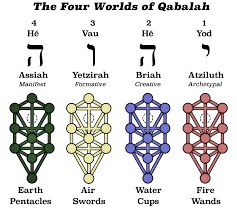
As pointed out by Alan Bain (Keys to Kabbalah 1996) in a Christian context (Anonymous 14th C. Middle English: The Cloud of Unknowing) these correspond to: Common, Special, Singular (or ‘Solitary’ ), and Perfect.
The Ladder Construction
One starts with one Tree, drawn in the usual way. The Tiphareth of this Tree is then taken to be the Kether of the next Tree down; Yesod is in the position of Daath and Malkuth forms its Tiphareth. The same process is repeated so that the Tiphareth, Yesod and Malkuth of the second Tree become the Kether, Daath and Tiphareth of a third Tree, and the same steps produce the final Tree. The Four interlaced Trees now form an extended diagram with a central vertical line on which appear eleven regularly spaced locations. These are taken to be Ten ‘Greater Sepiroth’ and a ‘Greater Daath’.
As Rod Thorn has pointed out, the single Tree diagram has upper and lower faces which exactly overlap in constructing the Ladder. Chesed and Geburah are separate from the faces and, while they are included in The Ladder, they do not overlap with any other sephiroth. They are maintained in their place in the scheme by their adjacent paths, but their essential nature as the essence of mercy and severity is not otherwise modified.
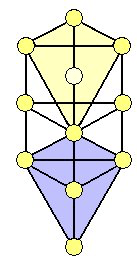
If one chooses to follow the inclination of Alan Bain, a further point is added above Greater Kether, this being ‘Ein’ or ‘Negative Existence’ The two additional ‘Veils’ – ‘Ein Soph’ and ‘Ein Soph Aur’ (The Limitless’ and ‘The Limitless Light’) are added at the tops of the two side pillars. This then creates a total of thirty-two points on the Ladder Diagram (below left) which Bain sees as corresponding to the Thirty-two Paths of Wisdom derived from The Sepher Yetzirah, and this, together with the Tarot Trumps, forms the basis of Bain’s proposed Cabalistic course.
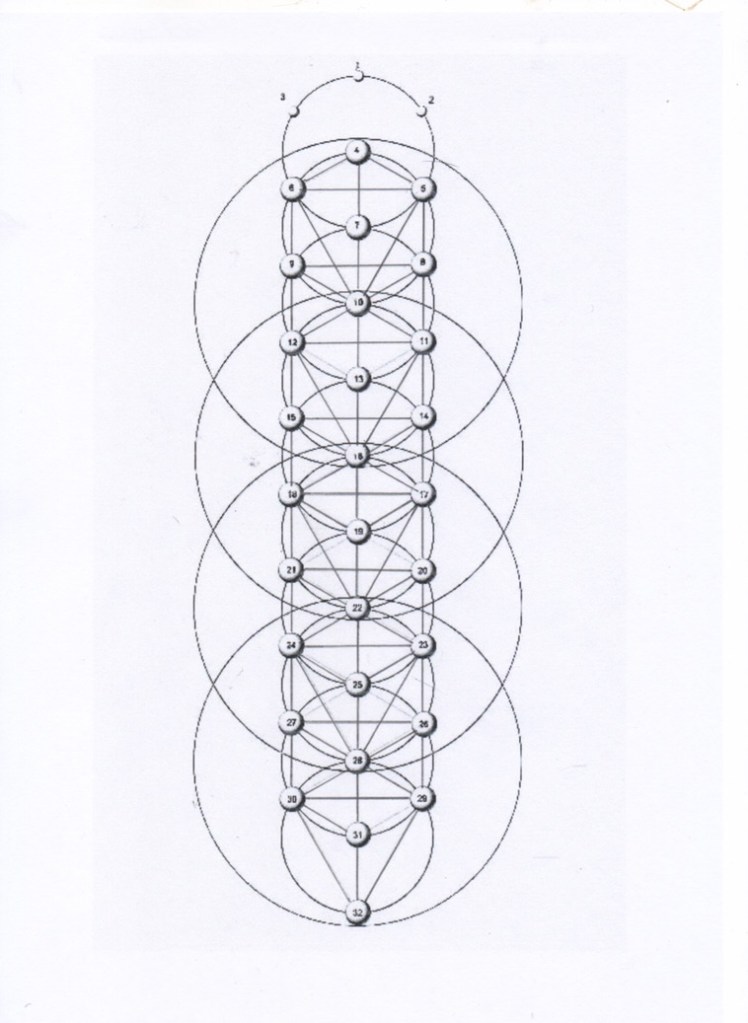
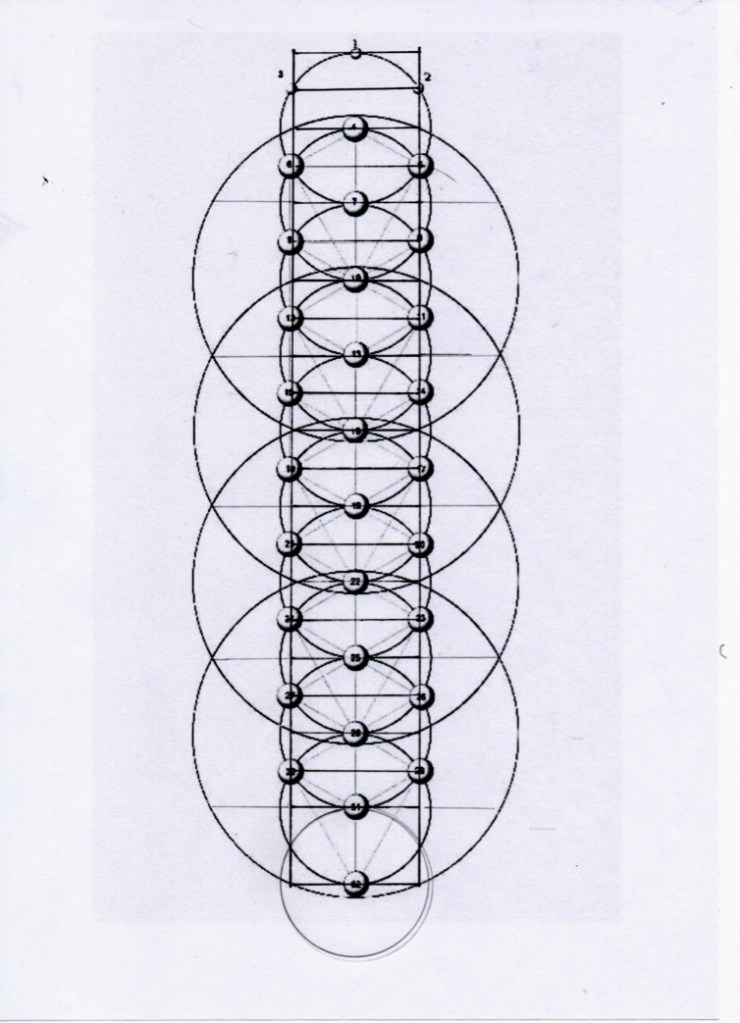
However, the inclusion of the Three Veils also creates Twenty-two levels or ‘rungs’ on The Ladder, (above right). This suggests correspondence with the twenty-two letters of the Hebrew Alphabet, not to mention the Greater Arcana of the Tarot as a guide to its interpretation and possible efficacy in terms of The Work. The title ‘Diagram Zero’ refers to the inclusion of Ain (No-thing).
Alan Bain was reluctant to accept a ‘Greater Daath’ as having a valid place on The Ladder and managed to eliminate it by moving all the lower Sephiroth up a notch. The result is that Greater Malkuth is centred on Yesod of the lowest Tree – i.e. the Tree in Assiah. There may be arguments for and against this, as there may be for the inclusion or exclusion of Greater Daath. Be that as it may, I have accepted Greater Daath, and thus offer a version called ‘The Gnostic Ladder’ – ‘gnosis’ being equivalent to ‘knowledge’.

Fig. 1. The version of the ladder under consideration in this article. It is called ‘Diagram Zero’ because, deriving from Alan Bain’s version, it includes The Three Veils of Negative Existence.
Trees representing the Four Worlds are interlaced and ten ‘Great Sephiroth’ and the ‘invisible sephirah‘ Daath ‘magically’ appear on the central pillar. Diagram Zero differs from Bain’s in including a ‘Greater Daath’ at the correct point in the sequence – hence I also refer to it as ‘The Gnostic Ladder’.
Bain either chose to ignore or did not notice that his Ladder has 22 levels or ‘rungs’.
The Ladder and the Four Worlds.
The Four Worlds of Kabbalah are Atziluth – the World of Emanation, Briah – The World of Creation, Yetzirah – the World of Formation, and Assiah, the World of Making. The Ladder illustrated is a Kabbalistic diagram constructed from the overlapping of four Trees of Life, one for each world.
Correspondences within The Greater tree and the four ‘Lesser’ Trees
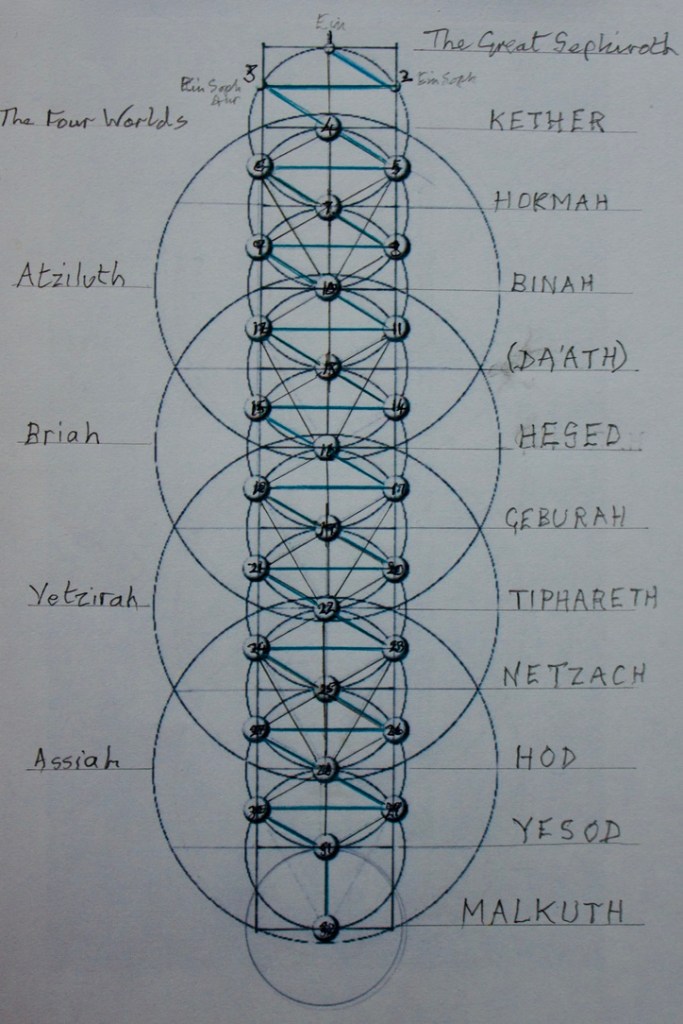
Fig. 2 Middle Pillar correspondences with Sephiroth of the Ladder and Sephiroth of component ‘Lesser’ Trees.
Things to note arising from Fig 2. geometry:
- That Atziluth comprises the Greater Sephiroth Kether, Chokmah, Binah, Daath and Hesed;
- Briah comprises Greater Sephiroth Binah, Daath, Hesed, Geburah, and Tiphareth,
- Yezirah comprises the Greater Sephiroth Hesed, Geburah, Tiphareth, Netzach and Hod,
- Assiah comprises Tiphareth, Netzach, Hod, Yesod and Malkuth.
- This pattern conveys something about both the nature of each ‘world’ and the relationship of the Greater to the Lesser sephiroth on the Middle Pillar, as when Malkuth to Yesod in Briah, for example, is identified with Tiphareth to Geburah on the Ladder (or ‘Great Tree’).
- The overlapping of the worlds also creates new correspondences, as when the Daath position of a lower tree coincides with the Yesod of the next higher tree. HOKMAH, DAATH, GEBURAH AND NETZACH on the Ladder each coincide with Daath on a ‘lesser’ Tree, and thereby imply particularly paradoxical or challenging points on the path to individuation, i.e. psychological maturity.
- The pattern implies that the intrinsically paradoxical Daath point in the lower tree, represents a significant point in individuality and independence on the higher Tree. Another example arises if one extends the tree pattern above Kether in Atziluth. One then finds that Ein (Negative existence) is in the position of Daath, which seems appropriate to its paradoxical nature.
- A particularly striking correspondence is where Daath in Briah coincides with Greater Daath on the Ladder. This is also Yesod in Atziluth.
- In general, as the Australian teacher Barry Long has pointed out, a higher level of consciousness usually corresponds to a greater acceptance of responsibility. The move from Tiphareth to Daath in Yetzirah, corresponding to the step from Malkuth to Yesod in Briah, is not for the faint-hearted since it also corresponds to stepping from Greaer Tiphareth to Greater Geburah on the Ladder.
- The move from Malkuth to the point of material independence at Yesod in Yetzirah, is also challenging as it implies the development from Hod to Netzach on the Greater Tree -significant in the present state of the world, and another indication that much of what is called ‘The Work’, or ‘The Great Work’, is essentially carried out in Assiah and Yetzirah.
- A-propos of the above, note that Greater Tiphareth – considered the critical point in an individual’s ‘awakening’ to reality – coincides with Tiphareth in Yetzirah. It is also at the point where Assiah and Briah overlap, which serves to emphasise the importance of the World of Yetzirah as the world in which The Work of Kabbalah is initially focused. There is also the issue that Greater Daath, coincides with Daath in Briah – the level from which a Cabalist teacher works as ‘Master of The Temple’. I won’t spell out other significant suggestions in the diagram, which the reader can pursue for him or herself.
- I will, however, reiterate that each of the Middle Pillar Sephiroth on the Ladder coincides with a corresponding Sephirah on a lesser Tree – Kether with Kether in Atziluth, Tiphareth, as remarked, with Tiphareth in Yetzirah and Yesod and Malkuth with Yesod and Malkuth in Assiah. This seems to me a validation of the inclusion of Daath on the Ladder.
- This pattern does not occur on Bain’s original version of the ladder. While I recommend the above attributions as intrinsically persuasive, I would not want to dismiss Alan Bain’s, or any other explorative arrangement of attributions to the Tree as innately misleading.
Assiah represents the ‘outer’ world of nature which we inhabit; Yetzirah is the ‘inner’ psychological world of thoughts, feelings and imaginings; Briah is the world of transpersonal archetypes; Atziluth is the level of the most absolute reality, the most remote spiritual world. Of these, both Briah and Yetzirah are felt to be ‘inner’ worlds, though evidently they may reflect or affect the ‘outer’ world. Assiah and Atziluth seem to be outside of us. Atziluth seems the most remote from ordinary humanity. Despite its familiarity, Assiah obviously has unknown, possibly unknowable aspects.
YETZIRAH
Yetzirah – ‘The World of Formation’, alias the”Special” stage of ‘Christian living’ described in the Medieval text ‘The Cloud of Unknowing’ – is the world of thoughts, feelings, judgements, opinions, logic, imagination, memories, hopes, fears, sense perception, body awareness and instincts; the virtual world model of prospect and retrospect with which it is only human to be constantly engaged.
From the moment of separation of child and mother at birth, one’s individual existence is experienced as external to other individuals, as they are external to it. This is also a ‘spatial sense’ expressed not only in the linguistic structure of subject and object, but also in the sense of an infinite ‘inner world’, as opposed to the external world of solid material, movement and change in a context of outward infinity, and , of course, the context of the collective discourses of human culture; politics, the arts, science etc. According to Boris Mouravieff “the yearning of the human heart secretly lamenting its profound loneliness’ is “…the essential goal of esoteric work.” (Boris Mouravieff – ‘Gnosis’ first published in French 1961.)
Yetzirah is the home of what we are pleased to call ‘consciousness’ – of nightmares, dreams and of our waking awareness of our existence in the world; our thoughts, feelings, sensations, memories, plans, imagination, hopes and regrets. One might call it a world of ‘attitudes’, but It is potentially the world of self-knowledge and of conscience. As both an inner and an externally focused consciousness, it is the world in which external and internal space are seen as one, and in which human action is determined. Yetzirah is therefore highly consequential.
In Cabala, particularly in its early stages, ‘The Work’ is concentrated in Yetzirah. Within this ‘virtual’ world we represent, model and mirror the ‘real’ world, but for each of us it is highly personal. We share our view of things selectively, typically seeking the esteem of our peers, but in Yetzirah each of us is ultimately alone, with access to our ‘inner’ world and our unique sense of self, or the Ego. We may also delude ourselves, distort reality, fail to accept hard truths or to value other peoples’ judgements and opinions, or, conversely, we accept social pressure too readily. We can also harbour secrets, as well as unacknowledged aims or desires ‘repressed’ as shameful or morally unacceptable despite their reality as an aspect of oneself. Such unacknowledged aspects can be completely hidden as part of one’s ‘personal unconscious’ forming what Jung calls “The Shadow”.
This is defined by Jung as “the thing a peson has no wish to be”. It is usually only known at all when unconsciously projected and seems to be external to oneself. However, accepting ownership of one’s shadow, and assuming responsibility for it, is, according to Jung, essential to psychological maturity. “The Work”, of course, is primarily about self-knowledge. (A 2023 publication “Jung’s Shadow Concept”, edited by Christopher Perry and Rupert Tower – is a collection of essays by practicing analysts exploring the subject in an informed and sensitive manner; meticulous to the extent of recognising Shadow infiltrations not only in the writings of Freud, Jung and Adler, but even in their own project.)
In ‘The Cloud of Unknowing’ the ‘Special’ state of Christian living – described as that in which the Lord of Lords has ‘graciously chosen thee’ among all His flocks to be one of His ‘specials’ – corresponds to Yetzirah. Nevertheless, one is exhorted to become ‘meek and loving’ etc. and much of the advice to the would-be contemplative is pretty much the undoing of Yetziratic activity. As the home of the all too human ego, in this world, as Alan Bain intimates, work on oneself can be comparable to Purgatory. It is precisely here that a ‘darkness’ is felt, a ‘cloud of unknowing – thou knowest not what’ except ‘in thy will a naked intent unto God’, in modern terms a desire to experience true reality and meaning; in Cabala terms, this is ‘Devotion to The Work’. But it is impossible to penetrate this ‘cloud’ purely by intellectualising, and one is advised to cultivate a ‘cloud of forgetting’ over thought and mental imagery.
This ‘forgetting’ – or perhaps ‘knowing nothing’ – is equivalent to ‘being in the present moment’ rather than obsessively reliving the past or rehearsing the future.
The cessation of thought is a familiar aim in various teachings aimed at awakening higher consciousness, such as Yoga or Zen, and awareness and moral sense are quite possible without one’s being obsessively preoccupied. No doubt we need to share our thoughts, feelings, hopes, and fears to function in the ‘outer’ world of other people, and, as we say, of ‘what actually happens’, and to contribute to culture. This enjoins an upbeat and proactive sense of responsibility – both to the facts and to society.
The Greek word ‘nous’, which occurs both in Neoplatonic thought and as ‘the eye of the soul’ or ‘The mind’s eye’ in the esoteric Christianity of Mount Athos, is relevant in denoting non-discursive, intuitive perception of the real.***** ‘Nous’ in ordinary usage denotes ‘common gumption’ – the state of not being half asleep.
As ‘The World of Formation’, Yetzirah is both inwardly and outwardly oriented, since it is concerned with thought and imagery in culture and society as well as one’s individuality. Aristotle, in particular, had argued that the human being is a political animal. The individual ‘internal dialogue’ can be seen as a continuation or aspect of the external dialogue – the ‘agora’.
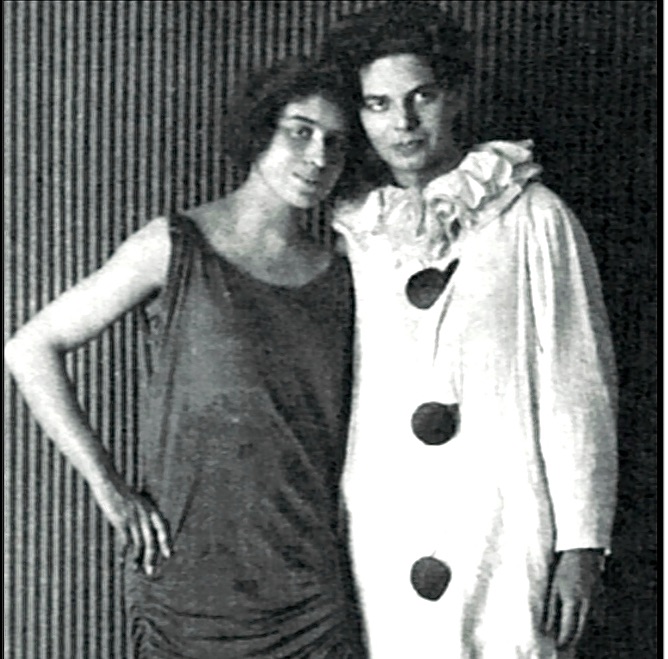
Hannah Arendt and Erich Neumann in 1923.
A proponent of this view was Hannah Arendt (1906–1975), one of the brilliant group of ‘assimilated’ German Jewish intellectuals which included the great Kabbalist scholar Gershom Scholem and his close friend the philosopher and social critic Walter Benjamin, as well as the Jungian analyst Erich Neumann, all of whom became refugees from Nazi Germany. Arendt is particularly associated with her critical account of the trial of the Nazi war criminal Adolph Eichmann in 1961. In her controversial ‘Eichmann in Jerusalem’ (1963) she argued that it was precisely the absence of responsible inner dialogue – the ‘dialogue of one’ – that characterised Eichmann.
This doesn’t mean he was in any state of enlightened transcendence – to Arendt he simply seemed incapable of the defining human capacity for individual responsibility and self-awareness, settling instead for meretricious clichés. One could perhaps say her criticism of Eichmann was that he was unheroic, not only disassociating himself from, but turning a blind eye to, atrocity. The World of Yetzirah can all too easily harbour or endorse a sense of ‘decency’ or ‘normality’ which reflects political or military currents at the time. Yet even in Nazi Germany there were genuinely decent individuals or groups who opposed the government or who secretly aided Jewish neighbours* risking severe penalties including execution.
After the war Eichmann had emigrated to Argentina where, in 1956, another Nazi expatriate, the journalist William Sassen, interviewed him with a view to writing his biography. Eichmann produced audio tapes and volumes of transcripts in which he unashamedly – even boastfully – emphasised his key role in the systematic state-sponsored killing of six million Jewish men, women, and children ******. The highly incriminating tapes were not available to the court in 1961, nor, apart from a few marginal notes in Eichmann’s handwriting, were the transcripts readily accepted as reliable evidence.
At his trial, Eichmann maintained he was never directly involved in murder and had no particular dislike of Jews and – he was just a decent, well-liked family man, unobtrusively doing what society asked of him.
Being almost incredulous at Eichmann’s conspicuous ordinariness, and also, perhaps, concerned to avoid any diabolic aestheticisation of a Nazi criminal***, Arendt coined the phrase ‘The Banality of Evil’, which some have misread as applying to the Holocaust itself rather than to its perpetrators. The American psychologist, Robert Jay Lifton (born 1926), whose studies, like Arendt’s, focus on political history and war, including Nazism, has written about “malignant normality” and the “thought-terminating cliché” – obviously somewhat similar phenomena to what Arendt described.**
As Israel Regardie argues in his splendid book The Middle Pillar (1938), when Eastern Philosophy speaks of “The mind as the slayer of the real… in point of fact it is not the mind which inhibits our perceiving what is real, what is worthwhile in life: It is the false development of mind – that mass of prejudices, emotional biases, improperly formed philosophies and superstitions, relics of the inheritance from misguided parents – which are here noted.” And, one might add, peer group pressure.
As Regardie also observes, The RUACH – in Kabbalism a level of the soul that more or less corresponds to Yetzirah – is both the home of the human Ego and of the Persona, described by C. G. Jung as the rôle we find for ourselves and the acceptable mask we assume to survive in human society. Often the ‘mask’, or ‘role’ is all too readily bestowed by society; one finds oneself in a comfortable, ‘respectable’ position and conforms accordingly.
If self-knowledge is a meaningful goal, most of us start from a rather vague and instinctive sense of self. Should the ”real me” be sought in terms of my reputation with other people – a sort of democratic consensus? Can ‘objectivity’ have any meaning in this context? Is not one’s self, in objective terms, an insoluble paradox?
On the Ladder, the Tree in Yetzirah – from Tiphareth downwards to Malkuth – overlaps the Tree in Assiah so that the Malkuth of Yetzirah coincides with Tiphareth in Assiah (See Fig. 1 above). The four Sephiroth of the lower triad of the Tree in Yetzirah, namely Netzach, Hod, Yesod and Malkuth, all find expression at the physical level in the Tree of Assiah. Fig. 2 (above) shows that The Greater Sephiroth of the Ladder coinciding with the Tree in Assiah are similarly Tiphareth, Netzach, Hod, Yesod and Malkuth.
Interestingly, this bears out an observation of G. I. Gurdjieff in connection with Gurdjieff’s ‘Stop’ exercise (recorded in ‘Views From The Real World, Early talks of Gurdjieff as Recollected by his Pupils’ 1973). Gurdjieff taught that human beings typically function according to a limited repertoire of ‘postures’, the styles of which are particular to one’s culture, historical era, nationality, social position, or profession. These postures are the combined product of emotional feeling, thought and physical movement, and one passes from one posture to another, as though on stepping stones. The ‘Stop’ exercise, in Gurdjieff’s teaching, was always carried out on an external signal, at which the student must freeze; not only one’s physical pose but also suspending thought, line of vision etc. thus bringing into consciousness the reality of the self between or behind the ‘postures’, and, no doubt, the falsehood of the postures themselves.
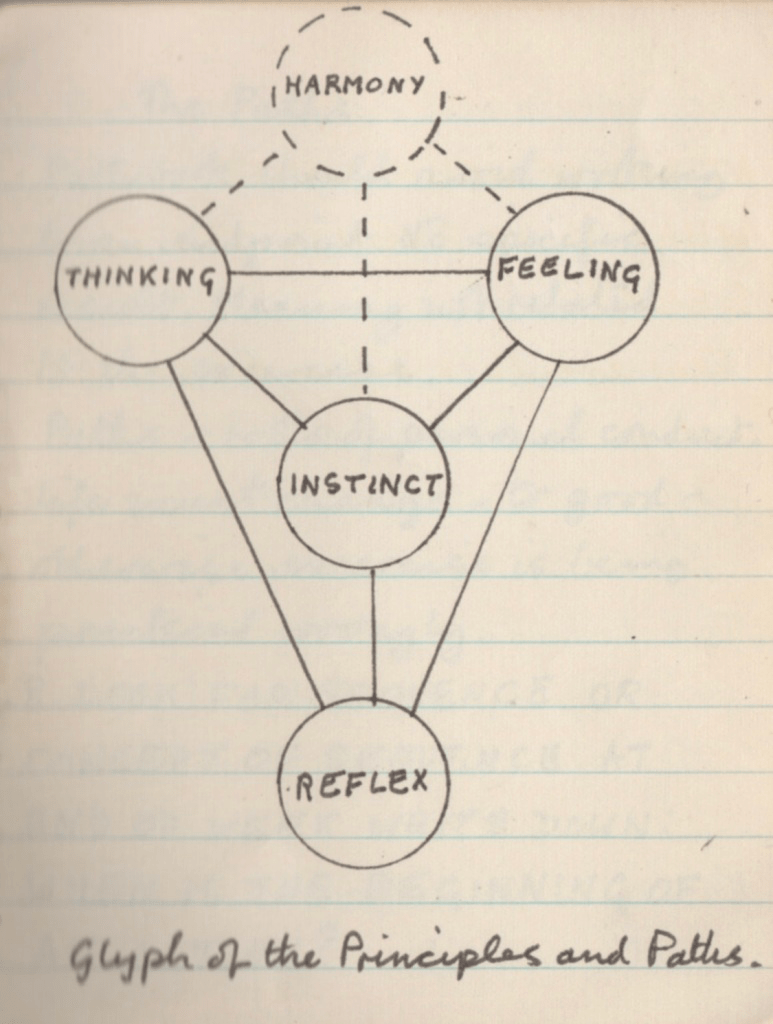
Fig. 3 – Basic Psychological principles corresponding to the Lower five Sephiroth of the Tree. Jung’s categories of ‘sensation’ and ‘Intuition’ correspond to ‘reflex’ and ‘Harmony’ on the Glyph.
As can be seen from the above diagram (‘Glyph’ – Fig 3), the three apices of the lower triad of The Tree are linked to a principle in the centre, ‘Instinct’, which corresponds to the Sephirah Yesod (usually translated as ‘The Foundation‘). The diagram also shows these principles linked to each other by so-called ‘paths’ or ‘channels’, such that Instinct (Yesod) need not always be involved in their interaction, though usually an action is imagined, formed and asserted in terms of Instinct, having fulfilled certain requirements of thought and feeling, as well as promoting oneself, and whomever or whatever one holds dear.
There are thus different ‘pathways’ to action; the original impulse, whether based on a sensory observation, abstract insight, or simply a need for self-assertion, can only be expressed as action through the mechanisms of the physical body. The instinctive sphere is informed by the input of thought and feeling, much of which may itself be ‘automatic’, and is the fulcrum of hopes, imaginings, dreams, practicality and impracticality.
The diagram also implies that thought, feeling, and movement (often simply ‘reflex’) can bypass the central sphere, here described as ‘instinct’, so that a feeling can have a direct expression in the body, which is capable of habitual or innately remembered action patterns without renewed reflection. The four principles (Sephiroth) may act together at an unconscious level, and their manifest expression can be unconsciously ‘learned’. That is precisely what Gurdjieff is describing in relation to ‘postures’, which means that the postures themselves are unconscious- mechanical – and need to be brought under observation. It also explains what Israel Regardie is on about when he writes about the mind as “the slayer of the real”.
Some Hebraic versions of the Tree reposition the paths joining Netzach and Hod to Malkuth to the upper part of the Tree, ensuring that all active intention is consciously formulated in Yesod – ‘The Foundation’.
Briah
As Kathleen Raine succinctly describes (see above – ‘Introduction’), the upper part of Yetzirah overlaps with the ‘transpersonal’ world of Briah. In fact it covers the same extent of the Briatic Tree as Yetzirah shares with the Assiatic Tree, such that the Tiphareth point in Yetzirah (‘Harmony’ in the Fig. 3 ‘Glyph’) coincides with Malkuth in Briah, Kether in Assiah and, most importantly, with Greater Tiphareth on the Ladder. As Tony Potter remarks in his commentary, this position “….is the first… on the upward journey on the Ladder at which it is possible to perceive reality…” The Tiphareth point in Yetzirah is that at which the mind can cease to be ‘the slayer of the real‘****.
Briah is also an ‘inner’ world, which, like Yetzirah, has its reflected effects in the ‘outer’ world of Assiah. But, corresponding to Jung’s ‘Collective Unconscious”, Briah is not an ‘inner world’ that we can personally identify with, subjectively manipulate or be more than partially aware of (although in Cabala, at the grade of “Master of the Temple” an individual adept is able to effectively run a Cabala group of aspiring initiates from the level of Binah, which is effectively the World of Briah). Jung speaks of ‘The Objective Psyche’, meaning that, like ‘outer reality’ it exists, but in a partially unknown state, even though it is expressed in one’s own life and times. As the world of universal archetypes it is experienced, if at all, as The Jungian analyst Erich Neumann observes (The Archetypal World of Henry Moore, 1959) neither as inside nor outside, but on a plane beyond both.
Though they are universal, there are cultural differences in the ways each archetype is expressed, and the result is an ever-evolving, inconclusive dialogue in terms of this or that language or culture. Erich Neumann gives numerous examples – some terrifying – of one identifiable archetype – in his encyclopaedic study, The Great Mother (1974)
Manifestations of Briah are ‘numinous’, meaning they come with an uncanny sense of ‘supernatural’ agency. They – or it – may communicate spontaneously through dream imagery, visions, religious experiences or in an artist’s work, sometimes with profound or disruptive effects on culture and ordinary consciousness. In esoteric teaching, the archetypal world is also said to exert a perpetual, unconscious effect through events in the world of Assiah, which we mistakenly view only in materialistic terms. In Kabbalah, Briah is reflected in and linked to Assiah. On The Ladder (See Fig. 1) the focal point of this link is the Malkuth-Kether-Tiphareth overlap with Greater Tiphareth, with Malkuth in Briah in the centre of Yetzirah.
Briah corresponds to what C. G. Jung refers to as the world of ‘The Soul’ – (The ‘Singular’ or ‘Solitary’ degree of Christian living) which is one’s being in the Archetypal World of ‘The Collective Unconscious‘ of which, according to Jung, IMAGERY is the native language (though a Kabbalist might regard the Hebrew language and Alphabet in a similar way). For Jung, contemporary human culture – science in particular – displays a remarkable ‘contempt’ for the psyche – the soul – considering that without it knowledge of reality would be impossible.
He writes: “The statements of the conscious mind [Yetzirah] may easily be snares and delusions, lies or arbitrary opinions, but this is certainly not true of the statements of the soul: to begin with they always go over our heads because they point to realities that transcend consciousness.” (Answer to Job 1958) Jung quotes Tertullian (155 CE – c. 220 CE – De testimonio animae) who wrote that ‘testimonies of the soul’ may seem common, or trite, but cannot be considered trifling considering the majesty of Nature from which they are derived. “Nature is the mistress, the soul is the disciple.”
According to Jung, “there is no doubt that there is something behind these images that transcends consciousness and operates in such a way that the statements do not vary chaotically but clearly relate to a few basic principles or archetypes. These, like the psyche itself, or like matter, are unknowable as such.”
These principles, or Archetypes, tend to be seen in terms of the Sephiroth by Cabalists, but, while they may be regarded as taking elemental form in Briah, they have corresponding presences in all of the Four Worlds, including Atziluth, the World of primordial Emanation.
Briah (World of Creation) comprises the unconscious structure of the ‘transpersonal’ or, in Jung’s terms ‘Collective’ psyche. Its – or one might say ‘her’ – manifestations, are unnerving to the masculine, ego view of the world in Yetzirah. According to Jung, such manifestations ‘without exception refer to things that cannot be established as physical facts’ and ‘frequently conflict with observed physical phenomena, proving that, in contrast to physical perception, the spirit is autonomous… ‘
But, as well as such intrusive and perplexing manifestations, in terms of The Work ‘it’s what happens that counts!’ In the Group teachings, what befalls a person is also a ‘statement of the soul’.
The poet Goethe seemed to know a thing or two: “All things ephemeral are seen as symbols; insufficiency becomes meaningful event; The indescribable is accomplished; The Eternal Feminine draws us upward.” (Goethe Faust Part II : “Alles Vergängliche Ist nur ein Gleichnis; Das Unzulängliche, Hier wird’s Ereignis; Das Unbeschreibliche, Hier ist’s getan; Das Ewig-Weibliche Zieht uns hinan.”)
* https://en.wikipedia.org/wiki/German_resistance_to_Nazism
**https://www.psychologytoday.com/gb/contributors/robert-jay-lifton-md
*** IN OUR TIME by Melvyn Bragg and Simon Tillotson, (©️ BBC 2018)
**** Quoted in Unlocking Reality, Universal Kabbalah Keys, by Michael Grevis (2017)
***** Robin Amis ‘VIEWS FROM MOUNT ATHOS’ 2014.
 J.N.PEARCE ARTIST